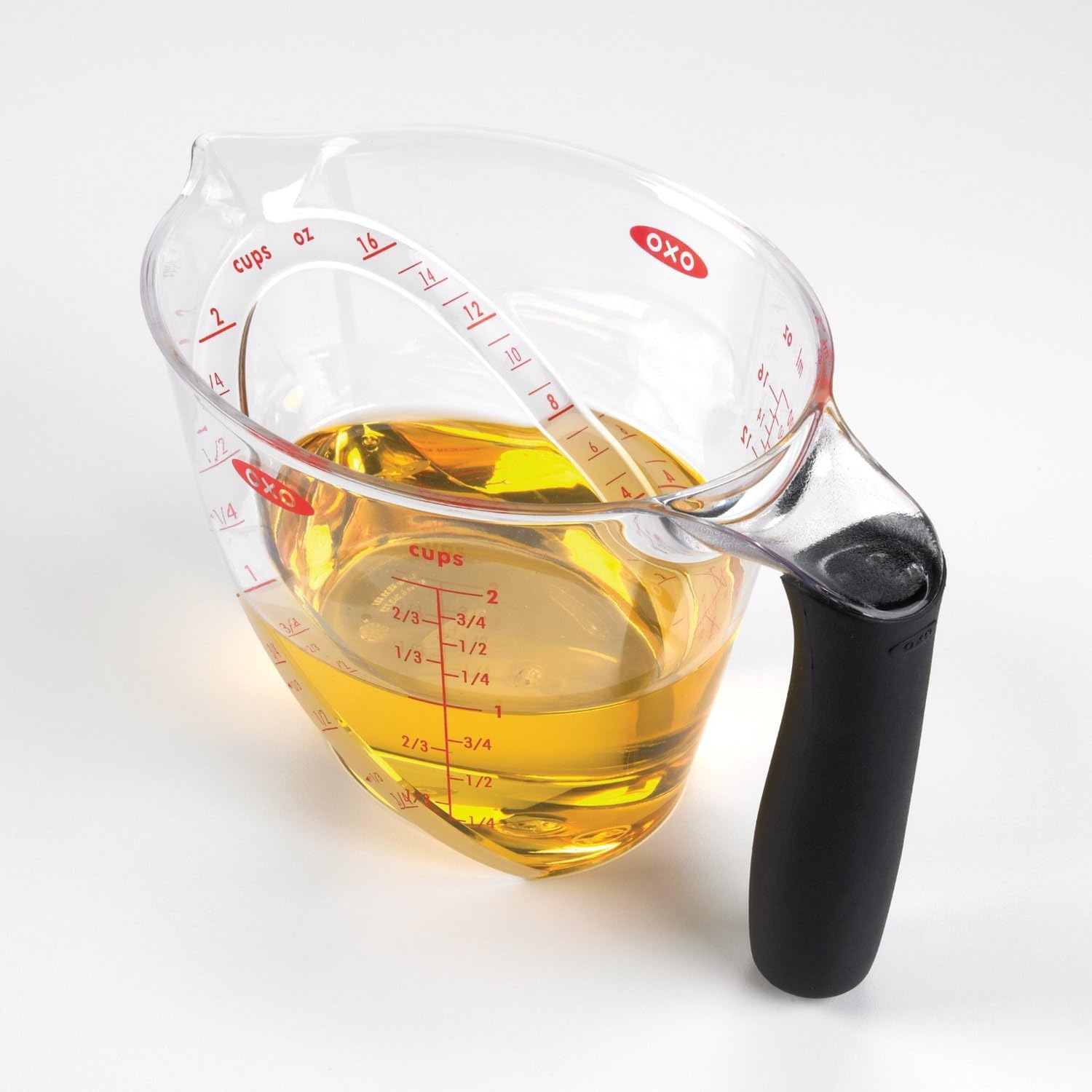
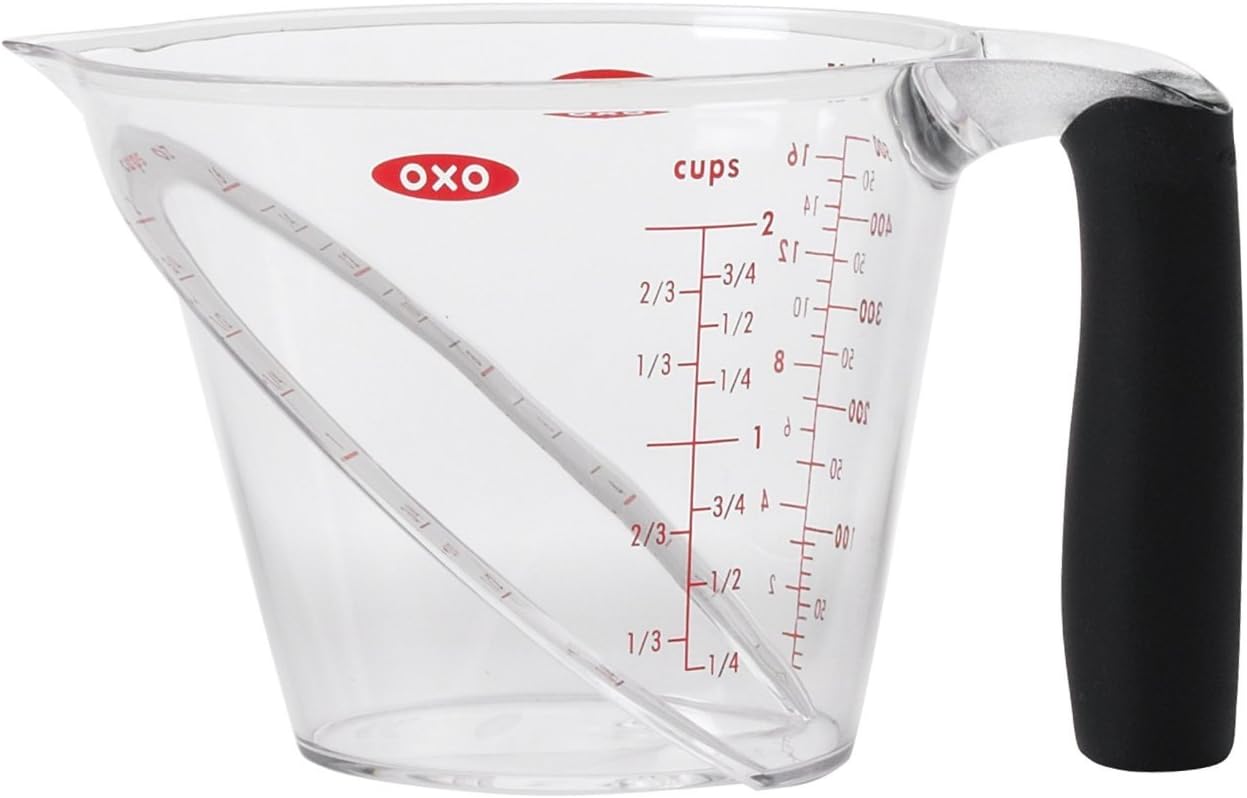
The OXO two-cup angled measuring cup changes where you look while measuring a liquid. An internal angled scale lets you read from above instead of repeatedly checking the outside wall at eye level. That is a useful convenience for some cooking routines, but it does not make a moving cup accurate or replace a scale when a recipe calls for weight. For the broader setup, OXO Smooth Edge Can Opener Review: A Different Cut, Not an Automatic Opener is a useful next read.
Review scope: This is a research-based assessment of the linked product, not a hands-on test. Listed specifications are distinguished from our practical buying analysis. Offers and selected variants can change.
What changes during a real recipe
Imagine adding a measured amount of broth to a pan. With a conventional jug, you may pour a little, lower your viewpoint, check the line and adjust. The OXO aims to make that checking step visible from above. It is most relevant when you repeat liquid measurements often or your counter arrangement makes the usual viewing angle awkward.
The benefit is less compelling if you normally measure directly into a bowl on a scale or use recipes that need only a rough splash. Identify the task before replacing a perfectly serviceable jug. A different scale layout is a reason to compare, not evidence that everyone needs another kitchen tool.
Visibility and accuracy are separate questions
The listing describes the angled reading surface and measurement markings. We have not calibrated this cup or compared its error against other measuring vessels. A scale that is easier to see may help you use a measure consistently, but that is different from proving the vessel itself is more accurate.
Place it on a stable, level surface and follow the supplied measuring guidance. Holding a tilted jug in midair changes the liquid level regardless of the viewing design. Allow movement to settle before deciding whether to add more. The clever part of the product does not remove ordinary care from the process.
Is two cups the right working capacity?
Use a few recipes you actually cook as the reference. If most liquid additions fit comfortably within this capacity, the cup may be a useful everyday size. If you repeatedly need much larger quantities, several fills can become slower than using a larger suitable jug.
Repeated fills also add a counting task. In a busy family kitchen, being interrupted between the second and third measure can matter more than the convenience of the angled scale. Conversely, buying a much larger jug for occasional use creates a storage cost. Choose the size around the frequent task and keep the occasional exception in perspective.
Read the unit, not just the number
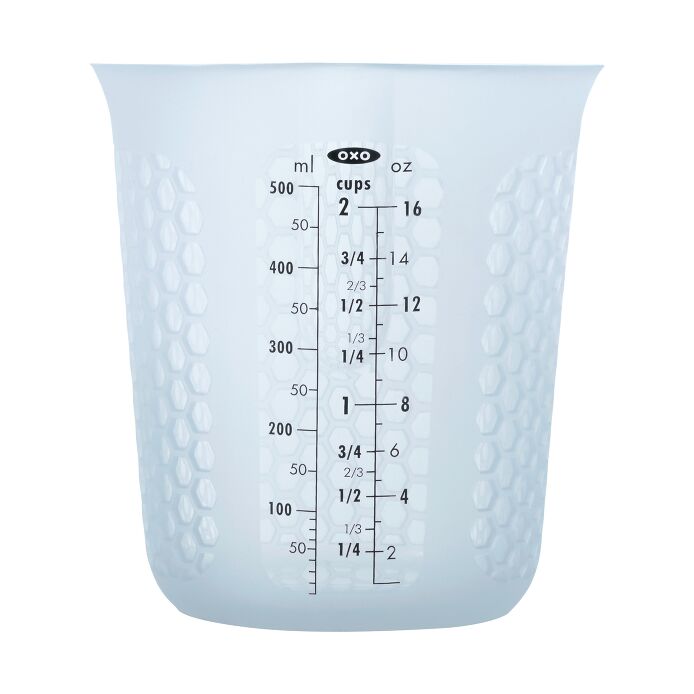
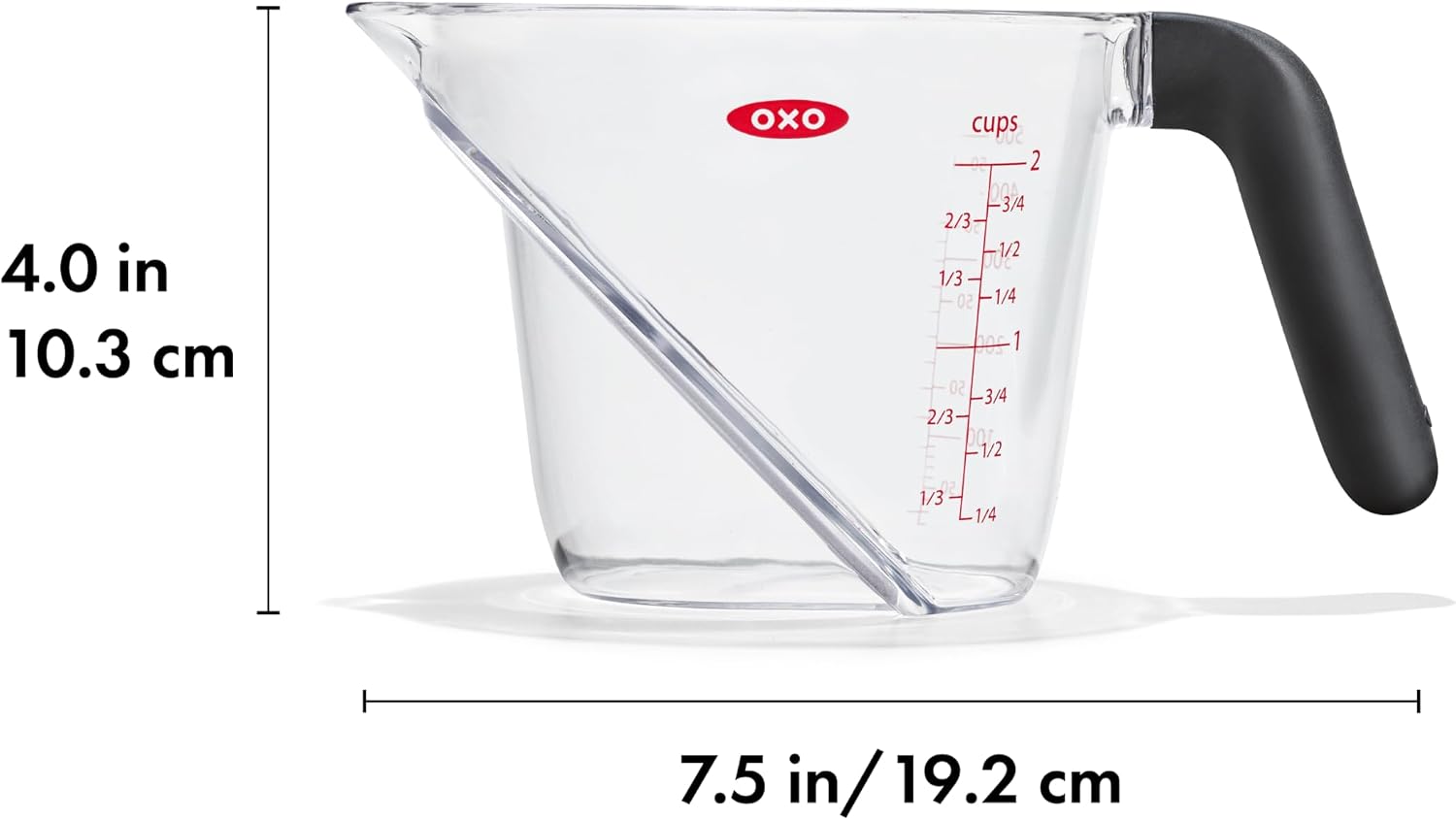
The product carries standard and metric markings. Check which scale corresponds to the recipe before pouring, especially when moving between recipes written in cups, fluid ounces and milliliters. A clearly printed number can still be the wrong unit for the task.
For ingredients specified by weight, use an appropriate scale rather than treating volume and weight as interchangeable. Different ingredients occupy space differently. This cup is most naturally evaluated as a liquid-measuring tool, not a universal replacement for measuring spoons, dry measures and weighing equipment.
Pouring matters after the measurement
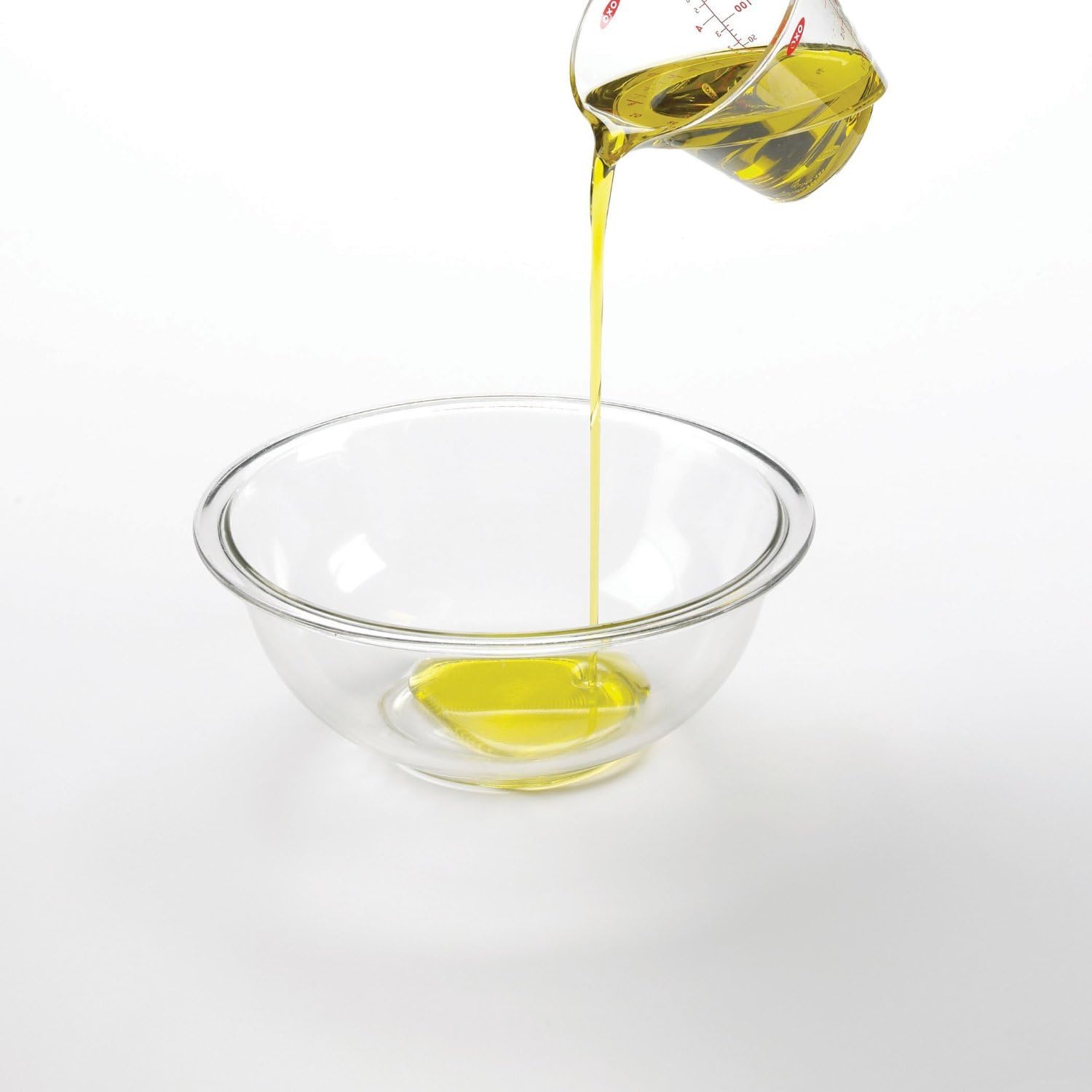
The handle and spout are part of the buying decision because the measured liquid still needs to reach its destination. Think about a narrow opening, a crowded mixing bowl or a pan near other utensils. A comfortable grip and a controlled route can matter as much as seeing the fill line.
We have not measured dribble rates or tested pouring with liquids of different thicknesses. Do not read the spout’s appearance as a guarantee of a clean pour every time. When you receive the cup, assess the ordinary transfer you bought it for before deciding that the measuring design has improved the whole task.
Check the current material and care guidance
The current linked listing identifies the cup as Tritan Renew with a soft nonslip handle. Older photographs, reviews or another size in the range may describe a different production version. Use the care and temperature instructions supplied with your actual item rather than assuming that every OXO measuring cup shares identical limits. For the broader setup, OXO Squeeze & Pour vs. Pyrex 2-Cup Measuring Cup: Flexible Body or Glass Handle? is a useful next read.
In particular, this review does not establish microwave, boiling-liquid or other temperature permissions. Those are requirements to verify for the intended use. If your main job is heating a liquid in its measuring container, choose only a vessel whose instructions explicitly support that job.
Give the handle room in the cabinet
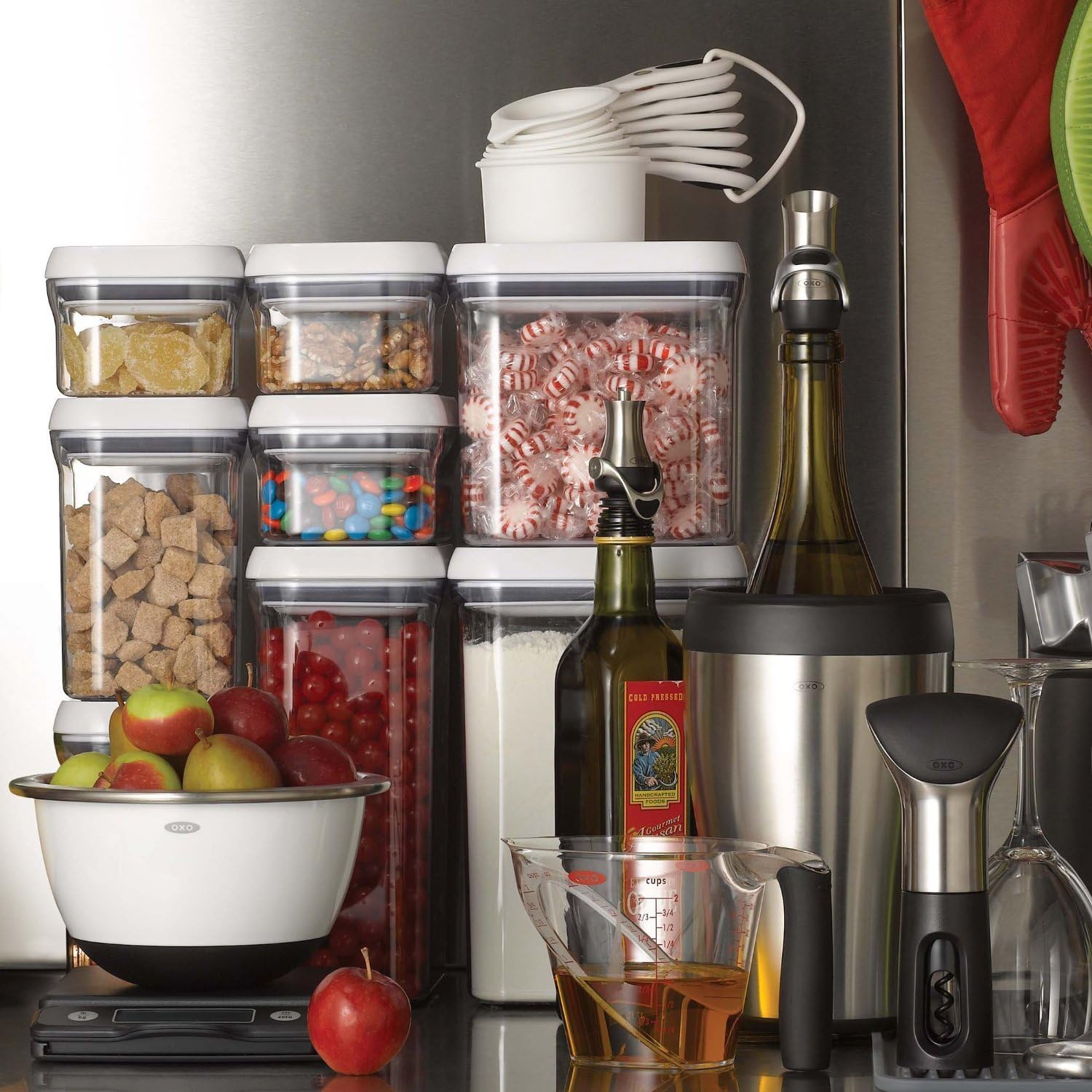
A handled measure has an irregular footprint. Check that it can sit securely on the intended shelf or in a suitable drawer without the handle catching the opening. A cup that must be unstacked from several unrelated items before every use loses some of its convenience.
After washing according to the instructions, let it dry appropriately before storage. Look at the internal scale as well as the outside when checking for residue. A readable scale is useful only when it remains visible, and a measuring tool should not become the place where dried sauce collects between cooking sessions.
A practical decision after the first few meals
Ask three questions: did the overhead scale make checking easier, did the capacity cover your normal recipe and did pouring work comfortably? Those are useful reasons to keep the cup. There is no need to invent a time-saving percentage or rank it above every other jug to explain its value.
Skip it if the current jug is easy to read, if weighing ingredients already suits the workflow or if the capacity is repeatedly inconvenient. For a small kitchen, the best measuring tool is the one that completes a frequent task and returns to storage easily. An extra vessel that duplicates a working routine is not automatically an improvement.
Which option fits your routine?
| Situation | Starting point | Tradeoff |
|---|---|---|
| Frequent modest liquid measurements | Consider the two-cup OXO | Overhead visibility is the main difference |
| Large batches need repeated fills | Consider a larger suitable jug | More storage space |
| Recipe specifies ingredient weights | Use a suitable kitchen scale | Volume does not replace weight |
Amazon product and current listing
Check OXO Good Grips 2 Cup Angled Measuring Cup on Amazon. Confirm the selected model, seller, delivered price and return terms. This link identifies ASIN B00005RKOE; it does not guarantee current stock.
Our buying decision
Choose the two-cup OXO when overhead reading solves a repeated annoyance and the capacity matches your recipes. Its distinctive benefit is visibility, not independently verified measuring accuracy. Confirm the supplied care and temperature instructions for the exact version.
Explore Kitchen ideas and Buying Guides. Related reading: OXO Pull-Out vs. Escali Primo: Which Kitchen Scale Belongs on a Small Counter?.
Sources and evidence limits
The linked Amazon listing supplies the product identity, photographs and listed features. Household scenarios and comparisons are editorial analysis. We have not measured durability, performance or user outcomes. We do not use star ratings as proof of quality.
Sources
- Amazon product listing — https://www.amazon.com/dp/B00005RKOE