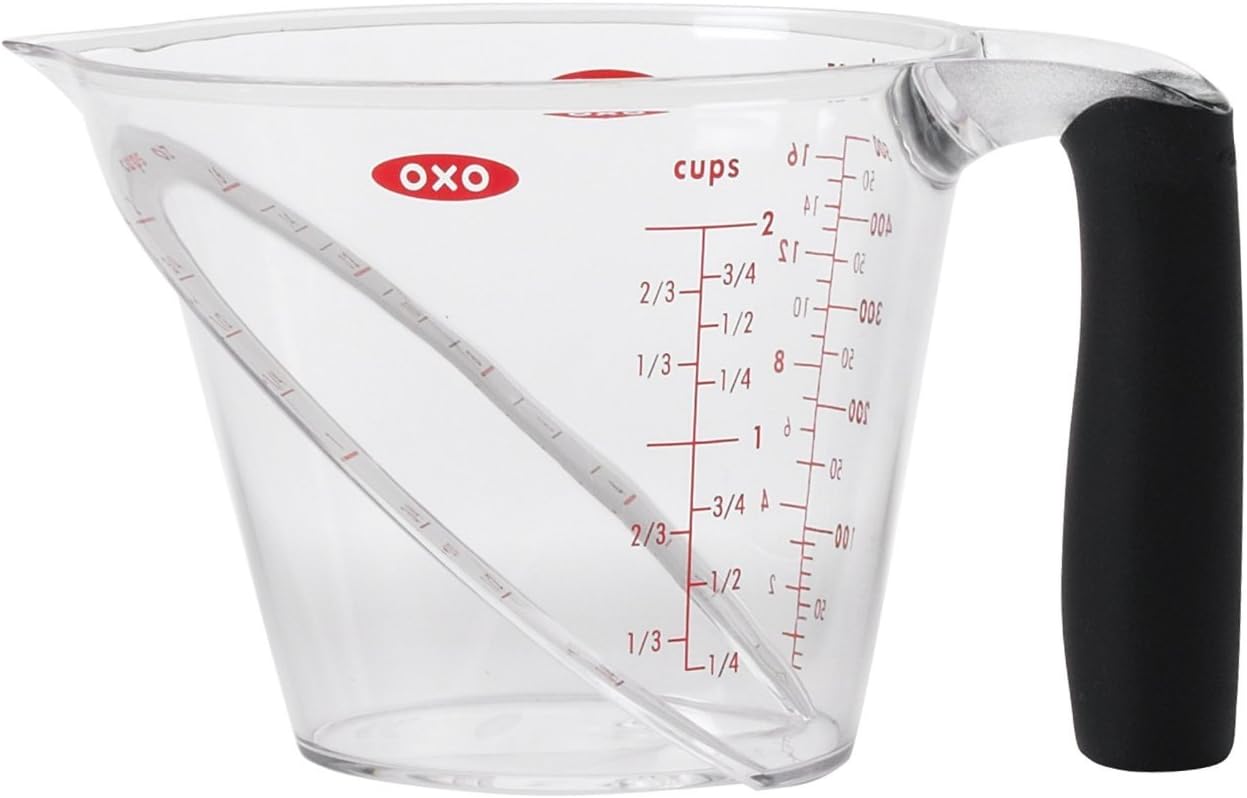
A two-cup measuring jug is a small purchase with a surprisingly specific job. You need to see the required line, carry the filled cup, pour into the actual bowl or pan, and put the cup somewhere accessible afterward. The most useful choice depends on that sequence, rather than on whether a kitchen collection already favors glass or plastic.
This research-based comparison covers the OXO Good Grips 2-Cup Squeeze & Pour Silicone Measuring Cup, model 11161000, ASIN B01434TUTU, and the Pyrex 2-cup glass measuring cup, SKU 6001075, ASIN B0002ITQHS. We checked the selected identities and current maker information. We have not tested their volume accuracy, pour control, grip comfort, dishwasher wear, or long-term durability. For the broader setup, OXO vs. Whiskware Dressing Shaker: Small Batches or a Larger Glass Mixer? is a useful next read.
Affiliate disclosure: As an Amazon Associate, Small Home Rhythm earns from qualifying purchases. Check the selected model and offer before ordering; prices and availability can change.
Choose by the task that actually repeats
Start with your usual recipes. Do you measure liquids at a crowded counter, carry the filled cup to a separate work area, or need documented heating use as part of the recipe? Write down the actual stage that your existing equipment makes difficult. A different cup is useful when it resolves that requirement, not simply because both models are popular kitchen names.
OXO is the candidate to examine for a flexible body whose spout changes with a squeeze. Pyrex is the candidate to examine when you prefer a rigid glass cup with a handle and need uses the maker expressly permits, subject to its full care directions. Neither receives an accuracy or pouring win here. The main decision is how you hold and transfer the contents. You may also find Microplane Premium Classic vs. OXO Etched Zester: Fine Grating, Care, and Drawer Fit useful for a closely related small-home problem.
| Decision point | OXO Squeeze & Pour 11161000 | Pyrex 2-cup 6001075 |
|---|---|---|
| Selected Amazon identity | B01434TUTU | B0002ITQHS |
| Material | Flexible silicone | Tempered glass |
| Handling approach | Grip the body; squeeze to shape the spout | Rigid body with separate handle and fixed spout |
| Published cleaning permission | Dishwasher, under exact directions | Dishwasher, under care directions |
| Heating decision | Microwave permission published; check complete exact-use directions | Listed microwave and preheated-oven uses require full care directions |
| Not measured here | Accuracy, filled-cup handling, pouring, wear | Accuracy, filled-cup handling, pouring, wear |
OXO: examine whether a flexible body suits your pouring task
The current OXO product page identifies the two-cup silicone model as SKU 11161000. Match the selected offer to that capacity and form. A mini, one-cup, four-cup, or set offer needs its own fit and capacity decision.
The flexible form changes the handling question. Consider whether gripping the body and forming the spout suits your hands, the liquid, and the receiving vessel. We have not measured how much effort the squeeze takes or how neatly it pours. A product illustration can explain the design without establishing a result for your actual task.
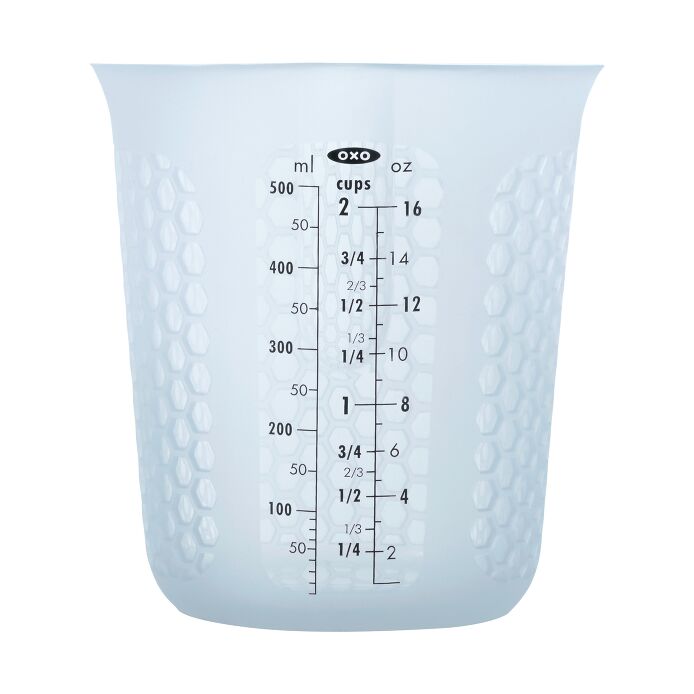
Check the OXO 2-Cup Squeeze & Pour Silicone Measuring Cup on Amazon
Pyrex: examine the glass workflow and care requirements
The Pyrex product page identifies SKU 6001075 with a glass body, red measurement marks, handle, and pouring spout. Confirm the two-cup model and selected ASIN. A different capacity, decorated storage item, or glass cup from another region should not inherit this comparison’s product-specific conclusions.
For a conventional side scale, plan a stable reading position and follow the appropriate measuring instructions for your recipe and equipment. Think about where the cup sits and whether the markings are easy for you to read. A familiar glass shape is a starting preference, not proof that the exact cup will suit your grip or the lighting in your kitchen. For the broader setup, OXO Swivel Peeler vs. Kuhn Rikon Swiss Peeler: Handle Shape and Cleanup for a Small Kitchen is a useful next read.
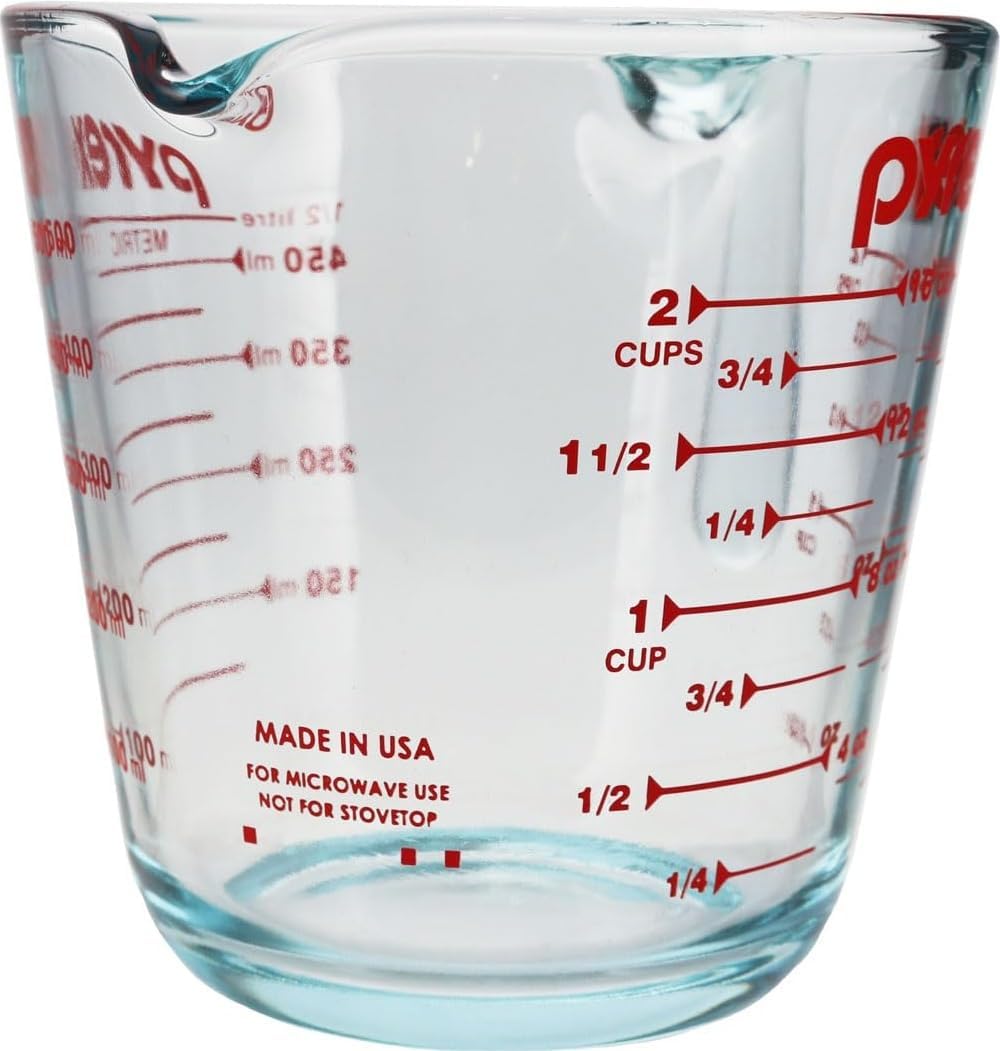
Check the Pyrex 2-cup glass measuring cup on Amazon
Keep volume, weight, and recipe units distinct
Read the recipe’s unit before choosing a measuring tool. A recipe asking for liquid volume and one asking for an ingredient’s mass are making different requests. Do not treat a cup marking as a universal conversion to grams. Use the measurement method and unit the recipe specifies, with appropriate equipment.
Check which unit convention the recipe uses when it matters. The word “cup” alone may not explain the intended standard in every source. Retain the recipe’s stated milliliter quantity or other clear unit rather than guessing from its country or a photograph. This is especially useful when collecting recipes from several places.
A scale may be the appropriate tool for a mass-based recipe. Our OXO versus Escali kitchen scale comparison addresses that separate decision. Buying a measuring cup should not be a way to avoid checking what the recipe actually requires.
Try the complete handling route
Before purchasing, identify where you normally fill the cup and where its contents go. Note the receiving vessel’s opening and its position. A cup can fit the storage shelf yet be awkward to carry through a busy kitchen. Keep the work route clear and use the equipment within its instructions.
Consider the intended user’s handling needs. An empty product image does not show what a filled cup will feel like in that person’s hand. If grip, reach, or lifting requirements are important, seek an appropriate opportunity to assess the actual equipment or obtain suitable advice. We have not compared filled weights or operating comfort.
Use a realistic capacity requirement. Two cups may suit your usual liquid stage, but repeated filling may be inconvenient for a recipe that needs much more. Conversely, a larger cup does not necessarily improve the visibility of a small quantity. Choose the capacity that supports recurring recipes rather than automatically collecting every size.
The small-kitchen meal preparation guide helps establish the surrounding work sequence. Include measuring, pouring, and the used-cup destination in that sequence so the tool does not become another object waiting on the only clear counter.
Resolve heating permission before using either cup that way
Do not infer microwave or oven suitability from the words plastic, glass, or measuring cup. Use the exact product directions and check that the intended appliance and task are permitted. If the required instruction is missing, obtain it from the manufacturer before relying on that use. An ordinary measuring task does not automatically authorize a heating step.
Pyrex’s full use-and-care guidance addresses sudden temperature changes, impact, hot handling, prohibited heat sources, and other limits. Its listed heating uses do not authorize stovetop, broiler, or countertop-appliance use. Follow the complete applicable directions, including inspection and handling requirements, rather than using this brief comparison as an operating manual.
OXO publishes microwave permission for this silicone model and describes a heat-dissipating exterior pattern. That maker claim is not a measured surface-temperature result from us. Follow the complete directions for the actual contents, appliance, and handling; do not assume the pattern permits bare-hand contact in every situation or that microwave permission extends to an oven.
Keep the recipe’s measuring stage separate from its heating stage when that is the suitable authorized workflow. You do not have to heat in the same vessel you used to measure. A permitted alternative vessel can make the best use of an existing cup without introducing an unsupported shortcut.
Plan washing and readable markings over time
Follow the chosen cup’s cleaning directions, including rack placement where specified. Use suitable tools and products for its material and markings. Check the cup’s condition as directed before use. Cleaning permission does not imply that every abrasive method, load arrangement, or treatment is appropriate.
Make the scale part of the condition check. If required markings are no longer readable, the cup cannot conveniently perform that measuring task. Do not reconstruct a missing line from memory or another vessel’s appearance. Seek suitable replacement guidance or use another appropriate measuring tool.
Plan where the washed cup dries and returns. Keep the cupboard arrangement accessible and suitable for the material. Do not jam the handle between unrelated utensils merely to claim that the cup fits. Our compact cutlery organizer review concerns a neighboring storage task; a projecting jug handle needs its own fit check.
We do not make a lifetime claim for either model. Dishwasher wear, marking retention, and accidental damage have not been tested here. Manufacturer directions and your actual condition checks are a more useful basis for ongoing care than a promise that one material will always last longer.
Check the storage footprint and the selected offer
Use the complete dimensions, including the handle and spout, when comparing the cup with your shelf or drawer. Check the opening through which it must pass and the space needed to retrieve it. A two-cup capacity describes the liquid volume, not the cupboard footprint.
If you expect to nest the cup with something else, confirm that the arrangement is suitable and easy to undo. Do not assume two measuring products nest well because their capacities differ. A fragile or awkward stack can make an otherwise useful purchase harder to retrieve every day.
Compare like-for-like offers: exact model, capacity, quantity, seller, delivered cost, and return terms. A set containing several sizes is a different storage decision from one cup. Check whether the listing has changed your selected variation before ordering. We do not rank current Amazon prices or claim that either offer is permanently cheaper.
Our collapsible colander review asks a related question about usable storage and setup. Apply the same practical discipline here: identify the tool’s recurring job and its return place before filling another cupboard corner.

Questions to settle before buying
Use a recent recipe as a buying worksheet. Note its stated unit, the largest quantity you normally measure at one time, the receiving vessel, any permitted heating stage, and the cup’s return place. This turns a general preference for a brand into a concrete equipment requirement. If the worksheet reveals that the recipe specifies grams, revisit the scale decision before purchasing another volume measure.
For a cook who pours a measured liquid into a small opening, the key question may be control of the transfer. Examine OXO’s squeeze-formed spout against the fixed Pyrex form, checking the full directions for the task. Consider whether gripping a flexible body or using a separate handle fits your needs. Neither design receives a drip-free promise from this comparison.
For a cook whose recipe includes a permitted warming step, the operating directions may decide the purchase more strongly than the reading design. Identify the exact appliance, check the selected vessel’s full permissions and restrictions, and plan suitable handling and a return route. Pyrex’s product identity gives you a source to investigate; it does not remove the need to follow those directions.
For a household already owning a readable, suitable cup, the better first change may be moving it to an accessible shelf. Test whether the measuring stage becomes easier when the existing tool is ready at the start. A purchase should solve a requirement the current equipment cannot appropriately meet, rather than compensate for an inconvenient cupboard arrangement.
Does a flexible spout guarantee more accurate or cleaner pouring?
No accuracy or pouring comparison was performed here. The squeeze-formed spout is a documented design feature. Follow the appropriate measuring method, read the scale in the intended stable arrangement, and assess handling suitability. Flexibility alone should not be presented as a measured advantage.
Is glass automatically the better choice for heating?
The exact product’s permitted use determines the answer. Check the complete directions for the vessel and intended appliance. Material alone does not establish permission, and a familiar brand name does not make every model interchangeable.
Should a small kitchen own both?
Only if two distinct recurring requirements justify them and both have usable storage. If your existing cup already handles the required measuring task appropriately, keep it. If you need a different pouring approach or a documented permitted use, compare that requirement first. Owning both is not necessary to complete an ordinary shopping decision.
A practical choice for your next recipe
Examine OXO when the flexible body and squeeze-formed spout fit your recurring task. Examine Pyrex when you prefer rigid glass measuring with a handle and its documented uses match your needs. Resolve the exact model, readable units, handling, heating directions, and storage before buying. Explore Buying Guides and our Kitchen hub for related equipment decisions. A useful cup supports the whole measuring stage and returns easily when the recipe moves on.