A quarter-sheet pan can suit a small cooking job, but the name alone does not tell you whether it fits your oven, supports your recipe, or matches the cleanup you are willing to do. Two pans in the same size category can differ in construction, surface, dimensions, and care limits. Those differences matter before a small kitchen adds another tray to its cupboard. If you are working on the same space, OXO Swivel Peeler vs. Kuhn Rikon Swiss Peeler: Handle Shape and Cleanup for a Small Kitchen covers the next decision in more detail.
Affiliate disclosure: As an Amazon Associate, we earn from qualifying purchases. This research-based comparison uses current maker information and exact Amazon identities. We have not baked on these pans, measured browning, tested release, weighed them, or compared warping and durability. The context photographs show baking situations and other trays; the two labeled product images identify the selected pans.
The two quarter sheets compared here
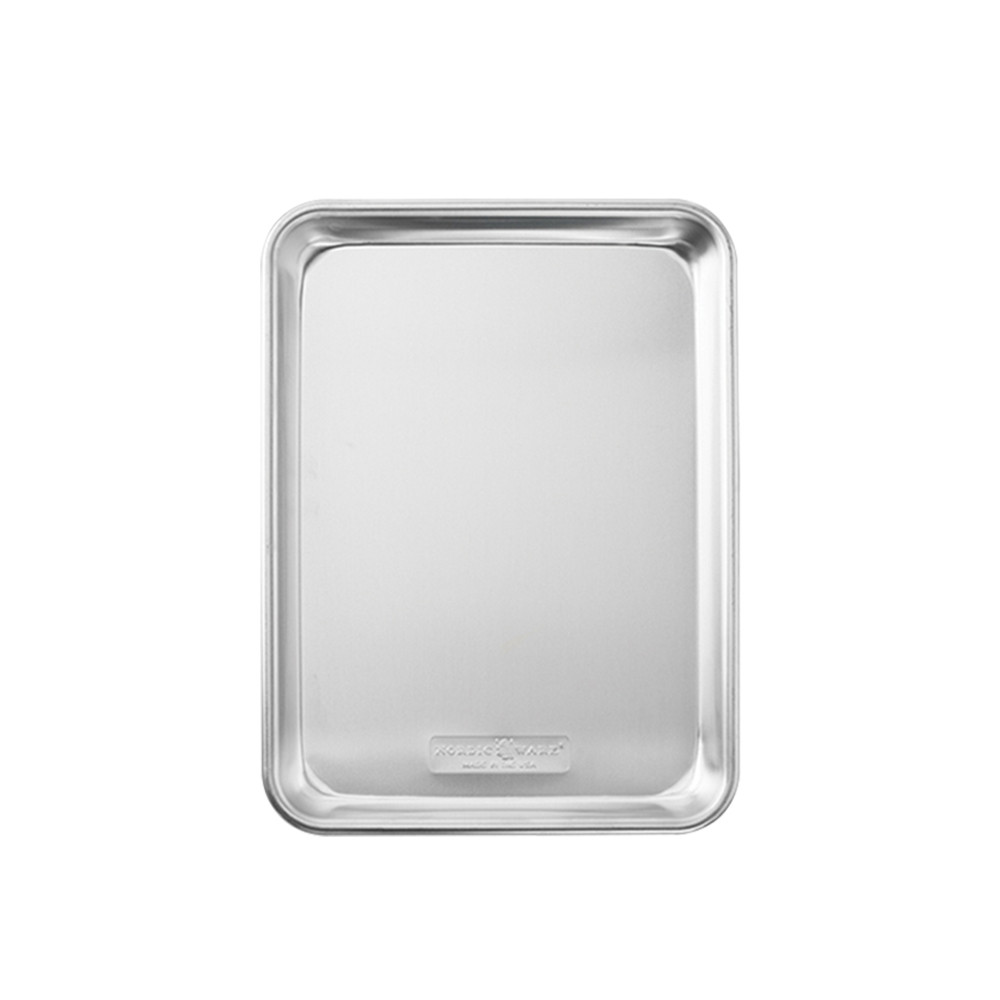
The first selection is Nordic Ware’s Naturals Baker’s Quarter Sheet, SKU 45300: the uncoated aluminum version, linked here through ASIN B011AU0MNI. The second is USA Pan’s nonstick Quarter Sheet, item 1045QS-1, linked through ASIN B001D1F2DA: an aluminized-steel pan with the maker’s Americoat silicone coating. This comparison is between those exact selections, not every small tray from either company.
Nordic Ware’s nonstick 45350, Prism models, larger sheets, sets with racks, and multipacks are different purchase choices. USA Pan also has other sizes and finishes. Verify the model, surface, included pieces, seller, and selected quantity when ordering. A listing photo or the phrase “quarter sheet” is not enough to establish that the cart contains the pan described in this article.
| Decision | Nordic Ware Naturals 45300 | USA Pan 1045QS-1 |
|---|---|---|
| Selected Amazon identity | B011AU0MNI | B001D1F2DA |
| Published construction | Uncoated aluminum | Aluminized steel with Americoat silicone nonstick coating |
| Published surface | Natural aluminum | Fluted bottom and coated surface |
| Maker’s stated oven limit | Up to 500°F | Up to 450°F / 230°C |
| Routine care direction | Hand washing recommended; avoid dishwasher and abrasive cleaners | Hand washing recommended; observe coating and utensil restrictions |
| What remains personal | Actual appliance fit, recipe suitability, occupied handling space, and preferred care routine | |
Nordic Ware: examine it for an uncoated surface
Nordic Ware identifies the selected Naturals 45300 as pure, uncoated aluminum. Choose this construction deliberately rather than assuming that the word “Naturals” means a separate applied nonstick coating. The maker markets its heat distribution and performance; those are manufacturer claims, and this article does not supply independent comparative baking results.
Consider the Nordic Ware 45300 quarter sheet on Amazon when you want this uncoated construction, your recipes and appliance permit its use, and its care routine fits your kitchen. Its natural surface does not establish that every food releases without preparation. Follow the actual pan and recipe directions rather than treating “uncoated” as a reason to disregard preparation or cleaning requirements.
USA Pan: examine it for the coated, fluted design
USA Pan identifies its 1045QS-1 quarter sheet as aluminized steel with a fluted bottom and Americoat silicone nonstick coating. That is a different construction from the Nordic selection. The maker describes release, strength, and heat-distribution benefits; we do not turn those descriptions into a tested claim that it browns more evenly or lasts longer than the uncoated pan.
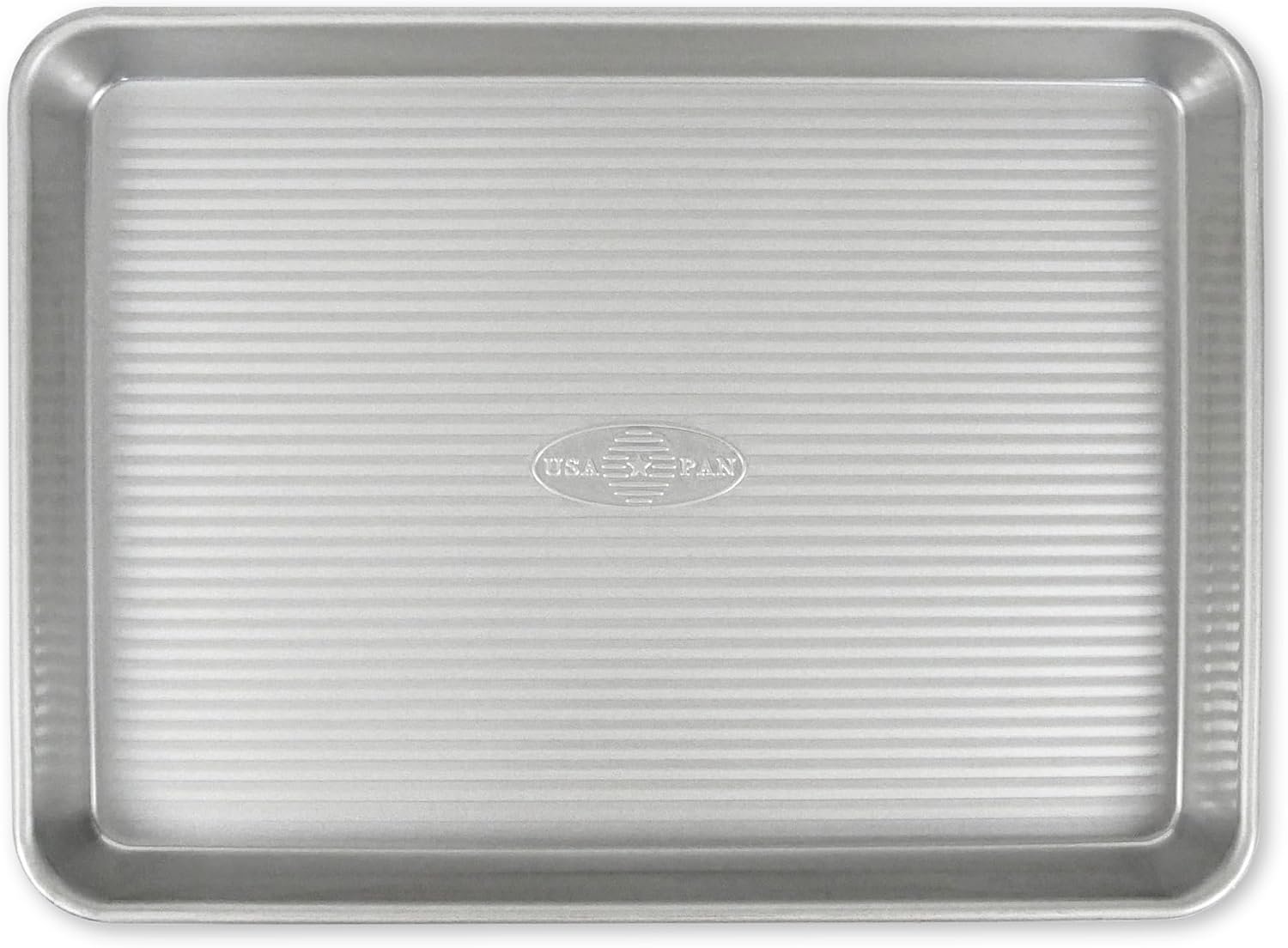
Consider the USA Pan nonstick quarter sheet on Amazon when you specifically want that coated design and can follow its use restrictions. Nonstick is not permission to cut food in the pan with a sharp metal tool or clean it aggressively. The purchase includes a coating-care commitment, so the household members who use the tray should understand the permitted routine.
Fit the exact pan to the exact appliance
Check the appliance’s instructions for approved cookware, rack positions, temperature use, and clearance. Compare those requirements with the selected pan’s full outside dimensions, including its rim. The internal cooking area describes food space, not the complete object that must enter the oven. A product advertised for small kitchens does not automatically fit every toaster oven or countertop appliance.
USA Pan publishes an outside size of 13 by 9.5 by 1 inch and a baking surface of 12.5 by 9 by 1 inch for this model. Keep those two specifications distinct. Nordic Ware’s current page gives its own interior dimensions; obtain the current complete outside specification for your selected 45300 when resolving appliance fit. Do not infer fit from an interior number or borrow a measurement from another version.
Check the door movement and the required working clearance as well as whether the tray can enter the cavity. Do not conduct a powered fit experiment with packaging or a paper template inside an appliance. Resolve dimensions and permitted cookware use from the actual instructions, and contact the maker if the information is insufficient. If fit remains unclear, pause the purchase rather than relying on the size category.
Match capacity to the recipe you cook
A smaller sheet is useful only when the food can occupy the intended area according to the recipe. Consider the meal or bake you repeat: a small cookie batch, a few portions of vegetables, or another task appropriate to a rimmed sheet. Do not promise a fixed serving count from the pan name. Different ingredients, spacing, and preparation methods use the available area differently.
Check whether the recipe requires a specified pan size or depth. A rimmed sheet is not automatically a substitute for a deeper cake or loaf pan, and changing the vessel can change the recipe’s requirements. If you already have a suitable smaller pan, keep using it. Buying a quarter sheet should solve a real repeated need rather than create a reason to rewrite recipes that already work in your equipment.
Think about the whole meal too. A quarter sheet that suits one component may still require another vessel for the remainder. Two simultaneous pans need appliance permission and appropriate clearance; this comparison does not establish that either arrangement is allowed in your oven. Choose around a real cooking sequence instead of assuming that several compact pans always use space more efficiently.
Keep heat limits and operating permissions separate
The published oven limits differ: Nordic Ware’s current 45300 page states up to 500°F, while USA Pan’s 1045QS-1 page states 450°F / 230°C and says not to exceed it. Use those limits together with all other pan and appliance instructions. A higher stated temperature limit does not prove better browning, greater durability, or permission for every appliance mode.
Check broiler, direct heat, and other operating questions specifically before use. Do not infer permission from “oven safe” alone, and do not assume that the appliance’s maximum setting is an appropriate pan setting. When a recipe or a preferred method exceeds a pan’s permitted use, choose suitable equipment for that job instead of trying to compensate through guesswork.
Read preparation and utensil requirements before choosing
Follow the maker’s directions for preparation and permitted utensils, then the relevant recipe. USA Pan’s page advises silicone, nylon, or wooden utensils, avoiding sharp metal tools, and does not recommend cooking spray. Those restrictions belong to this named coated selection. Share them with another cook if the pan will enter a household where people normally cut food directly on trays.
Check the instructions for any liner or mat separately, including its own heat limit and suitability for the intended use. A liner does not override the pan’s temperature restrictions or an appliance’s clearance requirements. The material should fit the actual permitted arrangement. Do not choose an oversized mat solely because it can be trimmed or folded without checking its maker’s directions.
Make cleanup a realistic part of the comparison
Both makers recommend hand washing for the selected pans. Nordic Ware’s current page advises warm soapy hand washing and avoiding abrasive cleaners and dishwashers. USA Pan gives warm soapy hand washing to help preserve its coating. If you require a pan that can routinely follow a different washing route, this pair may not be the right shortlist.
Consider your actual sink, washing tools, and drying position. Can the complete pan be supported while you clean it according to its instructions, and can it dry without blocking the only food-preparation space? A small pan may be easier to accommodate than your largest tray, but this article has not tested either in your sink. Use the physical dimensions and your ordinary work area to judge that practical fit.
Do not choose one surface on the assumption that every mark can be scrubbed away or that the other always cleans in a few seconds. Follow the permitted method and the maker’s advice about surface changes and damage. The kitchen utensil-drawer guide can help keep appropriate tools accessible without adding a separate cleaning kit for every pan.

Check storage with the pan’s protection needs
Give the selected pan a dry, retrievable home consistent with its instructions. If you stack trays, follow the maker’s guidance for protecting their surfaces and avoid forcing mismatched pieces together. A rimmed pan that only fits behind several larger trays may be awkward for the frequent small jobs that motivated the purchase. Test the storage route using dimensions before ordering another piece.
Do not add a rack, lid, or matching set automatically. An accessory needs compatible dimensions and its own permitted use, not merely the same brand name. If your job does not require it, skip it. The small-cabinet storage comparison covers larger changes, while the kitchen hub helps connect cookware storage with the rest of the room.
Compare current cost after resolving fit
Check the current delivered price, seller, model, quantity, included pieces, and return terms on the selected Amazon offer. We do not quote a fixed current price or claim one listing is always cheaper. Compare the same useful quantity. A multipack can lower a unit price while still creating an unnecessary total purchase and a storage problem.
Resolve appliance fit and care compatibility first, then use cost to compare viable options. A cheaper pan that cannot complete your intended job is not an alternative to a suitable one. If both selected pans work for the task, the surface you prefer to maintain and the delivered cost for one needed pan can guide the decision without an unsupported performance ranking. For a related step-by-step approach, see Microplane Premium Classic vs. OXO Etched Zester: Fine Grating, Care, and Drawer Fit.
Apply the comparison to two ordinary cooking routines
For a cook who wants a smaller tray for a repeated vegetable preparation, first check the recipe’s spacing, preparation, and permitted heat. Then verify the appliance and pan instructions together. If the routine includes sharp utensils on the tray or a washing method outside the selected pan’s care, change that routine deliberately or choose equipment suited to it. The surface preference matters after the complete task is feasible.
For someone baking small batches of cookies, check the actual recipe’s pan guidance and the number that can be arranged appropriately. A smaller sheet may be useful for a genuinely small batch, while several rounds in the oven can be inconvenient for a larger one. Neither maker’s release language establishes a no-preparation guarantee for your dough. Choose by the repeated batch and handling you intend, with a suitable cooling arrangement and space to finish the care.
In both situations, a matching rack should be a separate, verified choice if needed. Confirm its size, support, and intended operating conditions; a cooling rack and an oven-permitted rack are not automatically interchangeable. The pan listing does not grant permission to use an unrelated rack inside the oven. A plain sheet can remain the whole purchase when the job does not need another accessory.
Write the requirements before choosing between the two: exact appliance fit, permitted cooking method, desired surface, accepted utensil restrictions, and an available hand-wash route. If either candidate has an unresolved answer, it is not ready for comparison on price. This small written brief can also reveal that you already own suitable equipment and should skip both listings.
Which selection earns a place in your kitchen?
Choose Nordic Ware 45300 when you deliberately want the named uncoated aluminum construction and have resolved its exact dimensions, operating permissions, recipe use, and care. Choose USA Pan 1045QS-1 when the coated aluminized-steel design fits those same requirements and you accept its coating and utensil restrictions. Neither recommendation claims an independently measured release, browning, or durability advantage.
Skip both when an existing pan already does the job, the appliance fit is unresolved, the required cooking method falls outside permission, or the household needs another washing route. Explore the Buying Guides hub and shared food-and-dish cabinet guide only where they support a real need. A quarter sheet is a useful addition when its complete cooking, handling, cleaning, and storage route works in the kitchen you have.