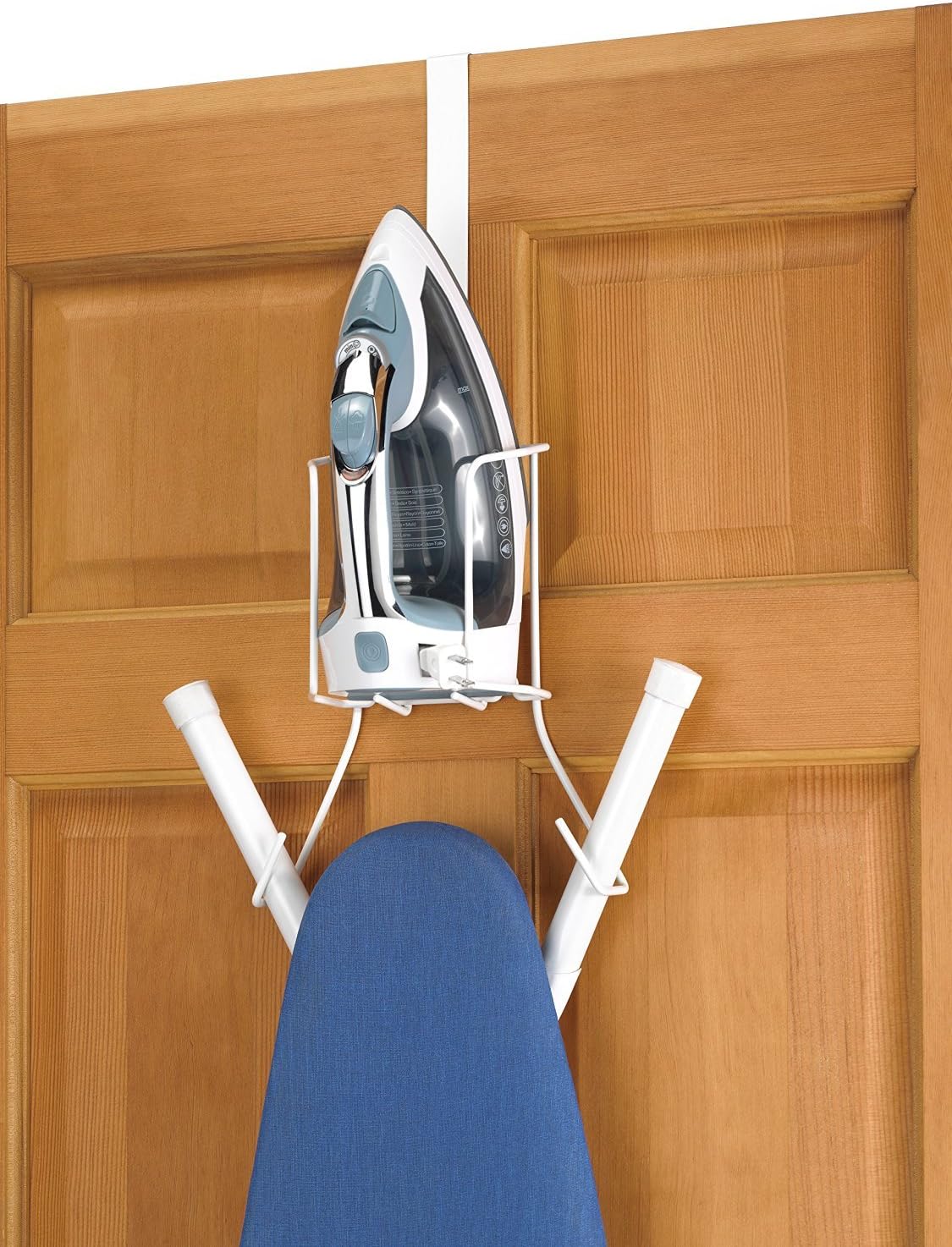
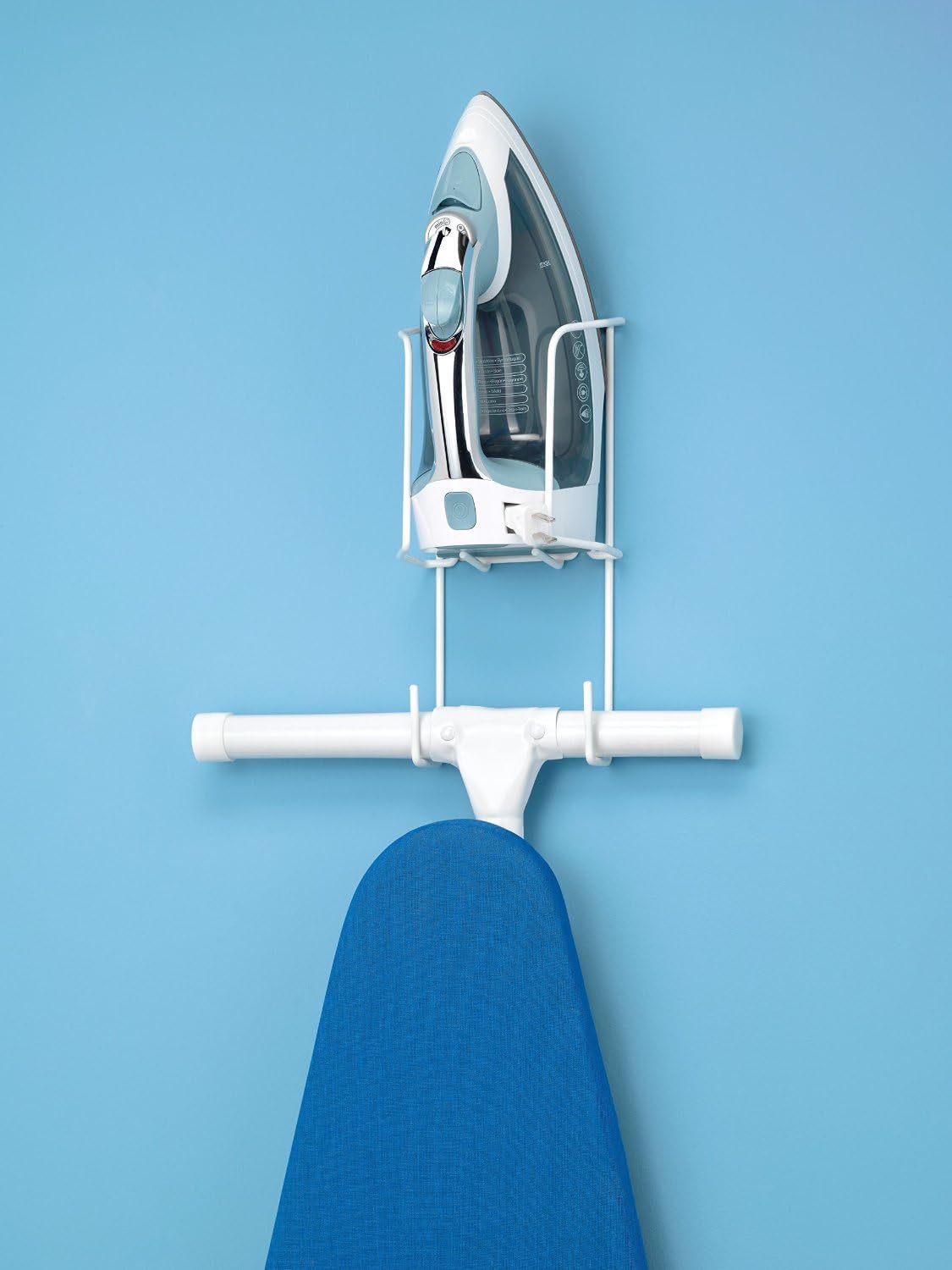
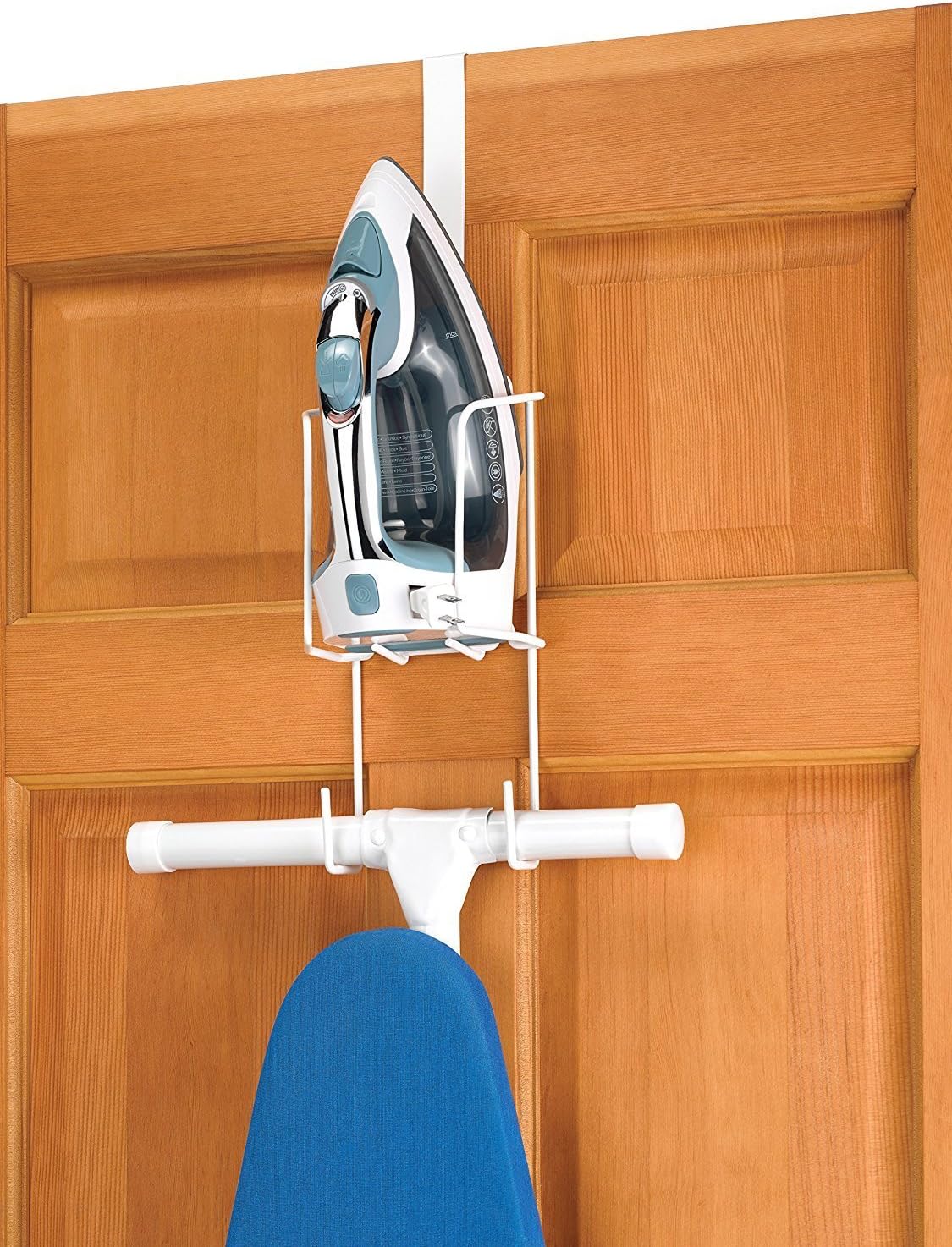
The Whitmor Wire Over-The-Door Ironing Caddy is a storage accessory for an ironing board and iron you already own. It does not turn the door into an ironing surface. Its appeal is getting a folded board off the floor while keeping the equipment together, but the door, the board and the iron must all fit the arrangement.
Review scope: This is a research-based assessment of the linked product, not a hands-on test. Listed specifications are distinguished from our practical buying analysis. Offers and selected variants can change.
The problem it solves is storage, not ironing
A folded board leaning between a washer and a wall can be awkward to retrieve and easy to leave in the way. The caddy gives that board a more deliberate parking place, with space for the iron nearby. That can shorten the setup routine if the door is close to the place where you actually iron.
It is a different purchase from an over-door ironing board that unfolds into a working surface. With this caddy, you still remove and set up your existing board. If the real problem is having nowhere to stand and iron comfortably, hanging the equipment more neatly will not create that working area. You may also find Conair Turbo ExtremeSteam Review for a Small Laundry Area: Where Will It Live? useful for a closely related small-home problem.
Measure the door at the top
An over-door accessory depends on more than the door’s width. Check its thickness, the gap above it and how it meets the frame. A bracket can appear to fit while preventing the door from closing normally. The product should not require forcing the door shut or accepting damage to the finish.
Use the exact bracket dimensions and supplied instructions to confirm compatibility before installation. We do not have a verified universal door-thickness range for this listing, so this review does not invent one. Renters should also distinguish a removable over-door arrangement from the listing’s wall-mount option, which brings separate installation requirements.
Trace the board’s full hanging outline
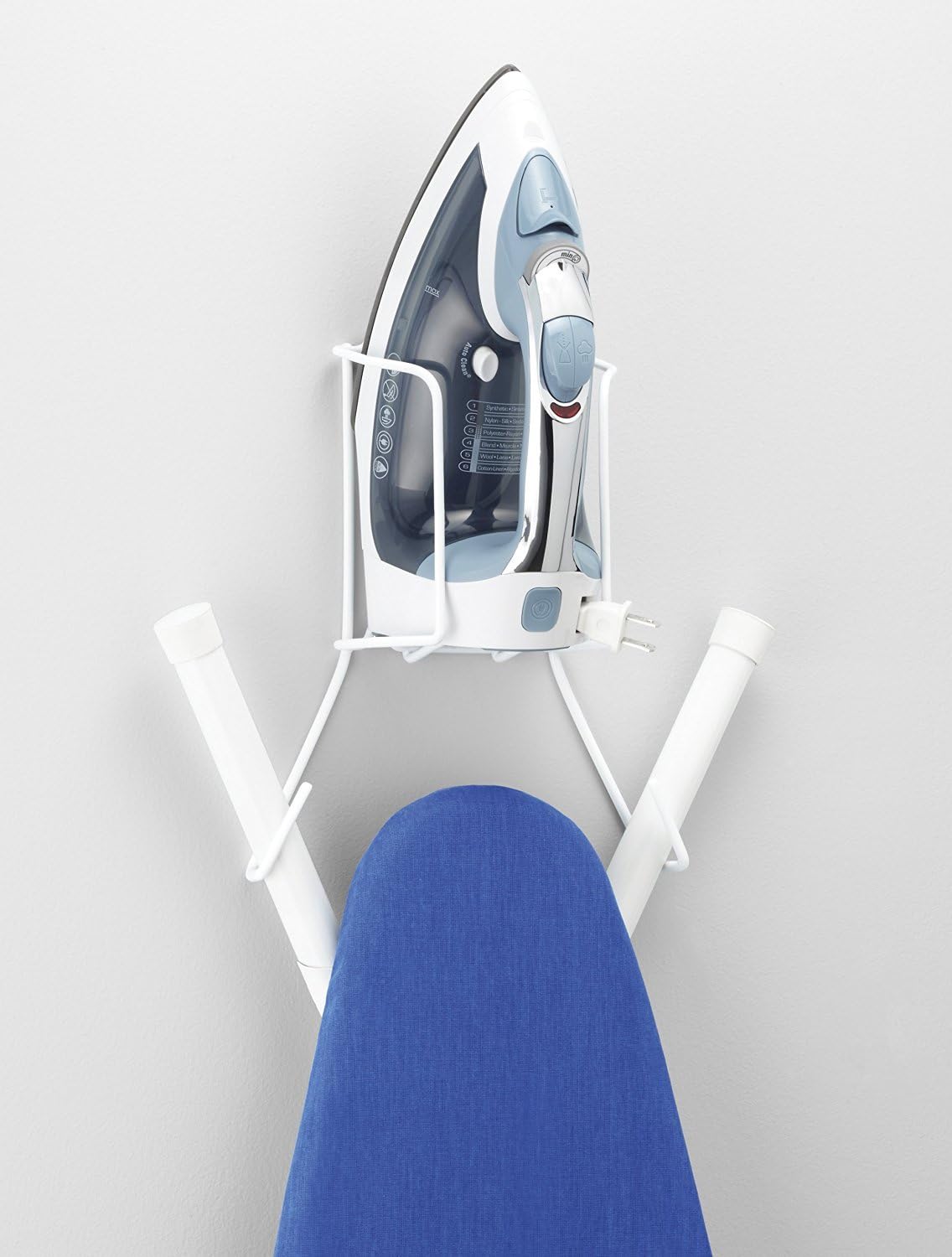
The listing says the holder accommodates T-leg and four-leg ironing boards, but that does not make every folded board identical. Look at the part that will rest on the hooks, the folded thickness and the distance from that point to the bottom of the board. A long board may reach farther down the door than a photograph suggests.
Then consider what is behind the door when it opens. The board can approach a wall, basket or machine even if the caddy itself clears the frame. A simple outline marked with removable paper can help you visualize the stored shape. Leave room for the board to be lifted free rather than planning around its static outline alone.
The iron needs its own fit check
The compartment is intended for an iron, but iron bodies differ in width, heel shape and cord arrangement. Compare your model with the listing and instructions. A large steam-generator base is a different storage object from an ordinary handheld iron and should not be assumed to fit.
Follow the iron manufacturer’s cooling, water and cord-storage directions before putting it away. This review does not establish a safe hot-storage temperature or claim that the caddy is a cooling station. If ironing ends just before you leave home, plan a suitable cooling location rather than making immediate storage a requirement the product has not been verified to meet.
Door movement is part of everyday use
A door-mounted load moves whenever the door moves. Consider whether that door is used frequently, whether children pull it quickly and whether the stored board could contact adjacent surfaces. A quiet, rarely moved laundry door presents a different situation from the main route into a busy room.
After installing according to the instructions, check normal opening and closing with the intended equipment in place. Do not slam the door as a test or add extra items beyond the stated design. If the arrangement rattles, shifts or obstructs movement, stop and reassess fit and installation rather than treating those effects as unavoidable convenience costs.
Wall mounting can be a better arrangement
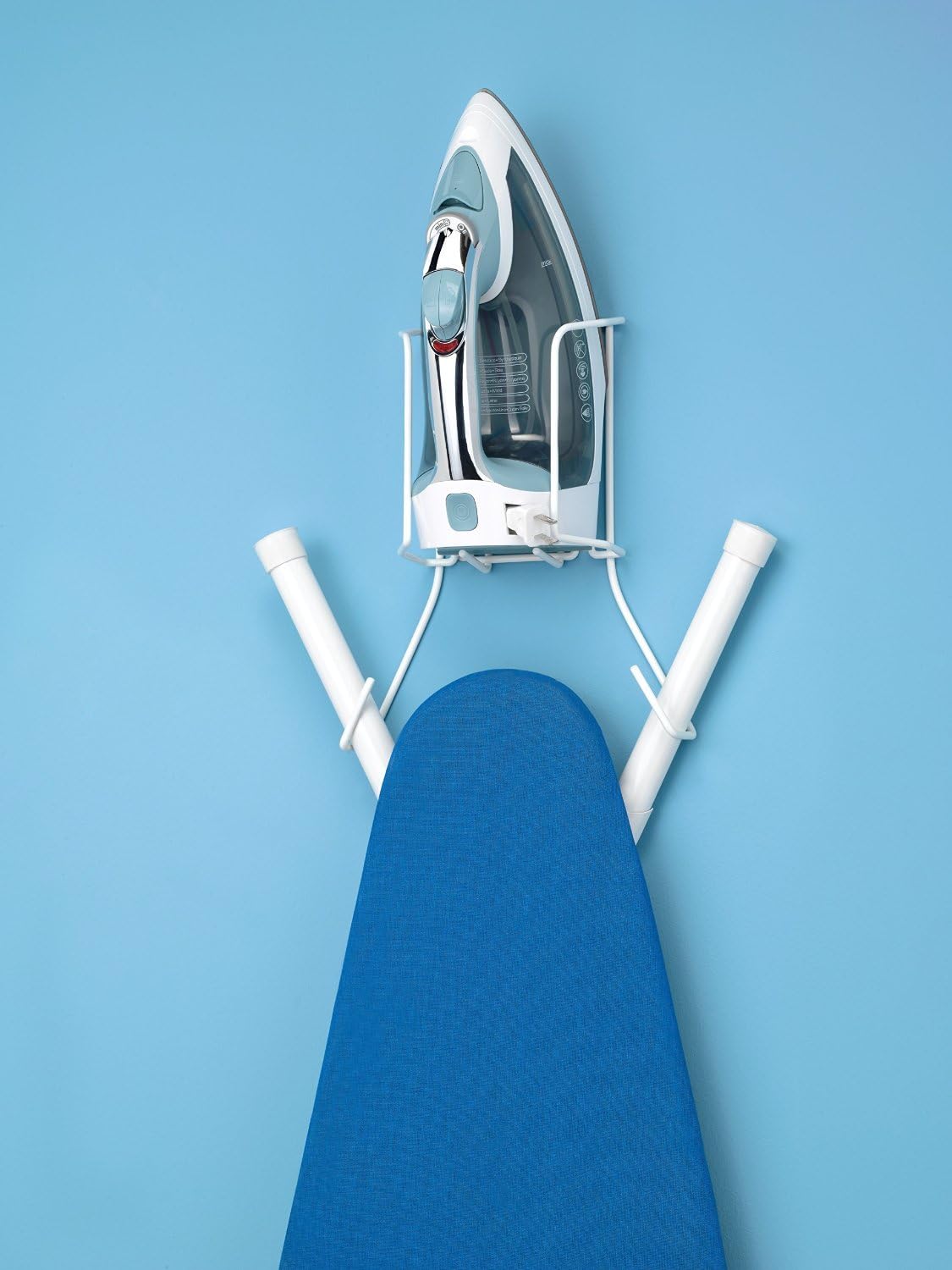
The listing also describes wall installation. A fixed storage point can avoid the movement problem, but it requires suitable mounting instructions, hardware and a wall that supports the intended load. This article does not specify anchors or a load rating because the correct setup depends on the product guidance and wall construction.
Compare the retrieval path for both placements. A wall location that looks less hidden may be easier to use than the back of a door that must be cleared first. In a small laundry area, convenient access often matters more than making the equipment invisible.
Try the complete ironing routine
A useful assessment begins with taking the board down, carrying it to the working spot and setting it up. After ironing and the required cool-down, reverse the process. Notice whether the hooks are easy to reach, whether the iron can be returned without tangling the cord and whether the door remains usable.
This whole sequence reveals more than checking whether the equipment can technically be squeezed into the holder. If a basket has to move every time or the board catches the door handle during removal, the placement may be wrong even when the dimensions appear compatible. Change the location before buying additional organizers around the problem.
When the purchase is worthwhile
The strongest case is a household that irons often enough to value ready access and currently stores the board awkwardly. The caddy can give existing equipment a defined home without adding a freestanding cabinet. Its listed dimensions describe the holder, however, not the total space occupied by a hanging board and iron.
If you iron only occasionally and already have stable, unobstructive storage, the improvement may be modest. Keep that arrangement unless there is a clear retrieval or floor-space problem to solve. We have not tested long-term coating wear, bracket deformation or load performance, so the recommendation rests on fit and workflow rather than an unverified durability claim.
Which option fits your routine?
| Situation | Starting point | Tradeoff |
|---|---|---|
| Board leans in a busy laundry corner | Consider an over-door caddy | Door and board geometry must match |
| Door must move frequently or cannot close with brackets | Consider suitable wall storage | Installation requirements change |
| No comfortable place to iron | Address the working surface and space | A storage caddy does not create an ironing station |
Amazon product and current listing
Check Whitmor Wire Over-The-Door Ironing Caddy on Amazon. Confirm the selected model, seller, delivered price and return terms. This link identifies ASIN B013WJXF84; it does not guarantee current stock.
Our buying decision
The Whitmor is worth considering when a folded board repeatedly blocks a laundry corner. Confirm the door’s top clearance and the board’s hanging geometry before ordering. It is a storage solution, not a substitute for cooling the iron or checking installation requirements.
Explore Laundry Area ideas and Buying Guides. Related reading: Honey-Can-Do Over-the-Door Ironing Board Review: What Happens When the Door Moves?.
Sources and evidence limits
The linked Amazon listing supplies the product identity, photographs and listed features. Household scenarios and comparisons are editorial analysis. We have not measured durability, performance or user outcomes. We do not use star ratings as proof of quality.
Sources
- Amazon product listing — https://www.amazon.com/dp/B013WJXF84