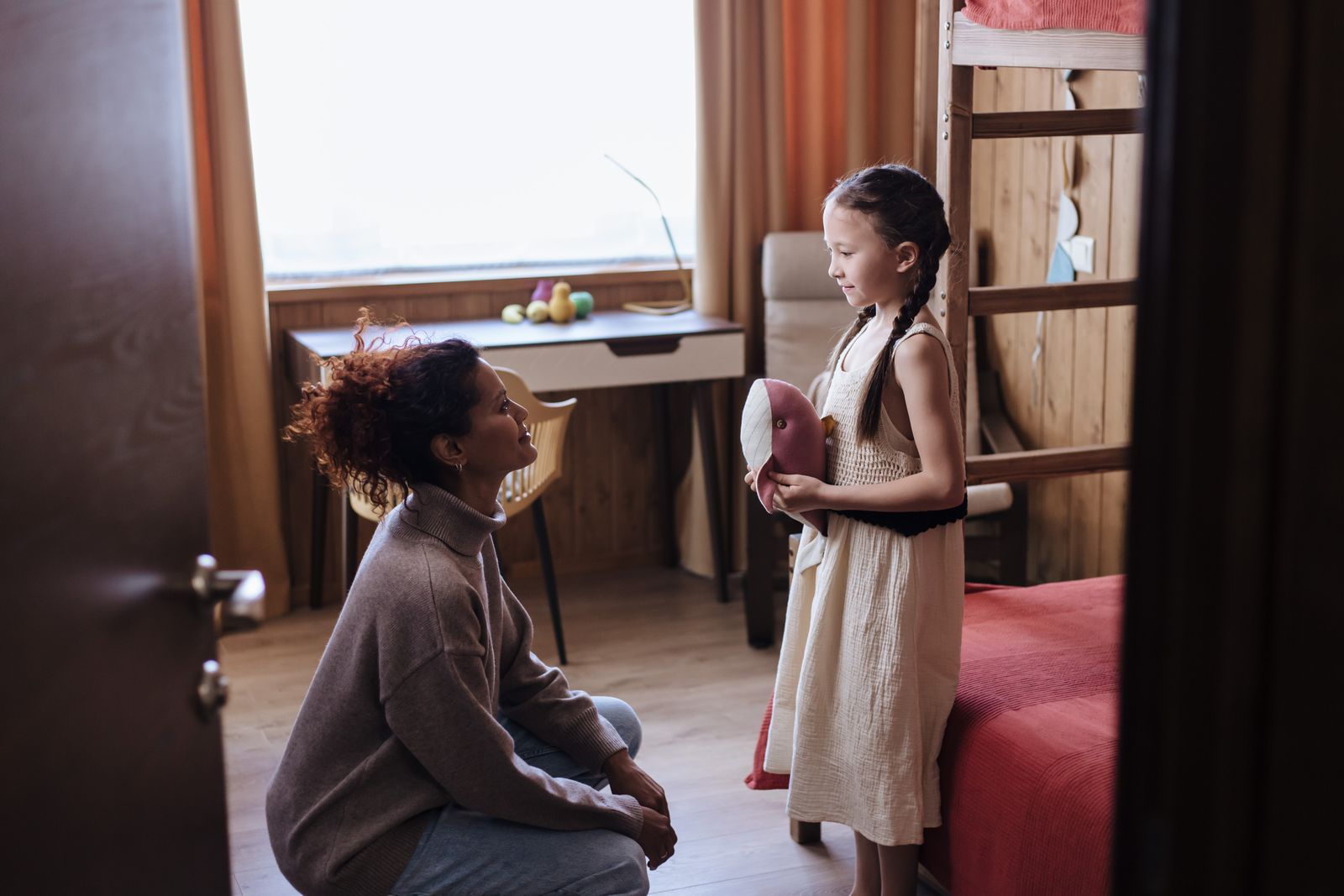
A small household problem is easy to mention and easy to lose. Someone notices that a drawer catches, a handle feels loose, or a lamp behaves differently. They tell an adult while that adult is cooking, and by evening nobody remembers which item needed attention.
A family reporting routine gives the observation a place, an adult owner, and a follow-up. Children can contribute by noticing and telling an adult. The routine does not turn them into repair helpers or ask them to investigate a possible hazard.
Start with a simple rule for noticing
Explain the rule in language the family understands: if something seems broken, different, or unsafe, stop using it where appropriate and tell an adult. For anything that appears urgent or dangerous, tell an adult immediately rather than waiting to write it down.
Adults decide the appropriate response and seek qualified or emergency help when the situation requires it. Do not use a household reporting board as a substitute for an immediate response to a suspected hazard. This guide is about communication and follow-through, not diagnosing electrical, gas, structural, or other technical problems.
For routine observations, encourage concrete descriptions. �The bedroom drawer stops halfway� is more useful than �the furniture is bad.� A child does not need to identify a cause or propose a repair to make a valuable report.
Make it acceptable to report something that later proves harmless. If every observation becomes an argument about blame, people may stop mentioning issues. An adult can thank the person for the information and then decide what it means.
Record location, observation, and time
Use a short entry with three fields: where it happened, what was noticed, and when. A paper note, a shared household list, or an existing digital tool can work. Choose the place that the responsible adults will actually review.
Write what was observed without inventing a diagnosis. �Desk lamp went off twice while being used this evening� describes an event. �The wiring is faulty� makes a technical claim that the observer may not be qualified to assess.
A photograph can help an adult document a visible issue when it can be taken safely without further use or investigation. Do not ask children to climb, open covers, reach behind equipment, or reproduce a failure for a picture. A spoken description is enough to begin.
Keep private information out of anything shared beyond the household. Avoid including a child’s face, personal paperwork, account details, or an unnecessary view of the home in a maintenance report. An adult can prepare the relevant description for the appropriate recipient.
Put the note where action happens
A reporting list does not need a new wall installation. It can be a small part of an existing household planning area. The important feature is that it is distinct from shopping requests and ordinary chores, and that somebody knows to check it.
If the home already has a central planning position, use the compact family command-center approach to keep the reporting section modest. Avoid placing sensitive maintenance details on a display visible to visitors.
For a child who cannot comfortably write the entry, an adult can record the observation. A simple picture or location cue may help identify the item, but the adult still interprets and manages the report. Do not let the recording method become a barrier to telling someone.
Give each report one adult owner
Ownership means one adult confirms the next step, not necessarily that the person performs the repair. They might inspect within their competence, contact the responsible property manager, arrange professional service, or decide that the item should remain out of use pending advice.
Write the owner’s name or an agreed household identifier beside the entry. �Someone will deal with it� is not an assignment. If the first adult cannot follow through, transfer the responsibility explicitly rather than leaving two people assuming the other has acted.
The simple family chore system offers a related way to make responsibility clear. Keep repair decisions with suitable adults even when children have other household contributions.
Use a next action that is specific enough to do: �check the exact maker’s support instructions,� �contact the maintenance office,� or �arrange an appropriate service appointment.� Avoid an entry that stays indefinitely at �fix it.�
Use a few understandable status words
Three or four statuses are usually enough. �Reported� means the observation has been recorded. �Adult follow-up� means an adult is managing the next step. �Waiting� identifies an external response or scheduled visit. �Closed� means the adult has confirmed the outcome.
Attach a reason to waiting: appointment booked, replacement decision pending, or response requested. Add the planned follow-up date where useful. This date is a reminder for the owner, not a promise that a repair will be completed by then.
Keep any restrictions clear. If an adult has determined an item should not be used, communicate that directly in a way appropriate to the household. A tiny status label that a child cannot read is not enough to establish an important restriction.

Close the loop with the person who noticed
When the adult has an outcome, explain it briefly: the service visit is arranged, the item has been assessed, or the issue has been resolved and its use confirmed as appropriate. The explanation should suit the child’s age without exposing technical or private details unnecessarily.
Closing the loop shows that reporting leads somewhere. It also prevents repeat reports caused by silence. If a problem is still waiting, tell the family what is pending and when the responsible adult intends to check again.
Do not mark an entry closed merely because it has been copied into an email or a service request. That confirms transmission, not resolution. Keep the next step visible until the adult has established the outcome.
A routine problem from observation to outcome
Imagine a child notices that a cupboard drawer no longer opens as usual. They tell an adult rather than pulling harder. The adult records the location and observation, decides how to handle use of the drawer, and takes ownership of the follow-up.
In a rental, the adult might describe the issue through the established maintenance channel. They keep the request details in their own records and note �waiting for response� on the household list. They do not assign the child to dismantle the drawer or prove the fault.
When an appointment is confirmed, the adult prepares the relevant access and supervises household arrangements. The maintenance-visit access guide illustrates how to prepare a small room without turning the visit into a whole-home rearrangement.
After the appropriate assessment or repair, the adult confirms the result and tells the child what happens next. The entry is then closed or updated with a further action. The routine has preserved the information without requiring everyone to become a repair expert.

Review the list briefly and consistently
Choose a review moment that fits the household, such as an existing adult planning check. Look first for entries without an owner, then for waiting items whose follow-up point has arrived. Keep urgent issues on their immediate response route rather than saving them for this review.
Remove resolved entries from the active list while preserving any useful service record in an appropriate private place. An active list crowded with old outcomes makes current issues harder to see.
If reports repeatedly vanish, simplify the recording place or the assignment step. If the list grows without action, examine the adult handoff and follow-up rather than asking children to write more detailed descriptions.
Explore related household communication in the Family Home guides and shared-space planning in the Living Room collection. The routine works when an ordinary observation becomes a clear adult responsibility and returns to the family as an understandable outcome.