
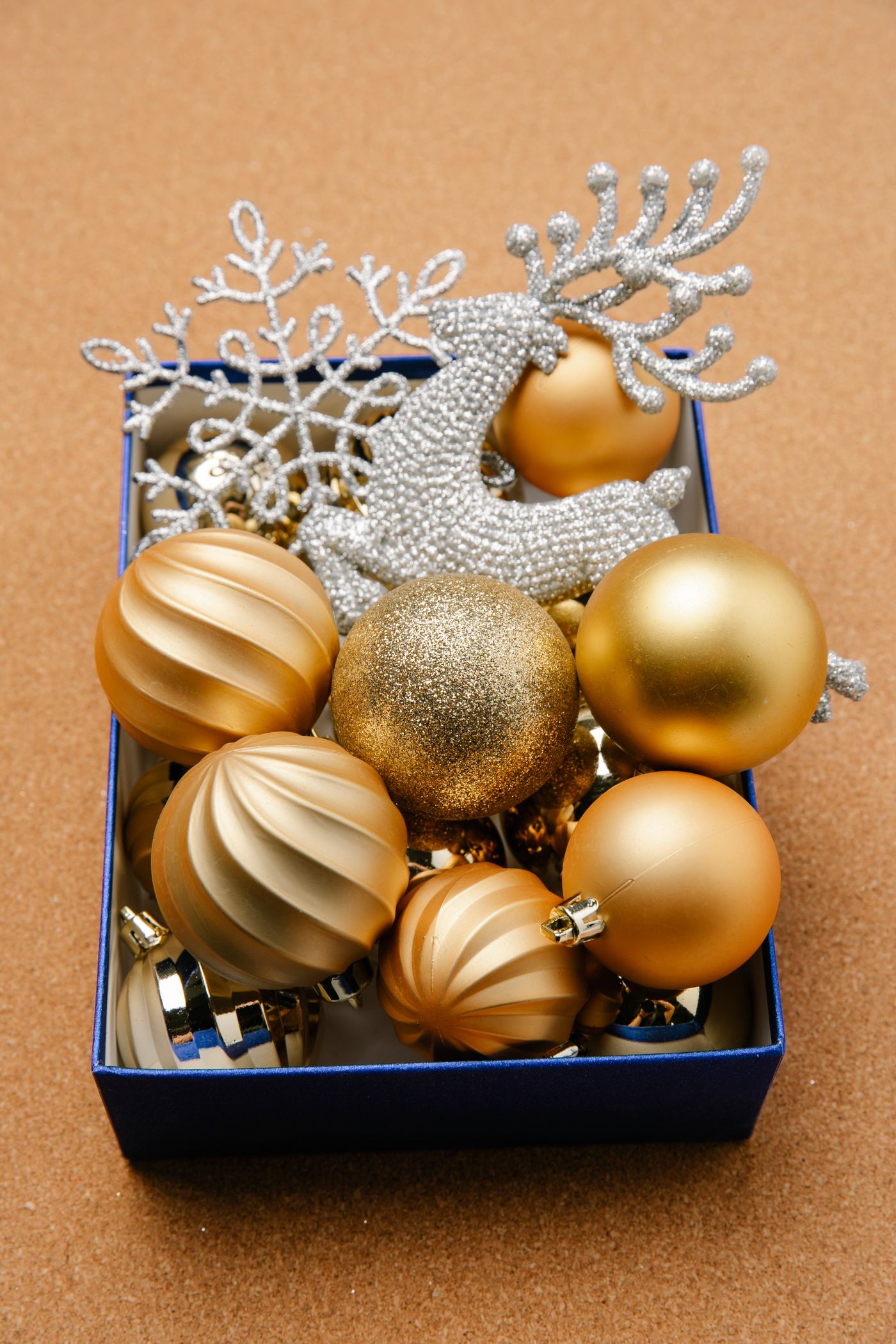
Beaded ornaments and embellished accents need space around their surfaces, not simply a box large enough to close. A projecting sequin, wire loop, or stitched bead can catch its neighbor even when neither object is especially fragile. Start by separating pieces that catch from pieces that compress, then give each one a position you can reach without dragging it through the rest.
Etsy’s October 14, 2026 holiday report highlights expressive, embellished decor; its data comparison ends September 14. The packing method below is an editorial response to that direction, focused on raised surfaces in a small closet rather than a claim about storage-product demand.
You can usually start with the packaging you already have. The useful upgrade is a better arrangement inside it, supported by a retrieval order. A new organizer becomes worthwhile only when you know which contact, pressure, or movement it must prevent.
Look for the part most likely to catch
Lay a few objects on a clear, supported surface and examine them individually. Look for exposed hooks, looped thread, loose trim, projecting wire, textured edges, and beads that stand proud of the backing. Pick up the object by its sound body rather than a decorative projection. If a hanging loop is also the only handle you can reach, change the placement before you pack.
Distinguish a stable raised surface from decoration that is already coming away. A sequin attached by one loose thread should not be pushed into a tighter compartment to hold it in place. Set that piece aside for appropriate repair advice. Packing can limit movement; it cannot make an unsound attachment reliable.
Do not test for snagging by rubbing ornaments together. A close visual check is enough to identify likely trouble. For a valuable, old, or uncertain object, retain its known suitable original supports and seek specific care guidance before introducing new wrapping materials or pressure.

Make separate groups for separate packing problems
Use three working groups: smooth firm objects, embellished firm objects, and soft embellished objects. The groups describe how the objects behave in a container. A cloth ornament with beads belongs with pieces that need support against crushing, even if it shares a color with a glass ball.
A fourth temporary group can hold things with metal hooks, stems, or detachable hardware. Remove detachable hooks only when that is an intended, easy operation. Keep each set in a small labeled envelope beside its own decoration. Do not pull apart a fixed hanger merely to make an item fit a preferred box.
This is narrower than a complete seasonal system. Our guide to storing seasonal decor in a small home covers how much of the closet the whole collection should occupy. Here, the decision is which neighbors can share a layer without their surfaces meeting during lifting and retrieval.
Color can remain a secondary cue. You might keep the blue pieces near each other, but a beaded blue star should still have a supported space apart from a hard smooth bauble. A visually satisfying row is less useful if lifting the first piece catches a thread on the second.
Choose separation that does not add pressure
Before adding individual bags, examine their openings, seams, and closures. An open mesh pouch can catch raised decoration. A tight pouch may press beads into fabric. A rigid compartment can separate objects well, but its wall may still rub a projecting edge if the space is undersized. There is no universal bag that suits every embellishment.
Where the maker permits soft wrapping, place it around the object loosely rather than winding it tightly. Keep adhesive tape off decorative surfaces. Attach a closure to the wrapping itself if one is needed, and leave an obvious way to open it without cutting near the object. Material compatibility matters more than making every package look identical.
For stable modern pieces, a clean divider may be enough to prevent side-to-side contact. For a delicate or valuable item, choose support with advice appropriate to its materials. Avoid turning improvised tissue or foam into a claim of archival protection. Unknown finishes, dyes, adhesives, and coatings need their own assessment.

Support the body and leave projections free
Set the main body on its support first. Check whether a bead, pointed tip, or hanging attachment is taking the weight instead. If so, alter the orientation or select a deeper space. The intended result is an object that rests naturally without being wedged upright by decorative parts.
Soft pieces need enough room to retain their shape. A flat fabric decoration may be stored flat if that suits its construction, while a stuffed figure may need a deeper compartment. Do not flatten both into the same shallow tray just because they are made of fabric. Keep stiff projecting trim away from neighboring soft surfaces.
Leave a small usable grasping area. If you cannot remove an object without pinching its beads, the compartment is functionally too tight. This applies even when the lid closes. The real fit includes your fingers and the opening motion, as well as the object’s largest dimension.
Use a capacity ceiling for the collection before adding another dense layer. A box that requires compression to close has exceeded its useful capacity for these pieces. Reducing the contents or choosing a different arrangement is more sensible than applying extra force to the lid.
Put loose hanging parts where they cannot migrate
Gather intended hanging loops gently alongside their own objects. Do not wrap a loop tightly around projecting details. If a detachable hook is stored separately, name both the envelope and the matching compartment. That small connection prevents the next decorating session from beginning with a tray of sharp mixed hardware.
Give strings and lightweight garlands their own suitable support. Dropping them across a layer of beaded objects invites them to settle around the raised surfaces. If a strand is fixed to the object, leave it relaxed within its allocated space rather than pulling it taut to force an arrangement.
You can keep one small hardware envelope for ordinary interchangeable hooks, but separate that shared stock from object-specific attachments. The difference saves time when a special fitting is needed. Label the shared envelope plainly so someone helping to unpack knows which pieces are actually interchangeable.

Check movement before deciding the box is finished
Inspect the packed layer before placing anything above it. Are the objects separated at their widest points? Can the supports move? Will a divider shift when you lift the tray? Correct obvious gaps in support without filling every remaining air space with tight packing.
Close the lid gently. If it meets resistance, reopen it and find the contact point. Do not use the fastening clips as clamps. A strong latch can conceal a poor packing arrangement until the next time the box is opened, when an already compressed object may catch on its wrapping.
Lift the container level using its intended handles, keeping it low and supported. There is no need to shake or tip it as a test. Listen and look for ordinary movement during careful handling. If contents slide as you carry the box normally, revise the dividers or reduce the number of pieces.
Our comparison of clear bins and opaque baskets can help with the outer container decision. Visibility is useful for identification, while a closed opaque box may suit a shelf better. Neither feature replaces separation inside the container, and neither guarantees protection from unsuitable storage conditions.
Give the closet a retrieval order
Put the box where it can be brought down without tilting or passing through a narrow pile of bags. Heavy containers belong where you can handle them comfortably. Do not bury delicate decor beneath spare appliances, luggage, or other items that will be moved during the year.
Mark the outside with a plain description such as “raised-bead ornaments, one supported layer.” A small note about opening orientation can be more useful than a decorative seasonal label. Photograph the arrangement only if that helps someone return the pieces to their assigned positions; it need not become a large catalog project.

Pack for the collection you intend to keep
If there is no comfortable place for an item even after you separate incompatible neighbors, decide whether it still belongs in the collection. Our seasonal declutter before bringing in holiday decor offers a broader decision process. An object that is repeatedly squeezed into leftover space may need a different home, a smaller collection around it, or a decision to let it go.
At the next opening, inspect the first layer before unpacking everything. A caught thread, shifted support, or displaced hook tells you exactly where to improve the arrangement. Keep that correction local. You do not need to rebuild every box because one unusually shaped piece needs a better compartment.
The useful stopping point is simple: each embellished object rests on its body, its projecting decoration has clearance, and you can retrieve it without brushing it through a neighbor. The closet then supports the display you enjoy instead of making every seasonal change a repair session.
Explore related household decisions in our Home Organization hub.
Sources and editorial scope
Editorial research checked October 15, 2026. Trend-report dates and limitations are stated in the article; these are editorial applications of published signals, not verified October keyword rankings. Practical household guidance; illustrations do not document a tested household or authenticate a pictured material.
