Affiliate disclosure: As an Amazon Associate, Small Home Rhythm earns from qualifying purchases.
Before buying a desk, shelf, or storage box, you need measurements you can read and record. A retractable tape measure is useful for that household task, but the way its blade stays extended can affect how you work alone. Stanley’s selected PowerLock uses a manually operated blade lock. Komelon’s selected Self Lock holds the extended blade automatically and uses a button for controlled return.
Research scope: This comparison checks the exact models and published operating features. We have not tested calibration, accuracy, blade reach, drop resistance, durability, or one-handed performance. The recommendations are editorial interpretations of the controls and a household measuring workflow, not results from a physical tool test.
Choose the control style you understand and will use consistently. Then record what you measured, from which points, and in which units. A tape with a preferred lock mechanism cannot rescue a furniture decision based on the wrong dimensions.
Identify the models before comparing the locks
The Stanley selection is the chrome 25-foot PowerLock, model 33-425, Amazon ASIN B00002X2GQ. The Komelon selection is the 25-foot Self Lock Power Tape, model SL2825, ASIN B000BQKXLE.
Check the actual variant on the current listing and packaging. Komelon’s Self Lock family includes several lengths and an SL2825IE version; that is not the same model identity as SL2825. Do not assume that units, markings, or dimensions are identical across every product with a similar case.
Likewise, this article does not cover every Stanley tape sold under the PowerLock name. A different length, model, or feature set needs its own verification. Choose the measuring scale you actually need and confirm it on the selected tool before ordering.
| Decision point | Stanley PowerLock 33-425 | Komelon Self Lock SL2825 |
|---|---|---|
| Selected nominal length | 25 feet | 25 feet |
| Extended-blade control | User operates the positive blade lock | Blade holds automatically as it extends |
| Return control | Release the lock and guide return according to instructions | Use the thumb button and guide controlled return |
| Published protection features | Mylar-coated blade in selected listing | Nylon-coated blade and rubberized case in published information |
| Relevant preference | A deliberate manual lock step | Automatic holding with a separate return-button step |
| Not established here | Comparative accuracy, service life, durability, comfort, or performance | |
Stanley PowerLock: a deliberate manual lock step
The selected Stanley listing identifies model 33-425 and its positive blade lock, Mylar blade coating, and Tru-Zero end hook. These published features establish the selected product’s description, not a ranking against the Komelon.
The practical distinction is the lock action. You extend the blade and operate the lock as directed when you want it held. A person familiar with that sequence may prefer the clear separation between extending and locking.
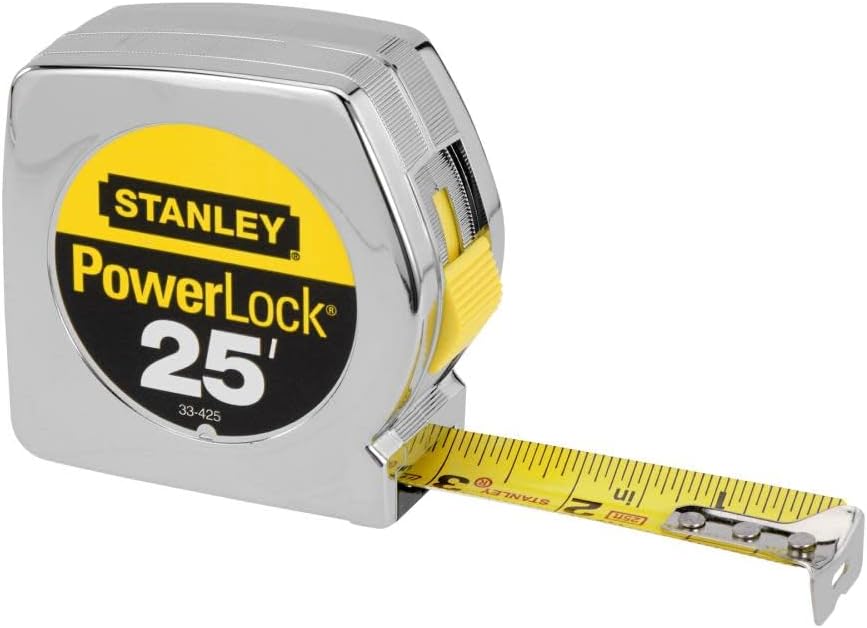
If you often pause to write down a dimension, make the lock step part of your measuring habit rather than assuming the blade will remain extended on its own. Check the reading and the reference points before recording the number.
Follow the maker’s directions for release and return. Do not let the blade snap back freely while your attention moves to a notebook. Keep hands and nearby people positioned appropriately for the actual tool and task.
Why consider it: the selected manual control may suit an established measuring routine. Why pause: it adds a deliberate locking step, and this article provides no independent evidence that its accuracy or durability exceeds the alternative.
Check the selected Stanley PowerLock 33-425 on Amazon, confirming the model and current purchase terms.
Komelon Self Lock: automatic holding and button-controlled return
Komelon’s standard Self Lock series page describes a blade that holds as it extends and a thumb button used for return. The selected SL2825 listing identifies the 25-foot model with a nylon-coated blade and rubberized case.
The operating difference can be relevant when you extend, read, and write in separate moments. Automatic holding removes the separate manual-lock action, but it does not remove the need to check the reading, support the measurement appropriately, or control the return.
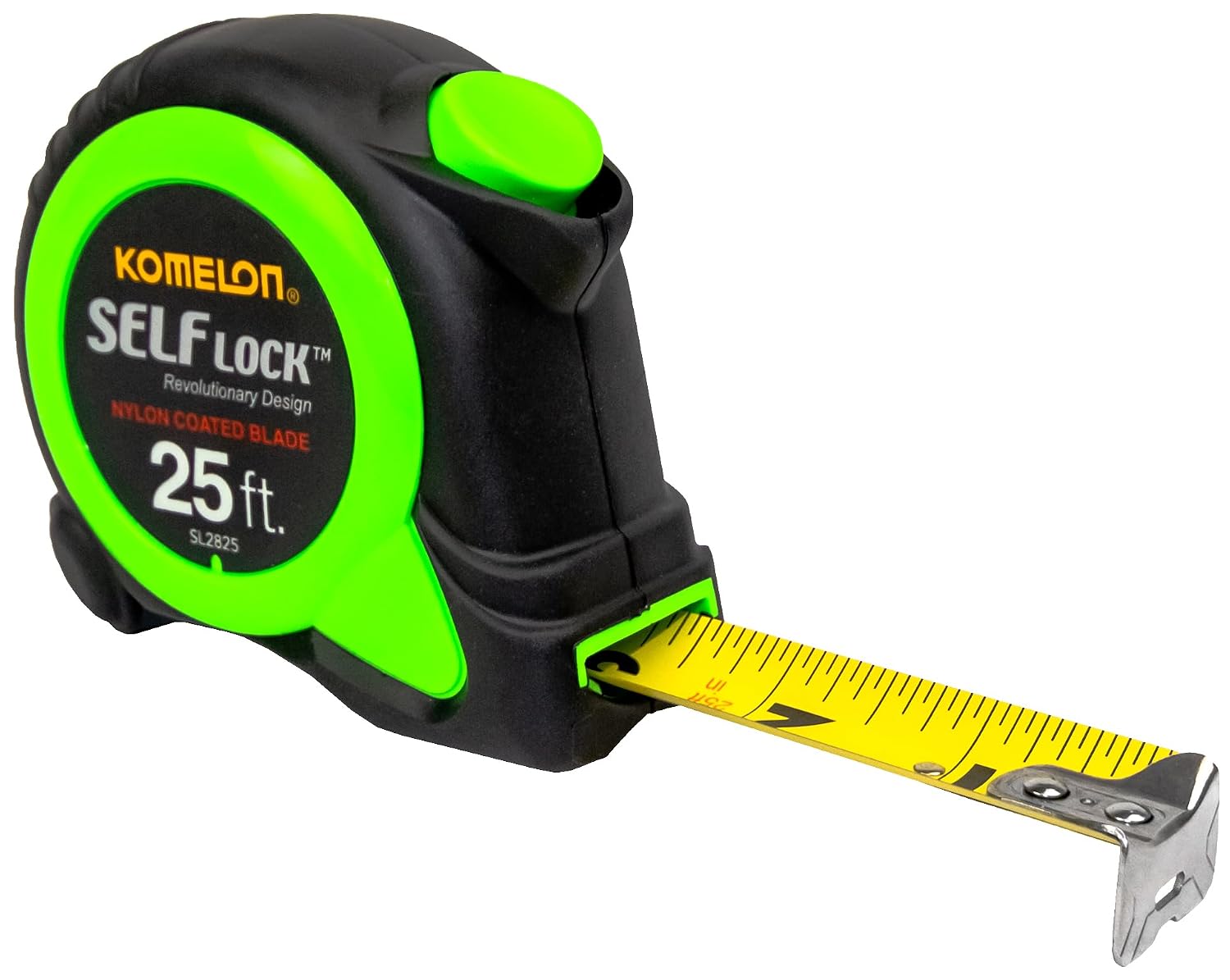
Komelon instructs users to control the speed of return. A return button is therefore part of an intentional operation, not permission to let the blade race back. Understand the control before using the tool in a crowded room or beside fragile furnishings.
Check the exact scale and variant you are buying. If the listing changes to another Self Lock length or an IE model, stop and verify whether it still matches your requirements. A family name alone is not enough to settle the units question.
Why consider it: its published automatic-hold arrangement may suit someone who wants that control sequence. Why pause: you still need a careful measuring process and controlled return, and no tested one-handed advantage or durability result is claimed here.
Check the selected Komelon Self Lock SL2825 on Amazon, checking model, seller, markings, and quantity.
Choose the control from your real measuring sequence
Picture a task you regularly perform: measuring a shelf’s usable depth, checking an opening, or recording space beside a desk. Do you already remember to lock a blade, or do you routinely stop between extending and writing? Which sequence feels clearer to you?
That preference is more concrete than a broad claim that one tool is �easier.� A manual lock may provide a useful deliberate checkpoint for one person. Automatic holding may suit another person’s pause-and-record process. Neither description proves suitability for every hand or physical ability.
Where possible, inspect a suitable demonstration or handle the exact tool safely in person. If buying remotely, review the applicable return conditions rather than assuming a published feature guarantees comfortable operation. Keep the comparison focused on the selected models.
You may also need a helper for a particular measurement. A lock mechanism does not establish that every long or awkward span can be measured reliably alone. Do not stretch across furniture, climb unsafely, or extend a blade beyond what the actual instructions and setup support.

Define the dimension before extending the blade
Household fit checks often fail because the recorded number describes the wrong thing. �Shelf width� might mean the cabinet’s outer width, the opening between sides, or the clear width inside. Write the intended dimension before measuring so the number has a meaning later. If you are working on the same space, LovTocTic Skull Planter Review for Halloween 2026: Check Fit Before Styling a Home Office covers the next decision in more detail.
For a storage box, distinguish outside dimensions from usable inside dimensions. For furniture, include projecting handles, feet, tops, and any installation requirements. For the room, identify baseboards, trim, outlets, and moving parts that affect the usable space.
Measure from consistent reference points and keep units explicit. Do not record an unlabeled �24� and expect to remember whether it described inches, centimeters, height, or depth. Sketching the dimension with arrows can prevent confusion when several similar numbers are involved.
The small dining-area measuring guide illustrates why room use matters alongside a furniture dimension. The same principle applies to a desk or cabinet: closed furniture size is only one part of fit.
Use a repeatable read-and-record routine
Follow the tool’s operating instructions for the actual measurement. Keep the intended line and reference points clear, read the appropriate scale carefully, and record the dimension immediately. Avoid holding the blade in an improvised position while trying to remember several numbers.
Repeat important measurements from the same defined points. If the readings differ, investigate the setup, units, alignment, and endpoints rather than simply averaging the results. An inconsistent measurement is a reason to pause a purchase, not a reason to choose the number you prefer.
Check the condition of the tool according to its maker’s guidance. Do not infer that every movement in an end hook is damage; hook designs can involve intended movement. Equally, do not assume that an visibly damaged or malfunctioning tool is adequate for an important decision. Resolve the specific condition using the actual instructions or appropriate help.
These household checks do not certify calibration or professional accuracy. If a task requires specialist precision or formal verification, use a suitable method and qualified assistance. A product comparison for home fit checks does not establish either tape’s suitability for that separate requirement. For a related step-by-step approach, see Fiskars Original vs. Scotch Precision 1448: Choose Scissors for the Task and the Hand.
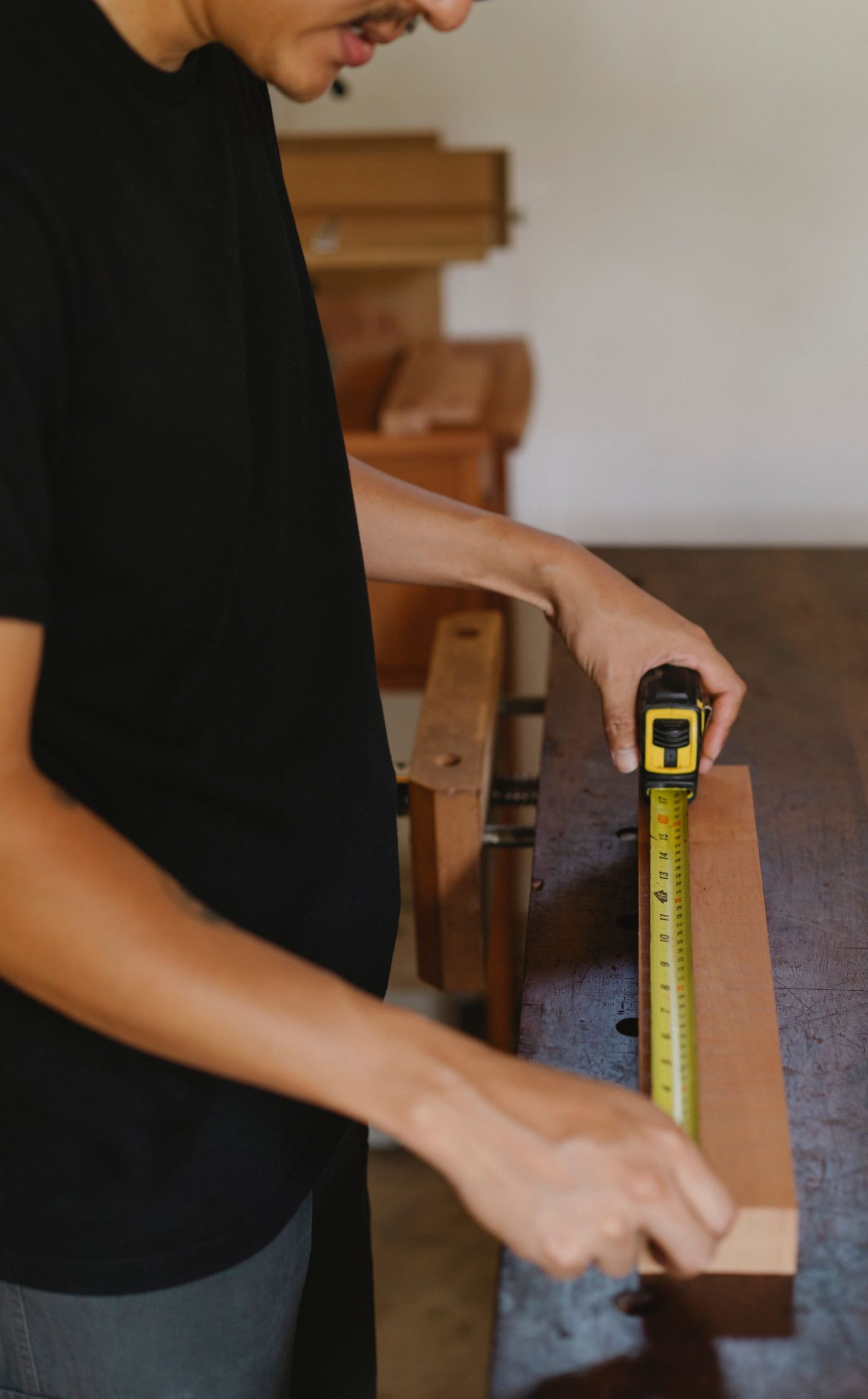
An example: checking a small home-office cabinet
Suppose you want a cabinet beside a desk. You begin by recording the proposed position, the available width, and the usable depth. Then you note the desk user’s occupied chair position and the route past it. The cabinet’s closed size may fit while its doors or drawers do not.
Next, compare the product’s complete outside dimensions to your defined measurements. Include handles and the maker’s setup requirements. Resolve any uncertainty in the listing before buying. A number labeled only �cabinet depth� may describe something different from the projection you need.
On the sketch, add the cabinet’s open-door or open-drawer space and the person using it. Check whether someone can still use the desk or pass through when the cabinet is in normal use. Keep required routes usable rather than treating a narrow leftover gap as automatic approval.
You can complete that workflow with either selected tape if its actual operation and suitability meet the task. The Stanley introduces your chosen manual-lock step; the Komelon supplies automatic holding and a button-controlled return. Neither mechanism decides where the cabinet belongs.
The home-office storage comparison helps decide whether a cabinet is the appropriate storage form in the first place. Sometimes a different already-owned arrangement removes the purchase need.
Keep the measurement record connected to the decision
Store the sketch or note where you will compare the listing, not only in a loose pocket beside the tape. Include the date if the room layout may change, the object being considered, and the measurement reference points. Photograph your own sketch if that is the easiest way to keep it available.
For a desk accessory, use the actual working surface and occupied setup. The mStand versus Nulaxy C3 comparison and Fellowes document-holder comparison show related decisions where an accessory’s footprint and use matter together.
Do not rely on a screenshot of a single dimension after the listing changes variants. Keep the exact product identity with the measurement brief. That makes the final comparison reviewable by another household member without asking them to reconstruct your reasoning.
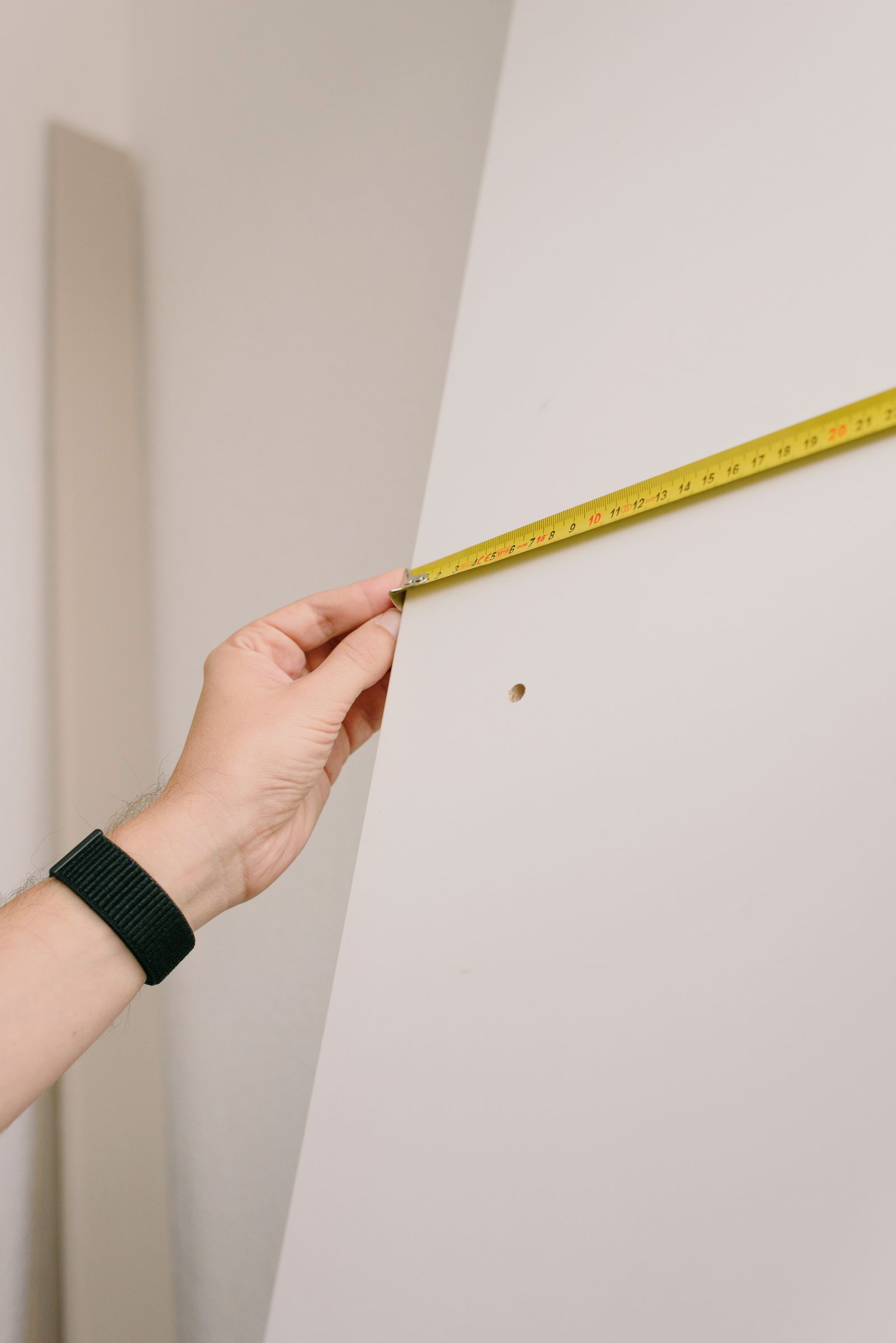
Care and storage should preserve a usable tool
Follow the exact maker’s care directions, including permitted cleaning and storage. Return the tool to a known place after the measuring task rather than leaving it in the furniture gap. Keep the notebook or measurement reference separate if it serves other household uses.
Store the tool where its intended users can find it and where access is appropriate for children in the household. A retractable blade is a tool, not a play item. Do not assign measuring tasks based solely on a child’s ability to reach the case.
Do not treat blade coatings or a rubberized case as a promise that neglect, water exposure, dropping, or forceful return will have no consequences. Published protective features do not establish an unlimited service life, and we have no comparative wear data to report.
Check whether you need to buy either one
If you already own a suitable tape in good condition with a control you understand and the scale you need, another 25-foot tape may not improve your household measurements. First improve the reference points, record keeping, or retrieval location that caused the problem.
For simple storage decisions, the before-buying organizer test can clarify whether a new container is needed at all. Measurement is most useful after the intended task and storage role are defined.
Compare current delivered prices for the exact selections, including shipping, seller, quantity, and return terms. No fixed price or customer-review consensus is used here. A cheaper unfamiliar variant is not the same offer as the model you checked.
The practical choice
Choose the selected Stanley if you prefer deliberate manual locking. Consider the selected Komelon if automatic holding and a button-controlled return suit your sequence. Confirm the exact markings and follow the operating directions either way.
Find related decisions in the Buying Guides collection and Home Office room guide. The strongest fit check combines a suitable tool, clearly defined dimensions, repeated readings where needed, and a record that remains attached to the exact purchase decision.