Most organizer purchases begin with a visual symptom. The drawer is messy. The shelf is full. Shoes are on the floor. The counter has too many bottles. The natural response is to search for a product that appears to make the category disappear. You may also find How to Store Seasonal Decor in a Small Home Without Keeping a Closet Full of Holidays useful for a closely related small-home problem.
Sometimes that is exactly the right solution. Sometimes the organizer becomes one more object the room has to store.
Before buying anything, I run a simple diagnostic. It takes about 20 minutes and answers one question: Is this a storage-tool problem, or is it an inventory and access problem?
Minute 0–2: name the friction in one sentence
Do not start with “I need an organizer.” Finish this sentence instead:
“This space is frustrating because…”
Useful answers sound like:
- “…I cannot reach the pans without lifting three others.”
- “…school shoes have no place near the door.”
- “…small toiletries disappear behind tall bottles.”
- “…the child cannot put art supplies away independently.”
Weak answers sound like, “It looks messy.” Mess can have many causes.

Minute 2–5: remove obvious non-members
Take out anything that does not belong to the category. Mail in the kitchen drawer, batteries in the bathroom cabinet, old cables in the bedside table, clothing in a toy bin. If you are working on the same space, How to Organize Cables, Chargers, and Tech Clutter in a Small Home covers the next decision in more detail.
Do not fully declutter yet. You are testing whether category contamination is creating the apparent shortage.
If removing foreign objects fixes the space, stop. You do not need an organizer. You need better category boundaries.
Minute 5–8: measure the category, not the shelf
Gather the true category together. How much physical volume does it occupy?
This is the step most shopping skips. People measure the cabinet and buy a bin that fills it, even if the category needs only half that volume. The bin then traps empty air and encourages future accumulation.
If the category is larger than the space, an organizer cannot change the arithmetic. You need to reduce inventory, relocate low-frequency items, or assign additional space deliberately.

Minute 8–11: test access with no organizer
Place the category back in the space as simply as possible. No decorative containers. No labels. Just group like with like.
Now perform the real task. Remove the most-used item. Put it back. Remove the second-most-used item. Put it back.
If access works, the problem may have been category mixing or excess volume—not lack of organizers.
If access still fails because items fall over, slide around, or hide in depth, you have identified a genuine tool problem.
Minute 11–13: classify the problem
Most storage problems fall into one of four types:
1. Containment problem
Small items scatter. A shallow bin, tray, or divider may help.
2. Depth problem
Items disappear at the back. Pull-out bins, drawers, or turntables for suitable categories may help.
3. Vertical problem
Short items sit beneath unused height. A shelf riser or adjusted shelf may help.
4. Volume problem
The category simply exceeds the assigned space. Buying a container will make it prettier but not solve capacity.
The best storage solutions for small homes expands these diagnoses across the whole home.
Minute 13–16: mock up the proposed organizer
Before buying, simulate the footprint. Use a cardboard box, shoebox, stack of books, folded towel, or painter’s tape.
If you are considering a rolling cart, mark its floor dimensions. If you are considering a storage bench, block out the depth. If you want shelf bins, place boxes of similar dimensions on the shelf.
Then use the room normally for a few minutes.

Test what the organizer blocks
Open doors and drawers. Walk the main path. Carry a laundry basket. Pull out the dining chair. Let a child reach the shelf. Open the dishwasher.
Storage products often solve one local problem while creating a circulation problem elsewhere.
This is especially important in entries, narrow bedrooms, and bathrooms where a few extra inches can change whether two functions conflict.
Minute 16–18: test the reset
Imagine the busiest realistic version of the category. Not the styled version after organizing—the normal Tuesday version.
Can the user return items quickly? Does the lid require two hands? Are the compartments too precise? Does the basket become too heavy when full? Does the cart need to be moved before every use? For the broader setup, A Family Chore System for Small Homes That Doesn’t Need a Chart on Every Wall is a useful next read.
A storage product should make the reset easier, not merely make the initial setup look cleaner.

Minute 18–20: write the buying specification
Only now decide what you need. A useful specification sounds like:
“I need a pull-forward bin no deeper than 14 inches, low enough to clear the shelf above, for weekly baking supplies that currently disappear behind daily dishes.”
That is much better than, “I need kitchen organizers.”
Specific problems produce better purchases.
The five things I want to know before buying
- Exact usable dimensions.
- Exact category.
- How often the category is used.
- Who must operate the organizer.
- What existing object or friction the organizer replaces.
If you cannot answer all five, I would wait.
When a bin is the right answer
Bins are strong when several small related items need to move together, when shelf depth causes scattering, or when a category needs a clear physical limit.
They are weak when the category is already stable on a shelf and the bin walls merely reduce usable dimensions.
When a basket is the right answer
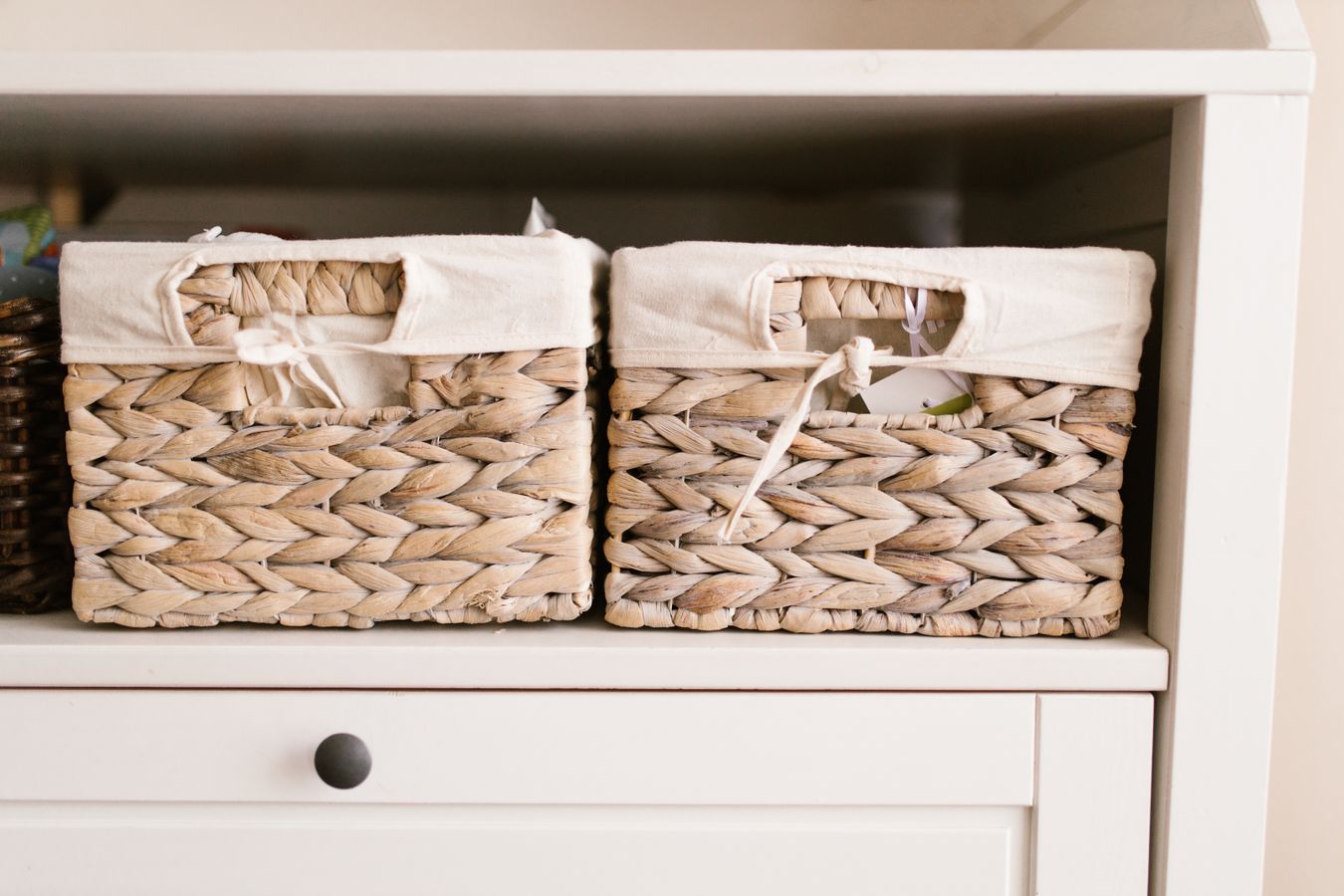
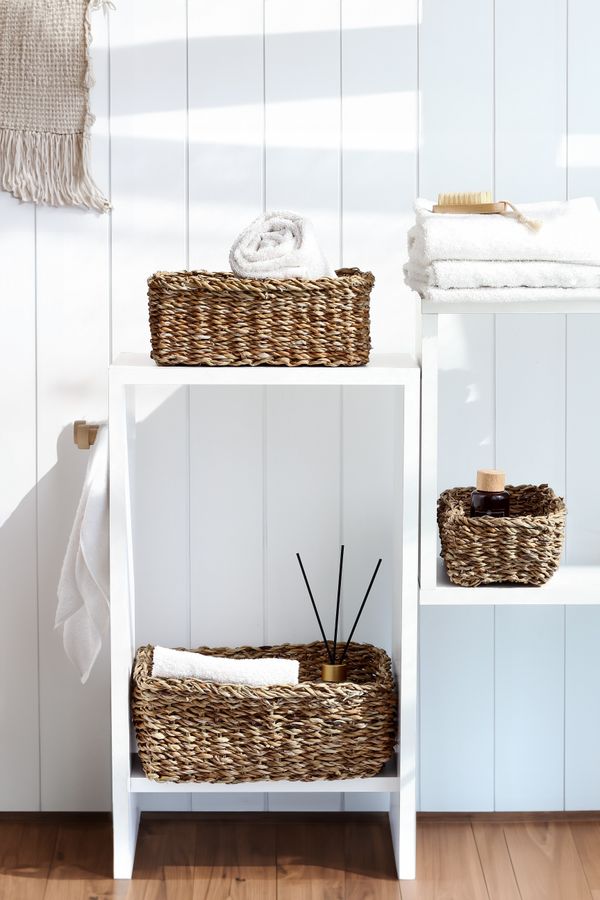
Baskets are useful for soft, irregular, or portable categories: blankets, guest towels, certain toys, laundry accessories.
They are weak for tiny items that disappear at the bottom or heavy items that make the basket difficult to lift.
When a drawer divider is the right answer
Dividers are excellent when small items slide into one another and the drawer is already the correct location.
They are not useful when the drawer contains too many categories or too much volume. In that case, the divider only creates more crowded compartments.
When a rolling cart is the right answer
A cart works when the category genuinely moves between work zones or when a narrow gap is the only practical storage location.
It fails when it has no parking spot. Then “mobile” becomes another word for “always in the way.”
When storage furniture is the right answer
Storage furniture should solve at least two needs whenever possible. A bench can provide seating plus shoes. An ottoman can provide a footrest plus blankets. A storage bed can replace a separate bulky linen cabinet. You may also find Small Bedroom Storage Review: Under-Bed Drawers vs. Dresser vs. Wardrobe vs. Storage Bed useful for a closely related small-home problem.
If excess volume is still the problem, start with the small-home decluttering guide before adding another organizer.
Three stop signs that mean “do not buy yet”
- You cannot name the category. Mixed clutter needs decisions first.
- The category exceeds the available space. Reduce or relocate before containing.
- The organizer would block another function. A storage win that creates a circulation loss is not a win.
One more test: wait 48 hours
If the purchase is not urgent, live with the simplified category for two days. Sometimes the temporary arrangement reveals that you needed fewer things, a different location, or no product at all.
This is particularly useful after decluttering. Do not lock a new system around an inventory that is still changing.

Run the test on one category, not the whole room
The 20-minute limit works because it keeps the diagnosis narrow. Do not use it to “organize the bathroom.” Use it for under-sink cleaning products, hair tools, bath toys, or towels. Do not test “the entryway.” Test school shoes or incoming mail.
Specific categories produce specific buying decisions. Room-wide frustration often contains several different problems that no single product can solve.
What I consider a successful organizer purchase
Thirty days later, the product should still save a step, protect a category boundary, or improve retrieval. If the only lasting benefit is that the objects look more uniform, the purchase may have been decorative rather than functional.
Decoration is not wrong, but it should be recognized as decoration. In a small home, functional storage deserves priority because every object has a footprint cost.
Keep a “do not buy yet” note
If you repeatedly shop for storage, keep a short note on your phone listing categories currently under observation. Write the dimensions, the friction, and the temporary test. This creates a cooling-off period between frustration and purchase.
You may discover that the category shrinks, moves, or solves itself through a routine change before a product is necessary.
Three examples of the test changing the purchase
Messy utensil drawer: after removing duplicate gadgets, the drawer closes easily. Result: no organizer needed, only one small divider for measuring tools.
Entryway shoe pile: the active shoes fit a narrow tray once seasonal pairs move to bedroom storage. Result: buy a tray sized to active pairs, not a six-tier shoe rack.
Bathroom bottles falling over: product volume is reasonable, but the deep cabinet hides small items. Result: a shallow pull-forward bin solves access without adding new furniture.
These examples illustrate the point of the test: the correct purchase is often smaller and more specific than the product you would have chosen from the original visual mess.
Explore this topic
Browse more practical guidance in the Home Organization hub. Room focus: Small Rooms.
Related published guides
- A Simple Seasonal Declutter Before Bringing Holiday Decor Into a Small Home
- 12 Space-Saving Ideas That Actually Work in a Small Family Home
Expert conclusion
Good organizers are tools. They solve specific geometry and access problems. Bad organizer purchases are containers bought before the problem is understood.
Twenty minutes of diagnosis can save money, floor space, and months of living with a product that technically fits but does not improve the routine.
Before you shop, name the friction, isolate the category, test access, mock up the footprint, and define the exact job. If you still need an organizer after that, you will know what to buy—and, just as importantly, what not to buy.