
One person sees a paper crane and wants to make ten. Another needs time to understand the first crease. A family origami session can accommodate both when the activity is built around sharing one manageable fold rather than producing matching models at the same speed.
Pinterest’s 2026 hobbies reporting includes growing interest in origami and small tactile projects. The useful household application is a short making session with a clear start and finish. The ideas below organize teaching and participation; they do not promise developmental results or reproduce somebody else’s diagram sequence.
Choose a fold someone can actually demonstrate
Start with a model that the person teaching can already make from an appropriate instruction or their own knowledge. Fold a sample beforehand. If the demonstrator cannot explain a step without repeatedly guessing, choose a simpler model or make the session a shared learning attempt and say so.
Use an instruction source you are permitted to use and give its creator appropriate credit when relevant. Keep the original available rather than trying to reconstruct a difficult model from one finished photograph. A paper boat, simple animal, or other familiar form can be suitable if its actual steps fit the people taking part.
Choose one initial model, not a menu of twenty possibilities. Participants can make different sizes or colors where the method permits, while sharing the same basic sequence. A small common starting point makes it easier to help someone without interrupting everyone else’s unrelated project.
Match the paper to the actual instructions
Check the starting shape, size, and paper properties the chosen model requires. A square-sheet model and a rectangular-sheet model are different starting tasks. Prepare suitable paper before inviting people to fold instead of discovering halfway through that the sheet cannot support the demonstrated sequence.
Use materials appropriate to the participants and the activity. Keep cutting or other tool preparation with a suitable responsible adult where needed, or choose prepared sheets that avoid that step. Do not assume thicker paper will be easier simply because it feels sturdier; test the actual fold yourself first.
Bring a modest number of spare sheets. A restart can be a reasonable response to a confusing sequence, and scrap paper may work if it suits the model. The art-supply organization guide helps keep the project small enough to put away without unpacking every decorative paper the household owns.
Demonstrate where the learner can see
Choose a shared surface with enough room for each person’s paper and hands. Check the view from the learner’s seat rather than assuming your own view is clear. A demonstrator seated opposite may need to explain orientation carefully because left, right, near, and far can look different across the table.
Use plain references that connect to the actual sheet: “the edge nearest you” or “the colored side facing down,” when those descriptions are correct for the step. Show the result of one action before starting the next. Avoid changing several folds at once while explaining what happened after the fact.
Give the learner time to compare their sheet with the demonstration. If the papers no longer match, return to the last understood point. The aim is to make the sequence visible enough to follow, not to keep a group moving at a pace that leaves one person quietly folding something unrelated.

Ask before touching someone else’s work
Offer a choice: show the step again, describe it differently, or help with the paper if the person wants that. Taking over can produce a tidy model while removing the activity the learner came to do. A slightly uneven fold can remain theirs if it still supports the chosen process.
Keep assistance specific. “Would you like me to hold this corner while you press?” is easier to understand than a general intervention that rearranges the whole sheet. Ask in an age-appropriate way and respect someone who prefers to watch or restart rather than have the model completed for them.
When an adult does part of a model, acknowledge that contribution without turning it into a failure. A shared piece can be satisfying, but it should not later be presented as something the child independently made. Keep the session’s story as honest as the household would want a school or club project to be.
Let different people finish differently
Decide what counts as a comfortable stopping point. Someone may finish one model, practice an early fold several times, or choose to watch after trying. Avoid requiring every participant to produce an identical object before the table can be cleared.
Provide an optional next task for people who finish early, such as repeating the same model on another suitable sheet or helping prepare a simple display area. Keep that task from becoming a race for the largest pile. The group should not need to abandon a slower participant to keep faster folders entertained.
The family paper-collage guide concerns a different activity, but its clear stopping-point principle is useful here. Decide when the shared session ends and what can continue individually. Origami can remain a short family activity without becoming a permanent claim on the room’s main surface.

Notice the process without grading the models
Ask what became easier, which step needed another look, or what the maker wants to try next. These questions make room for a real account of the activity. Avoid inventing a lesson or emotional benefit that the participant did not describe.
Keep comparison optional. Two people can explain how their models differ without ranking which one is the “good” version. If accuracy matters for a later step, discuss that specific fold rather than treating the whole object as a measure of the person’s ability.
Photograph a model only with the appropriate household permission, especially if a person or private details appear. Keep the image’s intended audience clear. A family making session does not need a public post to count as finished, and someone can enjoy a model without wanting it shared.
Choose a modest destination for the finished paper
Ask the maker whether the model is being kept, given away, displayed briefly, or released through an appropriate paper route. The destination can be small: one suitable shelf position or an identified envelope where the construction allows it. Do not compress a three-dimensional piece into storage that destroys the form its maker wanted to keep.
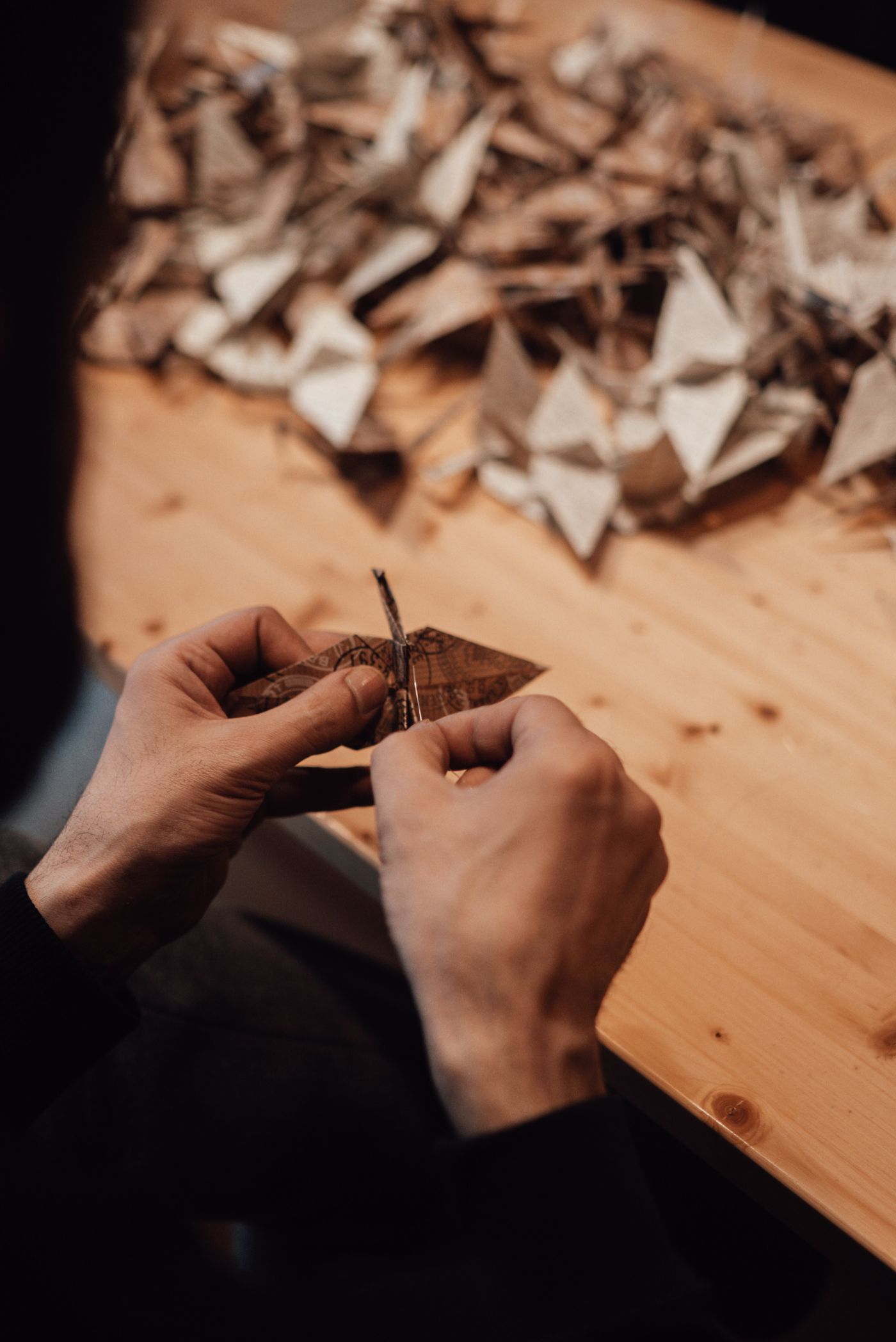
Use a display suited to the actual model and household rather than copying a hanging arrangement from a photograph. Keep attachments, small pieces, and access appropriate to the people sharing the space. A collection of paper cranes shown here is an example of folded forms, not installation instructions.
The reusable fabric-wrapping activity offers another hands-on family project with a different material and purpose. Keep its supplies separate from the paper models so the next session begins with the materials it actually needs rather than a general craft bundle nobody wants to sort.

Put the shared surface back into service
Collect reusable paper and remaining supplies, returning each to an identified place. Separate scraps from complete prepared sheets so the next person does not have to inspect every folded corner. Handle any tools appropriately and leave the work surface ready for its ordinary use.
For a shared table, the multipurpose-table guide can help make that return predictable. Keep a paused personal project in appropriate containment only if it has a real next step and a suitable destination. A family session should not leave someone else responsible for an indefinite pile of paper experiments.
If the household enjoyed the activity, repeat the same fold before buying another kit. Familiarity can let people notice their own progress without changing the task every time. The worthwhile result is a manageable shared experience in which each participant had room to see, ask, try, stop, and decide what happens to the object they made.
Explore related decisions in our Family Home hub.
Sources and editorial scope
Editorial research checked October 21, 2026. Published trend reports are context for these editorial applications, not verified live keyword rankings. Practical household guidance; photographs do not document a tested household or authenticate pictured materials.