Paper clutter feels bigger in a small apartment because there are fewer places for it to disappear. A week of mail on the dining table can make the whole room feel unfinished. School forms migrate to the kitchen counter. Receipts collect near the door. A bill gets placed somewhere “safe” and then becomes surprisingly difficult to find.
The solution is not to create more places to store paper. It is to create fewer places where paper is allowed to stop.
A small-apartment paper system works best when it controls the path paper takes through your home: where it lands, how you decide what happens next, where active papers wait, and how quickly unnecessary paper leaves the apartment. For a related step-by-step approach, see Where to Store Important Documents in a Small Apartment.
Start With One Paper Landing Spot
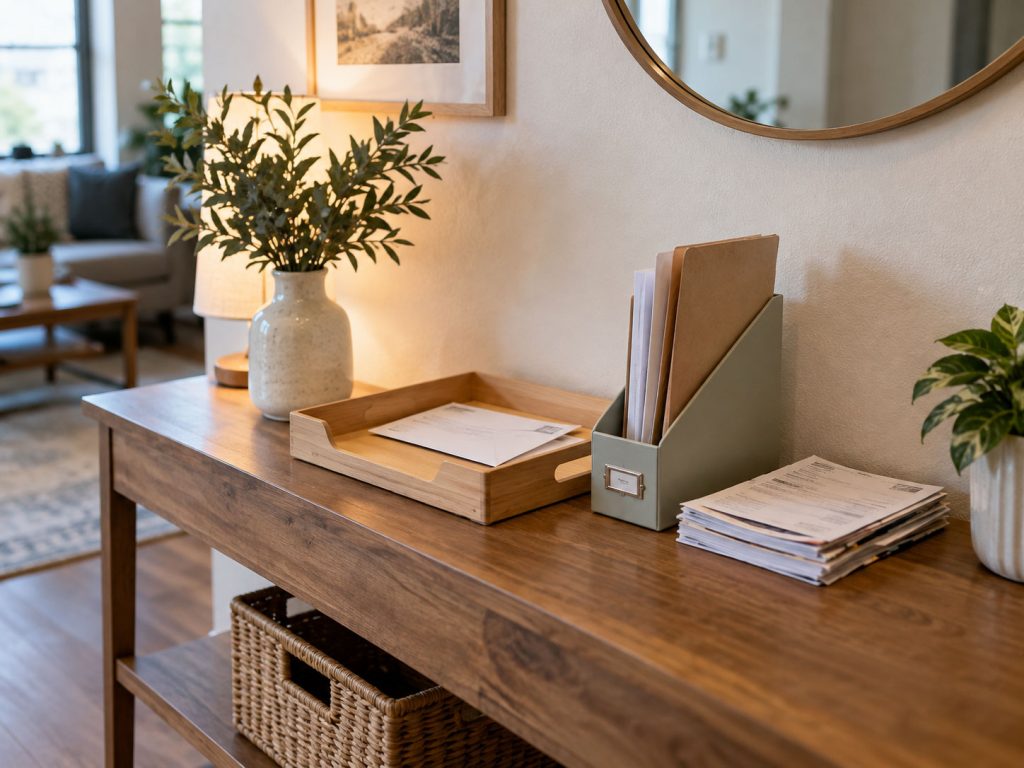
Choose one place where incoming paper is allowed to wait. Not one place in the kitchen, another by the front door, and a third beside the sofa. One place.
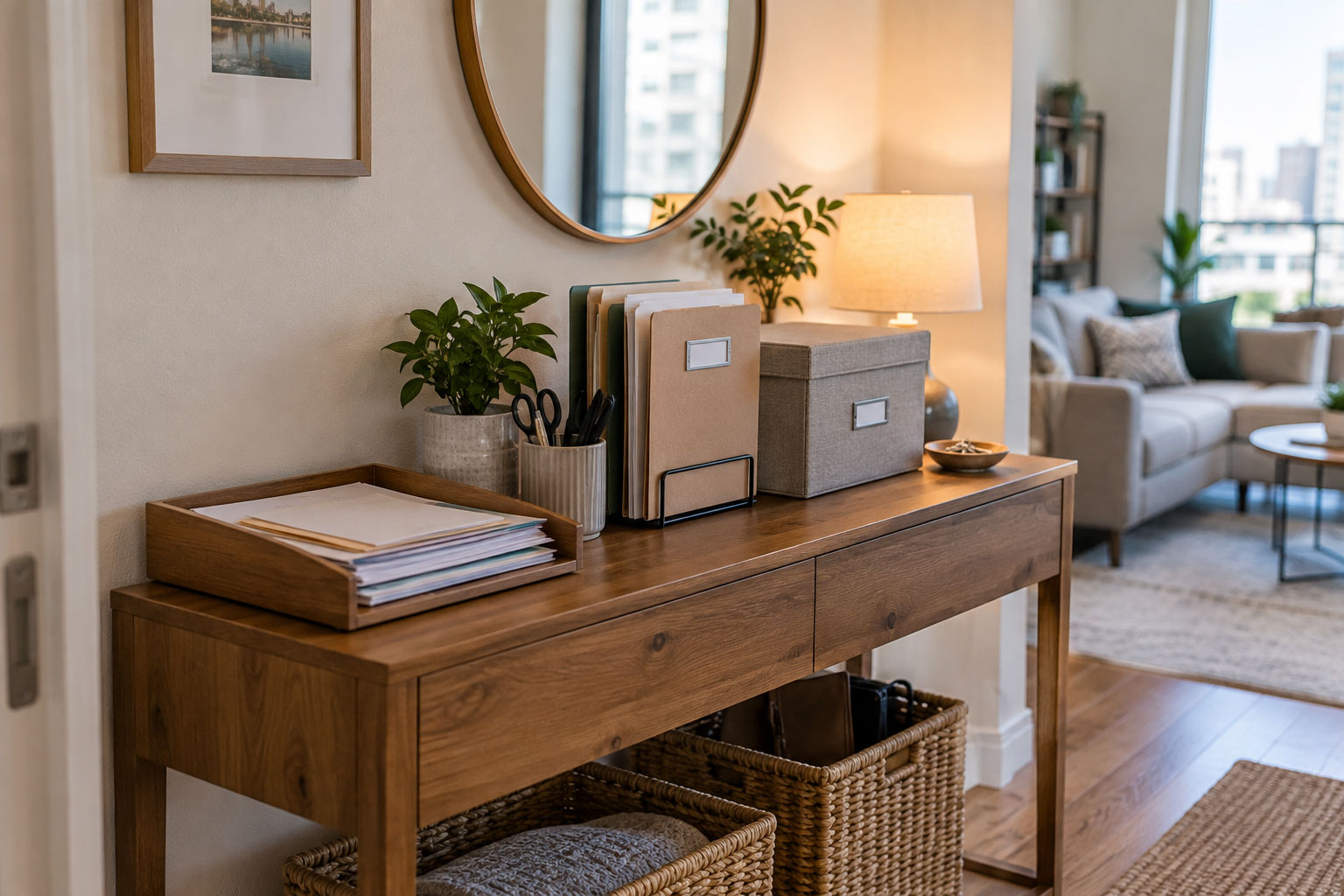
For a small apartment, that landing spot can be modest: a shallow tray on a console, a vertical file on a narrow shelf, or a slim wall pocket near the area where you naturally empty your hands.
The location matters more than the organizer. Put it close to the route paper already takes into your home. If you bring mail through the front door and sort backpacks in the entryway, placing the inbox in a bedroom closet may look tidy but will probably fail in daily use.
Keep the landing spot intentionally small. Its job is to hold unprocessed paper for a short time, not to become permanent storage.
Make Five Decisions Instead of Creating Twenty Categories
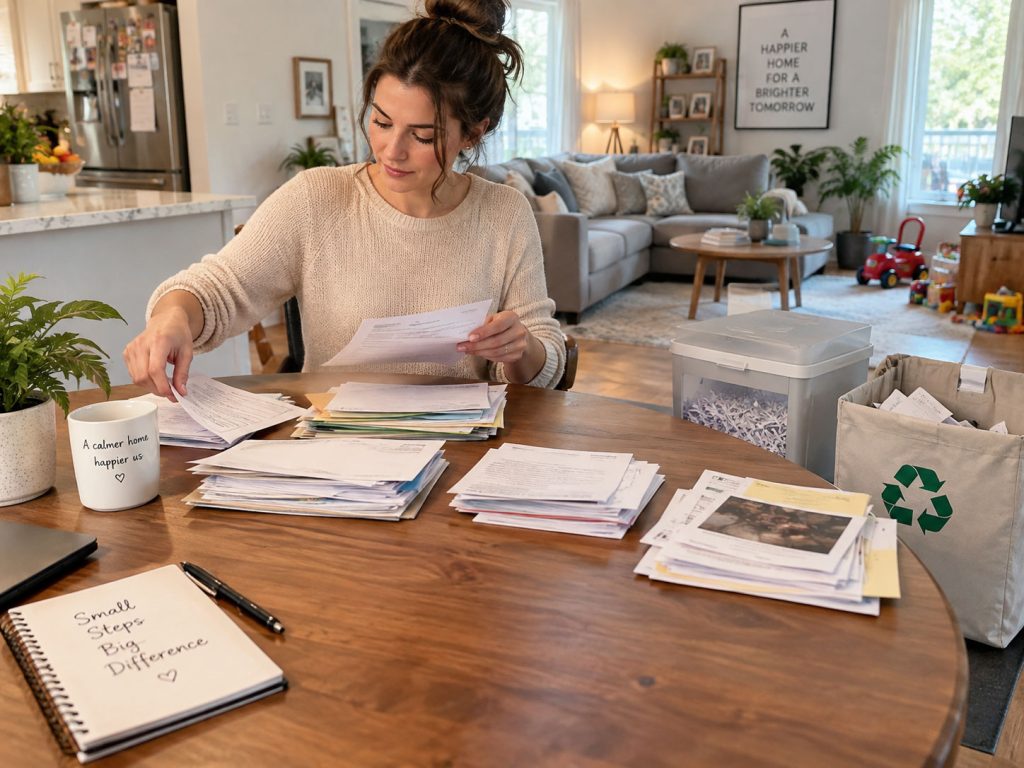
When paper enters the system, it only needs one next decision. A practical small-space setup can use five outcomes:
- Act: something requires a task, payment, signature, phone call, appointment, or response.
- File: the paper has a real reason to be kept for future reference.
- Shred: it can go, but it contains personal, financial, medical, or identifying information.
- Recycle: it has no sensitive information and no reason to stay.
- Relocate: it is sentimental, creative, or belongs to another household system rather than the paper archive.
This decision-based approach is useful in a small apartment because it stops you from building a complicated filing structure before you know whether a paper needs to stay at all.
A takeout menu you can find online does not need a folder. A school flyer for an event next Friday does not need permanent filing. A birthday card you want to keep may belong with keepsakes rather than insurance and tax records.
Keep an Action Folder for Papers That Still Need Something From You
The most dangerous paper pile is often not the largest one. It is the pile that mixes finished papers with unfinished tasks. If you are working on the same space, How to Organize Important Family Papers in a Small Home covers the next decision in more detail.
Create one visible action folder for anything that still requires attention. Depending on your household, this may include a bill to review, a permission slip to sign, a medical form to complete, a receipt for a possible return, or a document to bring to an appointment.
If your household produces a lot of action paper, divide this into only two or three sections, such as:
- Do: forms, calls, payments, or tasks.
- Waiting: paperwork you have submitted but still need to track.
- This Week: documents tied to a near-term date or appointment.
Resist adding more sections unless you consistently need them. In a small apartment, every additional category adds another decision and another place for paper to hide.
Separate Daily Paper From Permanent Records
Your everyday paper station should not hold birth certificates, vehicle titles, tax archives, passports, or other difficult-to-replace records.
Those documents need a separate, more secure storage system. Daily paper, by contrast, needs to be easy to process and easy to remove.
This separation protects important records and keeps your active paper area from growing into a general household archive.
A compact apartment might have a slim tray and action folder near the entryway while long-term documents live in one secure file box or document container elsewhere. The two systems serve different purposes and do not need to occupy the same furniture.
Give Reference Papers a Physical Limit
Some paper deserves to stay but does not need permanent, protected storage. This might include current insurance information, active warranty papers, selected household records, or short-term financial documents.
Give these papers a fixed amount of space, such as one compact file box.
The physical limit is useful because it turns an overflowing container into a signal. When the box becomes crowded, review it before buying another one. You may also find How to Downsize Before Moving Into a Smaller Home useful for a closely related small-home problem.
You may find expired policies, outdated versions, closed-account paperwork, duplicate statements, or documents you can now access securely online.
The goal is not to force everything into the smallest possible container. It is to prevent storage capacity from quietly expanding every time you postpone a decision.
Do Not Keep Every Paper for the Same Length of Time
One reason paper systems grow is the assumption that anything remotely official should be kept for seven years. That is too broad to be useful.
The appropriate retention period depends on the document and why you need it. Current IRS guidance, for example, says tax record retention depends on the event or item the record supports, and longer periods can apply in specific circumstances.
The Federal Trade Commission also distinguishes among records that may only need short-term retention, documents that should be kept while you own an item or property, and vital records that should be preserved much longer.
Before discarding tax, legal, insurance, property, or other consequential documents, check the current guidance that applies to that specific record. Your insurer, lender, employer, attorney, tax professional, or another relevant organization may have requirements beyond a general household rule.
Reduce Paper Before It Enters the Apartment
The easiest sheet of paper to organize is the one that never enters your home.
When it makes sense for your household, switch routine statements and notices to secure electronic delivery. Remove yourself from mailing lists you no longer value. Decline unnecessary receipts when a reliable digital version is available. Cancel catalogs you never use.
This does not mean every paper document should become digital. Original identity, legal, property, or other important records may still need physical storage. The goal is simply to reduce repetitive paper that arrives automatically and has little reason to occupy limited apartment space.
Digital paperwork can become clutter too, so keep electronic records in a simple folder structure you can actually search and maintain.
Be Careful With Papers That Contain Personal Information
Not every discarded paper belongs directly in the recycling bin.
The Federal Trade Commission recommends keeping documents with personal or financial information in a safe place and shredding sensitive records before throwing them away.
That includes papers containing information such as account numbers, Social Security numbers, medical details, financial information, or other identifying data that could be misused.
If you do not own a shredder, avoid creating a huge permanent “shred someday” pile. Use a small closed container and process it regularly, or look for a secure local shredding option when necessary.
Give School and Kid Papers Their Own Exit Route
Families with children often have a second paper stream that moves faster than ordinary mail: school notices, artwork, permission forms, calendars, worksheets, and activity information.
Do not automatically file all of it with household records.
Time-sensitive school papers can move through the action folder. Reference information can stay only as long as it remains useful. Artwork or meaningful schoolwork can move to a separate keepsake system rather than competing for space in the household file box.
This prevents children’s paper from turning one small paper station into a mixture of tasks, records, memories, and recycling.
Use a Weekly Paper Reset
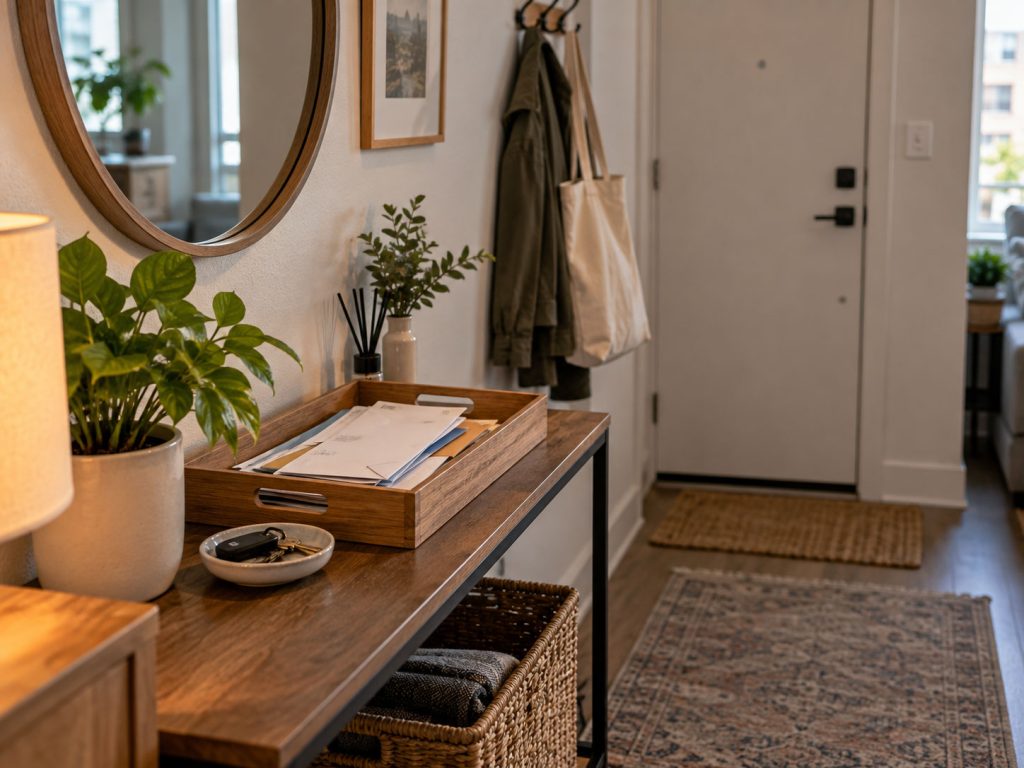
A small paper system stays tidy because it gets emptied, not because it has enough capacity to hold everything indefinitely.
Once a week, spend a few minutes processing the landing tray and action folder.
- Recycle obvious paper you no longer need.
- Shred sensitive documents that are ready to leave.
- Complete or schedule action items.
- Move true reference records into the compact filing system.
- Relocate sentimental paper to its proper keepsake area.
Then stop. You do not need to reorganize every household record each week.
A short reset works because it deals with the paper that is actively moving through the apartment before it becomes part of the background.
What to Do When the System Starts Overflowing
If the paper landing spot fills faster than you can process it, do not immediately buy a larger organizer.
Look for the point where the flow is breaking.
If the inbox is overflowing, paper may not be getting processed often enough. If the action folder is growing, tasks may need deadlines instead of storage. If the reference box is full, old records may need review. If sentimental papers keep entering the system, they may need their own home.
The container is rarely the real problem. An overflowing container is usually feedback that one decision is being postponed.
A Small Apartment Paper System Can Stay Very Small
You do not need a dedicated office, a large filing cabinet, or a wall-sized command center to keep household paper under control. You may also find A Home Filing System for Families With No Home Office useful for a closely related small-home problem.
A practical setup can be as simple as one incoming tray, one action folder, one compact reference box, and one separate secure place for important records.
The most important part is the movement between them.
Paper comes in. You make a decision. The paper moves forward or leaves the apartment.
When that rhythm becomes normal, the dining table no longer has to function as a filing cabinet, and your paper system can remain small enough to fit the home you actually have.
Sources
- I Was Drowning in Paper Clutter — This Decluttering Trick Got It Under Control — Apartment Therapy — https://www.apartmenttherapy.com/how-to-declutter-paper-clutter-37688140
- Paper Clutter Is Unruly, but Here’s How to Fix It — Apartment Therapy — https://www.apartmenttherapy.com/how-to-organize-paper-clutter-37504081
- Protecting your personal information: Which documents to keep and which to shred — Federal Trade Commission — https://consumer.ftc.gov/consumer-alerts/2025/06/protecting-your-personal-information-which-documents-keep-which-shred
- How long should I keep records? — Internal Revenue Service — https://www.irs.gov/businesses/small-businesses-self-employed/how-long-should-i-keep-records