You have one bedroom closet, a narrow entry cabinet, two kitchen drawers that are already full, and no home office. Where exactly are birth certificates, passports, insurance papers, tax records, vehicle documents, and medical records supposed to go? For a related step-by-step approach, see A Home Filing System for Families With No Home Office.
The answer is not “put everything in one fireproof box.” Different documents need different levels of access and protection.
A passport you may need for an unexpected trip has a different storage requirement from a property deed you rarely touch. A current insurance policy should be easier to reach than an original birth certificate. A digital copy can be extremely useful during an emergency, but it may not replace the original document when an agency requires one. You may also find How to Keep a Small Kitchen Clean When You Cook Every Day useful for a closely related small-home problem.
For a small apartment, the best approach is to create a document storage map: a small number of intentional locations, each with a specific job.
Use Three Questions to Decide Where a Document Belongs
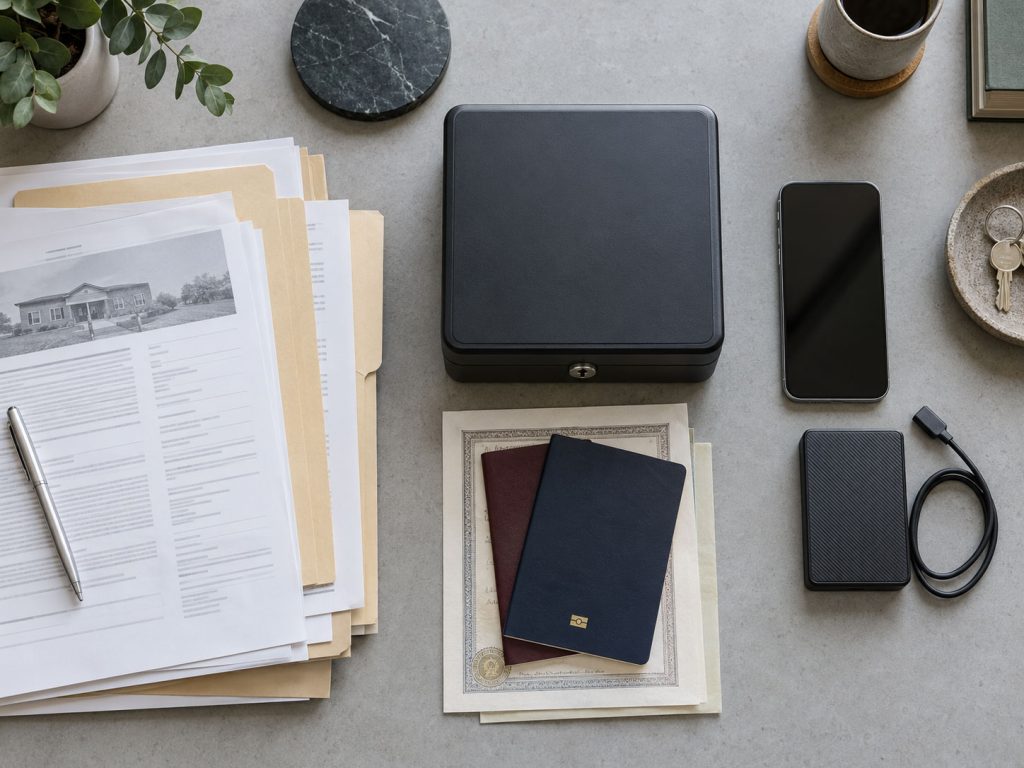
Before choosing a container, ask three questions about the document itself.
1. How quickly might you need it?
Some records may be needed with little notice. A passport, current health insurance information, lease, vehicle insurance document, or medical directive may be more useful if an authorized family member can reach it without waiting for a bank to open or searching through long-term storage.
2. How difficult would it be to replace?
Birth certificates, property deeds, vehicle titles, citizenship records, and similar originals may take time and formal procedures to replace. That makes protection more important than convenience alone.
3. How sensitive is the information?
Documents containing Social Security numbers, financial account information, medical details, or identity information should not sit in an open basket beside ordinary mail.
Once you answer those three questions, the right storage location becomes much clearer.
| Document characteristic | Best starting point |
|---|---|
| Needed regularly and replaceable | Accessible household file |
| Sensitive and difficult to replace | Protected home storage or appropriate off-site storage |
| Rarely needed and difficult to replace | Consider secure off-site storage |
| Useful during an emergency | Secure home access plus protected backup copies |
| Digital reference is sufficient | Protected digital storage |
Destination 1: The Accessible Household File
This is where important but ordinary reference records can live.
In a small apartment, it may be a compact hanging-file box inside a closet, a closed cabinet, or one dedicated section of a storage unit.
Good candidates may include:
- current insurance information;
- current lease or rental paperwork;
- selected medical records;
- tax files that still need to be retained;
- vehicle maintenance or financing records;
- major appliance or warranty information;
- important school records;
- household financial paperwork you genuinely need in physical form.
The important word is accessible, not visible.
The file box does not need to stay beside the sofa. It simply needs to be somewhere an authorized adult can reach without dismantling the apartment.
A closet shelf around waist or chest height often works better than the very top shelf. If you can pull the container out, use it for five minutes, and put it back without moving other storage, the location is practical.
Destination 2: Protected Storage at Home
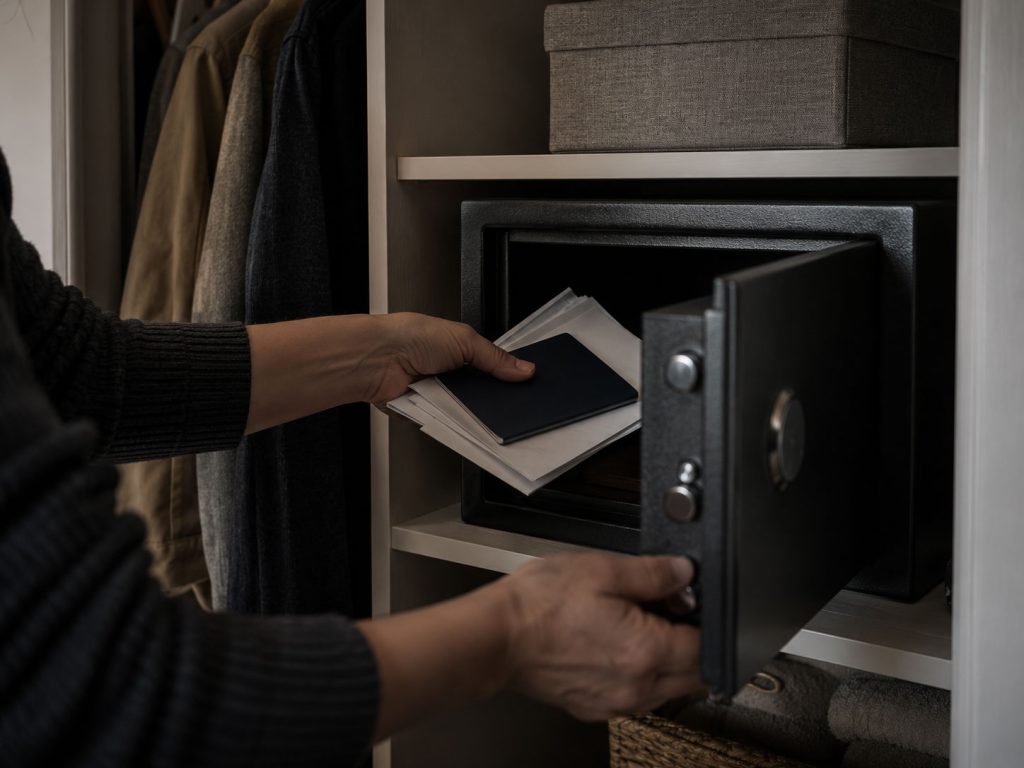
A small group of documents deserves more protection than ordinary reference files.
The Federal Trade Commission advises keeping important documents and records containing sensitive personal information in a safe place. That can include birth certificates, Social Security cards, valid passports, citizenship documents, marriage or divorce records, wills, powers of attorney, and other significant records.
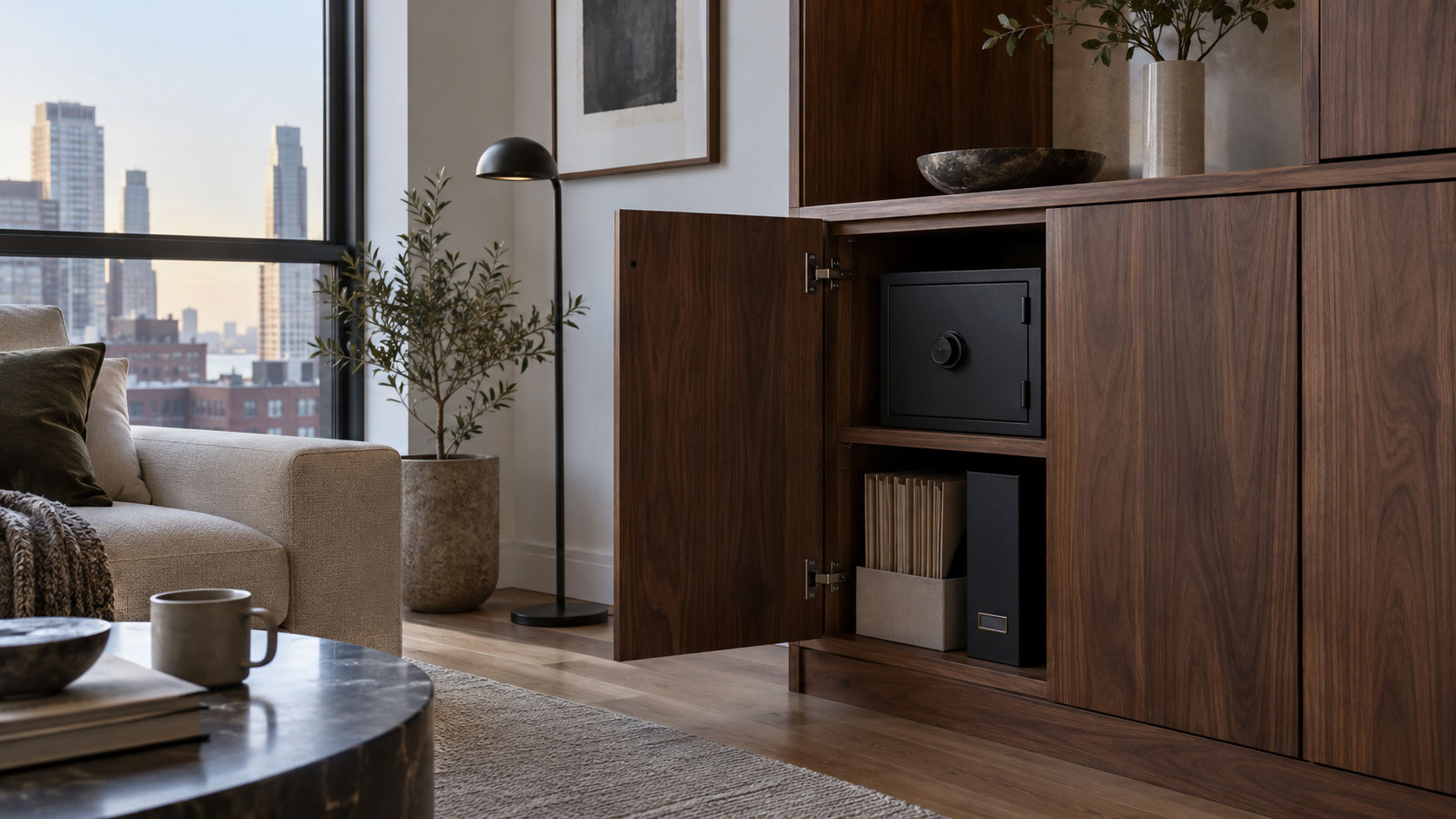
For an apartment, a compact lockable document safe or protected file box may be more realistic than a large floor safe.
When evaluating home storage, look beyond the word “safe.” Consider what you are actually trying to protect against:
- casual access;
- theft;
- fire;
- water;
- documents being misplaced during a move;
- children handling sensitive records.
A locking metal box may restrict casual access but offer little fire protection. A fire-resistant container may not automatically be waterproof. A heavy safe may offer more security but be difficult for a renter to place or move.
Choose based on the risk that matters to your household rather than assuming every protected container provides the same protection.
Where Should a Home Document Safe Physically Go?
In a small apartment, the placement of protected storage can matter as much as the container.
A good location is discreet, dry, reasonably accessible to authorized adults, and away from everyday household traffic.
Possible locations include:
- inside a bedroom closet;
- inside a closed wardrobe;
- within a secure cabinet away from plumbing;
- on a sturdy shelf that can support the container safely.
Avoid treating “hidden” as the only goal. A safe that is buried behind seasonal storage and impossible to reach quickly may create a new problem.
Likewise, avoid locations with obvious moisture risk. Under a bathroom or kitchen sink may seem private, but plumbing leaks and important documents are a poor combination. A laundry area can also expose papers to moisture. If flooding is a concern where you live, avoid keeping critical documents directly on the floor.
Destination 3: Off-Site Storage for Rarely Used Originals
Some documents are both difficult to replace and rarely needed. Those may be candidates for a safe deposit box or another appropriate secure off-site location.
FDIC consumer guidance identifies documents such as birth certificates, property deeds, and vehicle titles as examples that may be suitable for a safe deposit box when frequent access is not required.
But off-site storage introduces an important tradeoff: access.
Do not automatically put every valuable document in a bank box.
The FDIC specifically warns against storing documents you may need quickly when the bank is closed. Passports and certain medical or legal directives are examples where home access may make more sense.
Before using a safe deposit box, consider:
- how often you need the document;
- whether another authorized person needs access;
- what happens if you need the document outside bank hours;
- the bank’s rental agreement and access rules;
- applicable state rules if the box owner dies;
- whether the contents need additional water protection.
Safe deposit box contents are also not the same as money held in an FDIC-insured deposit account. Do not assume the contents themselves are federally insured against loss or damage.
Destination 4: Secure Digital Backup
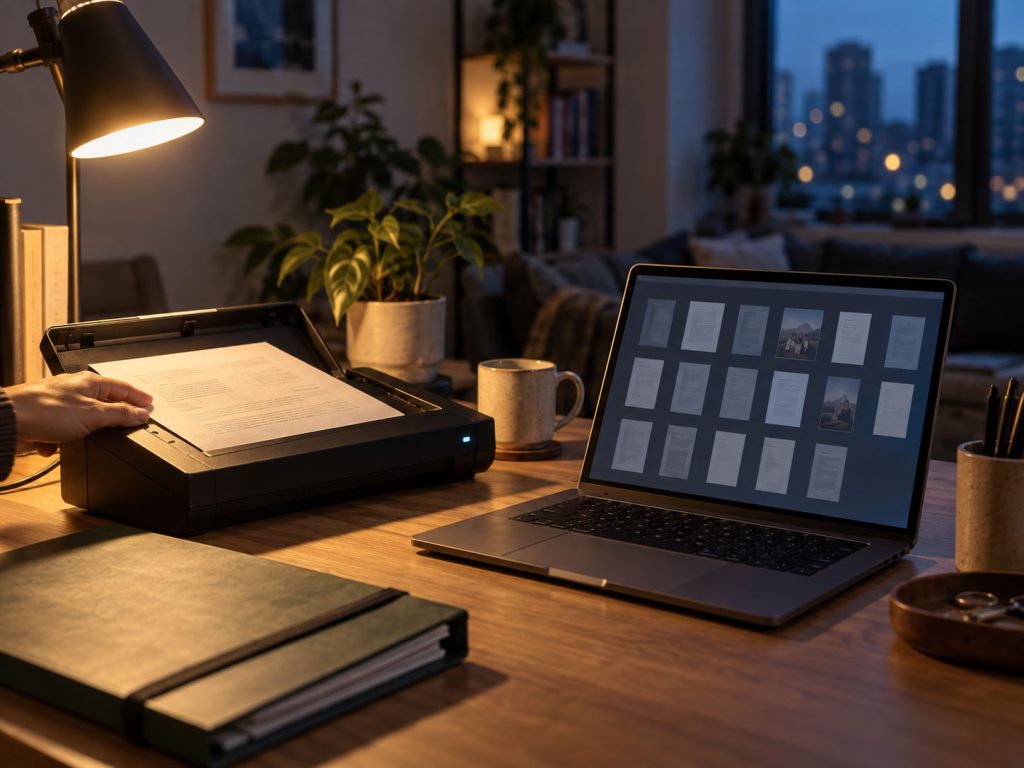
A digital copy can solve a different problem from physical storage.
It gives you access to information if the paper original is damaged, inaccessible, or somewhere else.
FDIC disaster-preparedness guidance recommends considering digital copies of important records and protecting sensitive files with encryption and device security.
You do not need to scan every paper in your apartment.
Start with documents that would be particularly useful if you suddenly could not access your home:
- insurance policies and contact information;
- identification documents;
- lease or property information;
- vehicle information;
- selected financial records;
- critical medical information;
- important legal documents;
- an inventory of key accounts and emergency contacts.
Use clear file names rather than random scan numbers.
For example:
Renters Insurance – 2026
Passport Copy – Alex Morgan – Exp 2031
Vehicle Title Copy – Family Car
Digital storage should be protected. Sensitive documents should not sit unencrypted in a shared download folder, on a public computer, or in an account protected by a weak password.
Destination 5: An Emergency Copy Set
An emergency copy set is not the same thing as your permanent document archive.
Its purpose is to help the household recover essential information if you need to leave home quickly or cannot access your main records.
Ready.gov’s Emergency Financial First Aid Kit encourages households to collect and organize critical identification, financial, insurance, medical, and household information before a disaster occurs.
Your emergency set might contain copies or records of:
- important identification information;
- insurance policy numbers and contact details;
- lease or housing information;
- emergency medical information;
- key financial institution contact information;
- important family contact details.
Do not make a portable emergency folder into a second complete identity archive. A bag that might be lost or stolen should not automatically contain every original identity document or sensitive number your family owns.
The goal is useful redundancy with thoughtful security.
A Document-by-Document Storage Map
There is no single storage location that is right for every household, but the following examples show how to apply the framework.
Birth certificates
These are difficult-to-replace vital records and contain sensitive identity information. They deserve protected storage. If you choose off-site storage, keep accessibility in mind and maintain an appropriate secure copy for reference.
Social Security cards
These should not live in a wallet or everyday file box. Store them securely and avoid carrying them routinely unless there is a specific reason to do so.
Passports
Passports require strong protection but may also be needed on short notice. FDIC guidance specifically notes that a safe deposit box may be inconvenient for something you could need quickly, making secure home storage worth considering.
Lease documents
Your current lease should be reasonably accessible at home because you may need to check terms, contact information, renewal dates, or proof of residence. A protected digital copy is useful too.
Insurance policies
Keep current information accessible and maintain a secure backup. During an emergency, policy numbers and contact details may be more immediately useful than a thick packet of printed policy language.
Tax records
Store retained tax records together by year in your household file system. The correct retention period depends on the record and circumstances, so do not discard tax documents solely because a generic number of years has passed.
Vehicle titles
A vehicle title is an ownership document you normally do not need every week. It may justify more protected home storage or appropriate off-site storage rather than the everyday vehicle folder.
Medical records
Separate essential medical information from ordinary paperwork. Current information that may be needed quickly should be accessible to the appropriate family members, while especially sensitive records require appropriate privacy protection.
Wills and powers of attorney
These require more thought than simply choosing the “safest” container. Access after incapacity or death matters. The FTC advises consulting an attorney about original wills, while FDIC guidance warns that certain documents needed quickly may not be ideal candidates for a safe deposit box. Follow the advice of the professional who prepared your documents and applicable state law.
Places That Look Convenient but Usually Are Not
Small apartments encourage creative storage, but some empty spaces are poor homes for important documents.
The junk drawer
It feels convenient until a birth certificate is underneath batteries, takeout menus, and old keys.
An open entryway basket
Useful for incoming mail, but inappropriate for long-term sensitive records in a high-traffic area.
Under the sink
Privacy does not compensate for plumbing risk.
The bathroom
Regular humidity makes it a poor document-storage environment.
Loose under-bed storage
It may work for ordinary household items, but critical papers stored directly near floor level are more vulnerable to water and accidental damage.
The very back of deep storage
A document that is technically safe but practically inaccessible will often cause people to create duplicate piles elsewhere.
Do Not Tell Only One Person Where Everything Is
A document system should not depend entirely on one family member’s memory.
At least one other trusted adult should understand:
- where the household file is;
- where protected originals are stored;
- how authorized digital backups can be accessed;
- whether any documents are kept off-site;
- who to contact about important legal or financial records.
You do not need to post passwords or safe combinations on the refrigerator. The goal is to avoid creating a system that becomes inaccessible when the person who designed it is unavailable. For a related step-by-step approach, see Small Apartment Paper Organization: A Simple System That Stays Tidy.
Use One Small Apartment Rule: Protect First, Then Minimize
Small-space organization often emphasizes owning less, but important documents are not an area where minimalism should override legal, financial, or practical requirements.
Do not shred a necessary original just because the file box looks crowded.
Instead, minimize in the right order:
- Remove obvious duplicates.
- Replace outdated versions when appropriate.
- Stop printing records that do not need paper copies.
- Move rarely used originals to more appropriate protected storage.
- Digitize useful reference copies securely.
- Review retention requirements before discarding consequential records.
The result should be a smaller system because unnecessary paper has left, not because necessary records were discarded.
Your Apartment Only Needs a Few Document Destinations
You do not need a filing room.
You need a map.
Ordinary retained records go in one compact household file. Sensitive originals that require home access go in protected home storage. Rarely needed documents may justify appropriate off-site storage. Selected records get secure digital backups. Emergency information is organized so it can still be accessed if your normal system is unavailable.
Once those destinations are clear, deciding where a document belongs becomes much easier.
The goal is not to hide important papers in the smallest possible space. It is to make them secure enough, accessible enough, and predictable enough that your family can find the right document when it actually matters. For a related step-by-step approach, see How to Build a Home Binder System That Actually Works in a Small Space.
Sources
- Protecting your personal information: Which documents to keep and which to shred — Federal Trade Commission — https://consumer.ftc.gov/consumer-alerts/2025/06/protecting-your-personal-information-which-documents-keep-which-shred
- How To Organize Your Important Papers Before a Disaster Strikes — Federal Trade Commission — https://consumer.ftc.gov/articles/how-organize-your-important-papers-disaster-strikes
- Emergency Financial First Aid Kit — Ready.gov — https://www.ready.gov/sites/default/files/2020-03/ready_emergency-financial-first-aid-toolkit-large-print.pdf
- Five Things to Know About Safe Deposit Boxes, Home Safes and Your Valuables — Federal Deposit Insurance Corporation — https://www.fdic.gov/consumer-resource-center/five-things-know-about-safe-deposit-boxes-home-safes-and-your-valuables
- Preparing Your Finances for an Unanticipated Disaster — Federal Deposit Insurance Corporation — https://www.fdic.gov/consumer-resource-center/2025-08/preparing-your-finances-unanticipated-disaster