Disclosure: As an Amazon Associate, Small Home Rhythm may earn from qualifying purchases. Price, stock and product variants can change.
A 36-pair label sounds like the end of floor-level shoe clutter. The Whitmor over-door rack turns a closet door into vertical storage, but its nominal capacity does not tell you how the door swings, what shoe shapes fit, or whether the hooks clear your frame.
This is a research-based review of the named 36 Pair Over The Door Shoe Organizer, white. We have not used, timed or durability-tested it. The practical checks below are designed to help you compare the current listing with your own room rather than treating a marketing photograph as proof of fit.
Measure the moving door
Measure door thickness, the gap above it, the clear width between hinges and knob, and the space behind the door when it opens. Add the rack’s depth plus the toe of your widest shoe; an empty rack is a poor fit test. Fold a cardboard spacer to the projected depth and close the door slowly. If the hook scrapes the frame or the rack hits a shelf, stop. Rental doors may be hollow-core, and hardware suitability should be checked before loading.
Capacity is not the same as usable pairs
The listing describes 12 tiers for up to 36 pairs, but boots, chunky sneakers and children’s footwear occupy different space. Count the pairs you would really put on a bar, then group them by height and weight. If one tier blocks the one below, leave a gap. Avoid forcing heels into an unstable angle or storing muddy shoes above clean clothes. A mixed household may do better with half the capacity and easier visibility.

Balance the load across the rack
Place heavier pairs lower and distribute weight evenly from left to right. Check the rack’s current manufacturer load directions; do not assume the door can carry the sum of 36 heavy pairs. Open the door a few times while empty, then partially filled, listening for rattling and checking the hinge side for strain. A door rack can make a narrow passage feel crowded if shoes project into it. The rack should not obstruct a room exit. You may also find Munchkin Super Scoop Review: Can a Bath Toy Net Dry in a Small Family Bathroom? useful for a closely related small-home problem.

The real retrieval test
If the door must be fully open to reach a pair, that may be inconvenient in a narrow bedroom. Test a weekday routine: can a child find, remove and return everyday shoes without pulling the rack or scraping a wall? Give frequently worn pairs the easiest levels and move seasonal shoes elsewhere. If a shoe falls off while the door closes, the organization system will not survive the first busy week.
Clean the door and shoes
Dirt from soles can transfer to the back of a white rack, door paint and clothes nearby. Clean and dry shoes before storage, then wipe bars and the door behind them. Inspect hooks and screws or connectors for looseness. The rack makes floor cleaning easier only when you can still open the closet and reach the lower corners. If door clearance is marginal, a narrow floor rack may be the more durable answer. If you are working on the same space, Fold vs. Hang Clothes in a Small Closet: Which Actually Saves More Space? covers the next decision in more detail.
A door is a moving wall
Unlike a closet shelf, a door rack moves several times daily. Shoes add depth on both the bedroom and closet sides of the swing depending on door orientation. Photograph the open door and identify any light switch, mirror, hamper or shelf it approaches. Check the top frame clearance with a strip of folded cardboard roughly as thick as the hook. If the door will not latch freely when the rack is installed, do not force the hinges or remove essential hardware. Distributing shoes across a rack only helps if the door continues to work quietly and safely. For the broader setup, How to Store Batteries, Light Bulbs, and Small Maintenance Supplies Safely is a useful next read.
Sort by shape before filling tiers
Put flats and lightweight sneakers together, then group high-tops, heels, boots and small children’s shoes. Decide which categories can sit securely on a bar without falling when the door moves. Label the accessible rows only if several people use the closet; labels may help children return their pairs. Save top tiers for rarely used light shoes and keep daily pairs at a comfortable reach. If the nominal capacity assumes tiny flats but your collection is bulky, plan for substantially fewer pairs. The rack is useful storage only when every stored shoe is stable and easy to retrieve. You may also find Brilliant Evolution Wireless Puck Lights Review: Useful for a Dark Small Closet? useful for a closely related small-home problem.
Questions to settle before ordering
Will this fit the room as it is today?
Start with the limiting check: measure door thickness and top clearance. Then account for the space needed to open, remove, wash and put away the item. In a small home, usable clearance is more revealing than the outside dimension alone. If the object or surrounding furniture moves, measure at both ends of that movement. Write down the number and compare it with the selected product variation, not a photograph of a similar model.
Will the routine still work when the room is busy?
Imagine the moment when a large over-door shoe rack on a closet door is needed and another person is using the room. Try the sequence with a paper placeholder: reach, use, clean and return. Look for a point where an extra movement blocks a doorway or requires another item to move first. If the item must be relocated after every use, plan a permanent home for it. A convenient purchase should reduce repeated friction rather than create a new reset job.
How should I compare variants and claims?
Match the Amazon ASIN to the named model, then compare dimensions, material, included pieces and current instructions. Manufacturer claims are starting points for a fit decision, not results of our own testing. Reviews may help identify questions to ask, but a customer’s room and usage can differ from yours. Check return terms and the seller at checkout. If a key specification is unclear, contact the manufacturer before ordering rather than assuming another color or size is identical.
Who should buy it—and who should pass?
Consider it if: A sturdy closet door with proven clearance and a collection of mostly low-profile shoes. The value lies in solving the daily placement problem for a large over-door shoe rack on a closet door. Try to identify the exact point in your routine when you would reach for it, and the precise space it will occupy once put away. A product that works only after clearing a surface every time is unlikely to remain useful.
Skip it if: A shallow closet, tight door swing or primarily tall boots and bulky sneakers. Do the small measurement and routine test before checkout. Amazon variations can have different materials, colors and dimensions, so verify the selected version on the page immediately before purchasing. We do not assume the current price, warranty or availability.
Before-you-buy fit check
- Measure door thickness and top clearance. Write down the result rather than estimating from a photograph.
- Mock up depth with the bulkiest shoe. Write down the result rather than estimating from a photograph.
- Count usable tiers, not advertised pairs. Write down the result rather than estimating from a photograph.
- Check door hinges and mounting instructions. Write down the result rather than estimating from a photograph.
Once those checks are done, look at the product photographs and the installation or care instructions for the exact variation. Include the object around the product in your measurement: a swinging door, a drawer opening, a child’s reach or a plug and cable can change the fit. If one necessary dimension is missing, ask the manufacturer or choose a product with published specifications. A reversible paper or cardboard mock-up is cheaper than a return.
What could you use instead?
A short floor rack, under-bed boxes or a small set of shoe shelves may fit awkward footwear better. The right comparison is the full routine: how many steps it takes to get the item out, use it, clean it and return it. Count surfaces you gain as well as any shelf, wall or floor area the new item consumes. If a tool you already own covers the occasional job, keep the new purchase on a wish list until the problem repeats several times.
Amazon product and current listing
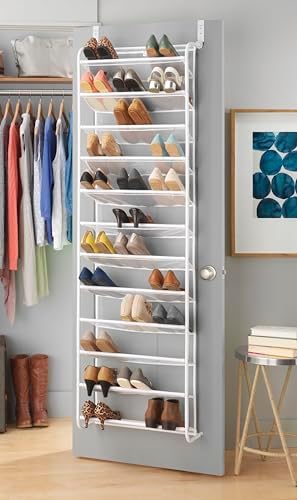
Whitmor 36 Pair Over The Door Shoe Organizer, white — View this exact model on Amazon. Check the selected color, variant, seller and latest manufacturer instructions; the image illustrates the listed item and does not document a hands-on test.
Before placing an order, open the affiliate link and compare the product title and ASIN B09BP3BJXQ with the specifications that mattered in your room. If the listing switches to a different variation, stop and recheck the measurements and materials. Reviews can surface recurring complaints, but treat them as individual experiences and weigh them against the published product details.
Final verdict for a small home
A sturdy closet door with proven clearance and a collection of mostly low-profile shoes. A short floor rack, under-bed boxes or a small set of shoe shelves may fit awkward footwear better. Keep the decision tied to the one friction point this item could remove; a larger capacity or an extra shelf is not useful if it makes the room harder to move through, clean or share. Revisit the fit checklist with the current listing before buying.
Explore more Buying Guides and the Closets Storage room guide for related small-home ideas.
Sources
- Amazon product listing for 36 Pair Over The Door Shoe Organizer, white — https://www.amazon.com/dp/B09BP3BJXQ