Disclosure: As an Amazon Associate, Small Home Rhythm may earn from qualifying purchases. Price, stock and product variants can change.
Keys disappear easily when an entryway has no counter. Yamazaki’s white magnetic rack adds hooks and a shallow tray to a steel door or other compatible surface. The magnetic mounting makes it appealing for renters, but it works only on a surface that holds it securely under the weight of everyday items. If you are working on the same space, A Rainy-Day Entryway System for Wet Shoes, Umbrellas, Coats, and Kids’ Gear covers the next decision in more detail.
This is a research-based review of the named Magnetic Key Rack with Tray, white. We have not used, timed or durability-tested it. The practical checks below are designed to help you compare the current listing with your own room rather than treating a marketing photograph as proof of fit.
Test the exact door surface
A refrigerator magnet that holds a note is an initial clue, not proof that a loaded rack will stay put. Test a magnet on the intended part of the door, including painted panels and the area near the latch. Some stainless steel surfaces are not magnetic and many apartment doors have nonmagnetic skins. Check the manufacturer’s mounting directions and optional fasteners for the exact version sold. Never rely on a magnetic key holder for an emergency key that must remain accessible if the rack falls. You may also find Whitmor 36-Pair Over-the-Door Shoe Rack Review: Too Much Rack for a Small Closet? useful for a closely related small-home problem.

Map the door swing and reach
Stand where you normally enter with bags in hand. The rack should be reachable without stepping around the open door or brushing a wall with your shoulder. Place a paper rectangle the size of the tray on the door and open it fully. Make sure hanging keys cannot scratch the frame, and children cannot catch straps on a low hook. On a shared doorway, consider who uses the keys and whether the tray is visible enough to build a habit.

Limit the tray to landing items
A tray is useful for a small fob or transit card; it becomes a clutter shelf when mail, coins and receipts pile up. Define one or two allowed items and empty it during a weekly entryway reset. Keep heavier wallets or sunglasses elsewhere if the maker’s load guidance does not support them. Put a tiny basket for outgoing papers on an existing shelf instead of asking the key rack to do every job. You may also find Sunday Reset vs. Nightly Prep vs. Morning Launch: What Keeps a School Week Running? useful for a closely related small-home problem.
Hooks and household routines
Separate household keys by user or purpose so a visitor does not grab the wrong ring. Hang the everyday set at hand height and move spare keys to a secure, designated place. If you regularly enter with groceries, rehearse the motion from bag to hook without setting food on the floor. A hook succeeds when it sits precisely where the action happens; even a well-designed rack gets ignored if it is on the far side of the doorway.
Care and security
Clean the contact surface and rack as directed before mounting; grit behind a magnet can mark a painted finish. Recheck adhesion and alignment periodically after heavy door slams. Avoid showing labeled house keys through a door window or leaving sensitive information in the tray. If you are renting, inspect the paint finish before applying any supplied adhesive and confirm the removal method. Small storage should not compromise a smooth door closure or a secure lock.
Magnet strength in everyday use
Magnetic mounting removes a drilling step but adds uncertainty about the door material and surface. Test the proposed spot with an ordinary magnet and then check the manufacturer’s weight guidance for both hooks and tray. A thick paint layer, curved panel or accumulated grit may affect contact. Put the rack where the door closes gently; repeated slamming can challenge any mounted object. Do not hang a loaded bag or wet umbrella from a small key hook merely because it has unused space. If you cannot confirm safe support, use the appropriate supplied screws on a permitted surface or select a different organizer.
Design a real landing zone
The entryway routine begins before you close the door. Identify which hand carries groceries, which hand holds the keys and where the light switch sits. A rack at the wrong height may look orderly while being awkward to use. Pair it with a separate spot for shoes and mail, because the narrow tray cannot collect everything arriving home. If a child carries a school bag, give the bag a robust hook elsewhere and let the key rack do its one small job. Review the tray once a week so it remains a landing point rather than a shelf of abandoned coins. For the broader setup, Wall Hooks vs. Entryway Bench vs. Narrow Cabinet: What Earns Its Footprint? is a useful next read.
Questions to settle before ordering
Will this fit the room as it is today?
Start with the limiting check: test magnet strength at the exact mounting spot. Then account for the space needed to open, remove, wash and put away the item. In a small home, usable clearance is more revealing than the outside dimension alone. If the object or surrounding furniture moves, measure at both ends of that movement. Write down the number and compare it with the selected product variation, not a photograph of a similar model.
Will the routine still work when the room is busy?
Imagine the moment when keys and small items on a magnetic entry door is needed and another person is using the room. Try the sequence with a paper placeholder: reach, use, clean and return. Look for a point where an extra movement blocks a doorway or requires another item to move first. If the item must be relocated after every use, plan a permanent home for it. A convenient purchase should reduce repeated friction rather than create a new reset job.
How should I compare variants and claims?
Match the Amazon ASIN to the named model, then compare dimensions, material, included pieces and current instructions. Manufacturer claims are starting points for a fit decision, not results of our own testing. Reviews may help identify questions to ask, but a customer’s room and usage can differ from yours. Check return terms and the seller at checkout. If a key specification is unclear, contact the manufacturer before ordering rather than assuming another color or size is identical.
Who should buy it—and who should pass?
Consider it if: An entryway with a reliably magnetic door and a few light everyday key rings. The value lies in solving the daily placement problem for keys and small items on a magnetic entry door. Try to identify the exact point in your routine when you would reach for it, and the precise space it will occupy once put away. A product that works only after clearing a surface every time is unlikely to remain useful.
Skip it if: A nonmagnetic door or an entry where the door swings too close to a wall. Do the small measurement and routine test before checkout. Amazon variations can have different materials, colors and dimensions, so verify the selected version on the page immediately before purchasing. We do not assume the current price, warranty or availability.
Before-you-buy fit check
- Test magnet strength at the exact mounting spot. Write down the result rather than estimating from a photograph.
- Check full door swing and key reach. Write down the result rather than estimating from a photograph.
- Verify hardware and finish compatibility. Write down the result rather than estimating from a photograph.
- Set a limit for what belongs in the tray. Write down the result rather than estimating from a photograph.
Once those checks are done, look at the product photographs and the installation or care instructions for the exact variation. Include the object around the product in your measurement: a swinging door, a drawer opening, a child’s reach or a plug and cable can change the fit. If one necessary dimension is missing, ask the manufacturer or choose a product with published specifications. A reversible paper or cardboard mock-up is cheaper than a return.
What could you use instead?
A small removable hook on a suitable wall or a shallow bowl on an existing shelf may be more dependable. The right comparison is the full routine: how many steps it takes to get the item out, use it, clean it and return it. Count surfaces you gain as well as any shelf, wall or floor area the new item consumes. If a tool you already own covers the occasional job, keep the new purchase on a wish list until the problem repeats several times.
Amazon product and current listing
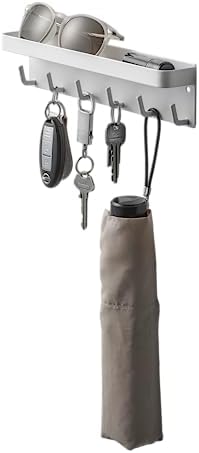
Yamazaki Home Magnetic Key Rack with Tray, white — View this exact model on Amazon. Check the selected color, variant, seller and latest manufacturer instructions; the image illustrates the listed item and does not document a hands-on test.
Before placing an order, open the affiliate link and compare the product title and ASIN B0154HAWHE with the specifications that mattered in your room. If the listing switches to a different variation, stop and recheck the measurements and materials. Reviews can surface recurring complaints, but treat them as individual experiences and weigh them against the published product details.
Final verdict for a small home
An entryway with a reliably magnetic door and a few light everyday key rings. A small removable hook on a suitable wall or a shallow bowl on an existing shelf may be more dependable. Keep the decision tied to the one friction point this item could remove; a larger capacity or an extra shelf is not useful if it makes the room harder to move through, clean or share. Revisit the fit checklist with the current listing before buying.
Explore more Buying Guides and the Entryway room guide for related small-home ideas.
Sources
- Amazon product listing for Magnetic Key Rack with Tray, white — https://www.amazon.com/dp/B0154HAWHE