Small entryways are easy to over-furnish because every problem seems to ask for a different object. Coats suggest hooks. Shoes suggest a bench. Mail suggests a console. Visual clutter suggests a cabinet. Before long, the first six feet inside the door contain more furniture than some bedrooms.
I would approach the entryway differently. Start with the repeated arrival pattern, then choose the smallest storage tool that interrupts that pattern effectively.
This comparison looks at three common solutions—wall hooks, an entryway bench, and a narrow cabinet—not as decor, but as pieces competing for some of the most valuable circulation space in a small home. For a related step-by-step approach, see How to Store Family Shoes in a Small Entryway Without Building a Shoe Wall.
Start with what actually lands by the door
For one week, notice what appears in the entry after people come home. Current shoes? Backpacks? Handbags? Coats? Keys? Packages? Sports gear? Dog leads? You may also find Sunday Reset vs. Nightly Prep vs. Morning Launch: What Keeps a School Week Running? useful for a closely related small-home problem.
Do not design around every category that could theoretically live there. Design around the categories that arrive repeatedly and create friction when they have no obvious destination.
If the problem is mostly keys, mail, and chargers rather than outerwear, the existing guide to a daily landing zone for keys, mail, chargers, and small clutter is a better starting point than adding large furniture.
Option 1: wall hooks
Wall hooks have an unusually strong space-to-function ratio. They occupy almost no floor area, keep soft items visible, and allow bags or coats to be returned in one motion.
Where hooks perform best
- coats and jackets,
- current handbags or backpacks,
- dog leads, umbrellas, hats,
- small households where floor width is extremely limited.
They are especially effective when the door opens directly into another room and a bench would narrow the main walking path.
Where hooks fail
Hooks have almost no natural capacity control. If you install twelve hooks, the household may eventually hang twelve categories plus multiple items per hook. The floor is clear, but the wall becomes a dense layer of fabric.
I prefer fewer hooks than the theoretical maximum. Active outerwear should rotate seasonally; backups belong elsewhere.
Option 2: the entryway bench
A bench can combine seating and low storage. That sounds efficient, and sometimes it is. The important question is whether anyone actually sits down to put on shoes.
If the answer is yes, a bench can replace both a chair and a shoe zone. If the answer is no, it may simply be a large horizontal surface that attracts bags and coats.
Where a bench earns its footprint
- young children need a stable place to sit while shoes go on,
- adults regularly sit to tie shoes,
- the lower area holds a tightly limited number of active pairs,
- the entry is wide enough that the bench does not narrow traffic.
For households battling shoe sprawl, the first question is still quantity. Stopping entryway shoes from spreading through a small home usually requires an active-pair limit even when a bench is present.
Option 3: the narrow cabinet
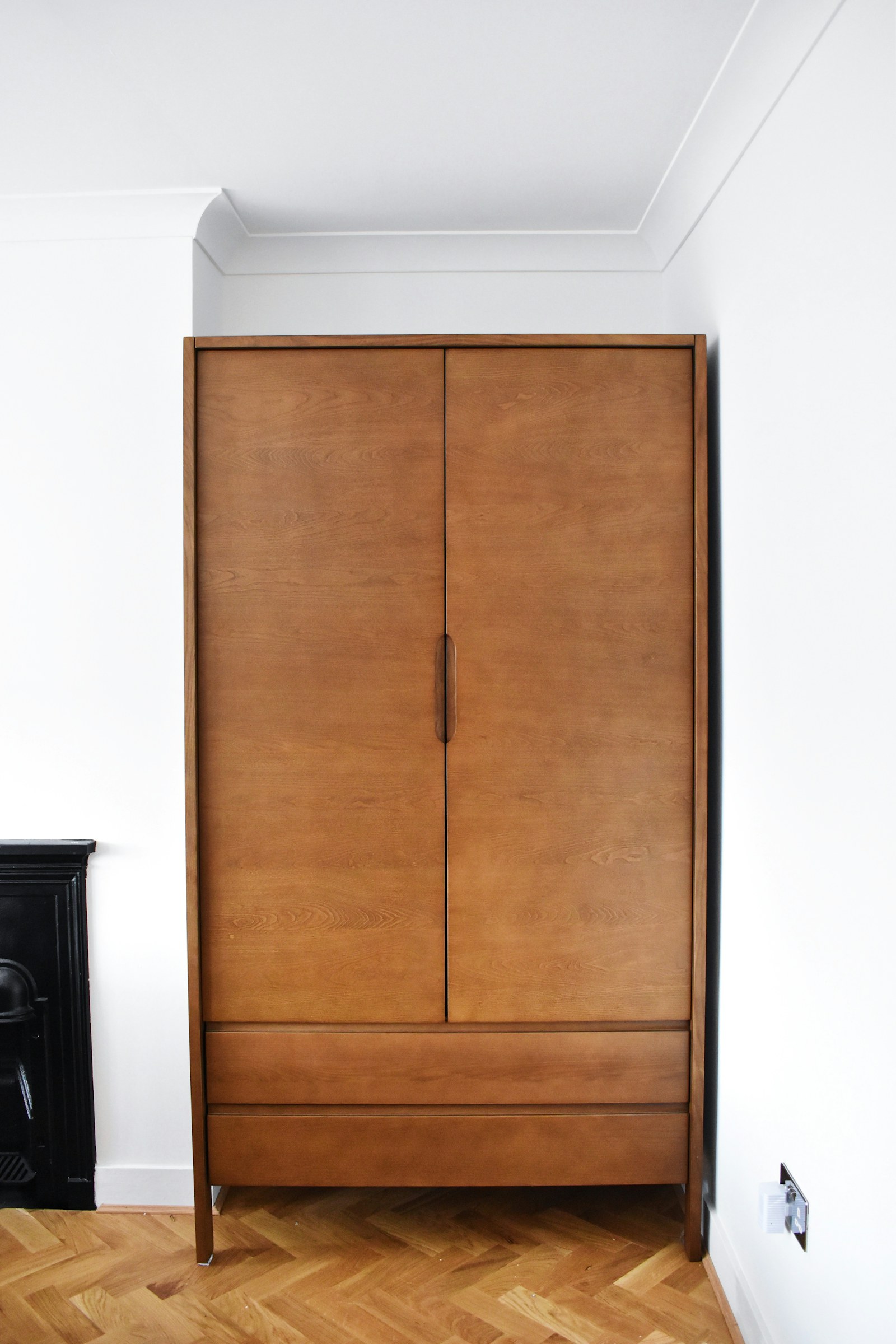
A shallow closed cabinet is the strongest choice when visual calm matters. Shoes, gloves, small bags, and household items can disappear behind a door, which helps an entryway feel more like part of the home than a utility zone. For the broader setup, Sort Laundry at the Hamper vs. at the Washer: Which System Creates Less Work? is a useful next read.
Where it performs well
- the entry is visible from the living room,
- the household dislikes open shoe storage,
- categories are small enough for shallow storage,
- there is wall length but not much depth.
Where it fails
Closed storage can hide overcapacity. Extra shoes remain because the cabinet door closes. Gloves multiply. Packages wait inside instead of leaving the home.
A cabinet needs a category limit just as much as an open shelf does.
Footprint comparison
Wall hooks clearly win if floor area is the dominant constraint. They use vertical wall space and preserve the path.
A narrow cabinet can be surprisingly efficient if its depth stays shallow. A bench usually consumes the most floor depth because it must be comfortable enough for sitting.
Do not compare furniture width alone. Tape the full loaded depth on the floor, including projecting coats, open doors, and shoes sticking out.
Capacity comparison
A cabinet can hold the most mixed small inventory. A bench can hold more shoes or bulky soft items. Hooks hold the least, but that limitation can be useful.
In small homes, insufficient capacity and excessive capacity can both create clutter. The entryway should hold today’s active layer, not the household’s entire coat and shoe inventory.

Family comparison
Families need storage that clarifies ownership. One hook per person, one shoe section per person, or one narrow cabinet shelf per person can reduce arguments about where things belong.
However, do not duplicate every category. Shared umbrellas, dog equipment, reusable bags, and outgoing returns may need one common zone.
The existing small hall closet system for coats, shoes, bags, and family gear is useful when the home has a closet and the challenge is distributing these categories between the closet and the visible entry.
Visual-clutter comparison
Narrow cabinet: strongest for visual calm.
Bench: neutral if the top remains clear; visually busy when the seat becomes a pile.
Hooks: visually light when sparsely used, visually heavy when every hook carries several items.
This is why capacity discipline matters more than the organizer style.

What changes in a rental?
Renters need to consider wall-mounting rules, repair requirements, and whether a freestanding solution will adapt to the next home. A bench or narrow cabinet is easier to relocate, while permanent hook rails may be more efficient in the current space.
If there is no true foyer at all, creating a landing zone in an apartment with no entryway shows how little furniture is actually required to establish a functional threshold.
The hybrid systems I prefer
Most successful entries use two tools, not three.
Hooks + shoe tray: best when the household needs outerwear storage but rarely sits to put on shoes.
Hooks + narrow bench: useful for families with children when seating is real, not decorative.
Narrow cabinet + two or three hooks: strongest when the room needs visual calm but current bags or coats still need one-motion access.
Bench + closed wall cabinet: only when the entry is wide enough; otherwise the room begins to feel furnished rather than functional.
A five-question buying test
- What exact category is currently landing on the floor?
- Does the solution replace another object or merely add furniture?
- Can everyone who uses it reach it comfortably?
- Does the loaded footprint preserve the main walking path?
- What is the capacity limit?
If you cannot answer the fifth question, the new storage may simply become a larger version of the current mess.
Do not forget outgoing items
Returns, library books, donation bags, packages, and school forms are not long-term entryway inventory. They need a short-term outbound location and a trigger to leave.
The guide to handling mail, packages, and returns in a small entryway is a useful complement because it separates objects that live by the door from objects that should exit through it.
How to size the system for one person, a couple, or a family
A one-person household can often function with two hooks and one small shoe boundary. A couple may need separate hook ownership but can still share one narrow shoe zone. Families need more capacity, but not necessarily more furniture. I prefer adding clearly assigned hooks or shelf sections before adding a second piece of floor furniture.
The key is to scale the active layer, not the entire seasonal inventory. Winter coats, sports gear, umbrellas, backpacks, and everyday shoes should not all receive permanent prime entryway space at the same time unless they are actively used. If you are working on the same space, A Rainy-Day Entryway System for Wet Shoes, Umbrellas, Coats, and Kids’ Gear covers the next decision in more detail.
What to do when the entryway becomes a package zone
Online orders can overwhelm even a well-designed entry because packages are bulky and temporary. Do not enlarge permanent storage for temporary cardboard. Create one short-term outbound/inbound location and a rule for when packages must be opened, recycled, returned, or moved elsewhere.
A bench with an empty lower shelf can temporarily help, but if parcels remain for days, the issue is workflow rather than furniture.
What changes when sports gear enters the picture
Sports bags, helmets, balls, and wet gear behave differently from ordinary bags and coats. They are larger, dirtier, and often seasonal. I would not let sports equipment colonize the daily entry system unless the entry is the natural departure point and the gear can be contained safely.
If sports items are the main source of overflow, use a dedicated sports-gear drop zone instead of making the shoe bench carry another job.
Maintenance: the five-minute entry reset
Once a week, remove anything that no longer belongs to the active layer: extra shoes, empty bags, expired papers, out-of-season accessories, or returns that should already have left. This small reset prevents the entry from slowly expanding its definition of “belongs here.”
My expert conclusion
If the entryway is extremely small, I start with hooks because they solve high-frequency soft-item clutter without spending floor space. I add a bench only when sitting is genuinely part of the routine. I choose a narrow cabinet when visual calm is important and the household can maintain clear capacity limits.
The entryway does not need to store everything related to leaving home. It needs to make the next arrival and departure easier. The furniture that earns its footprint is the one that removes the most repeated friction while occupying the least valuable space.