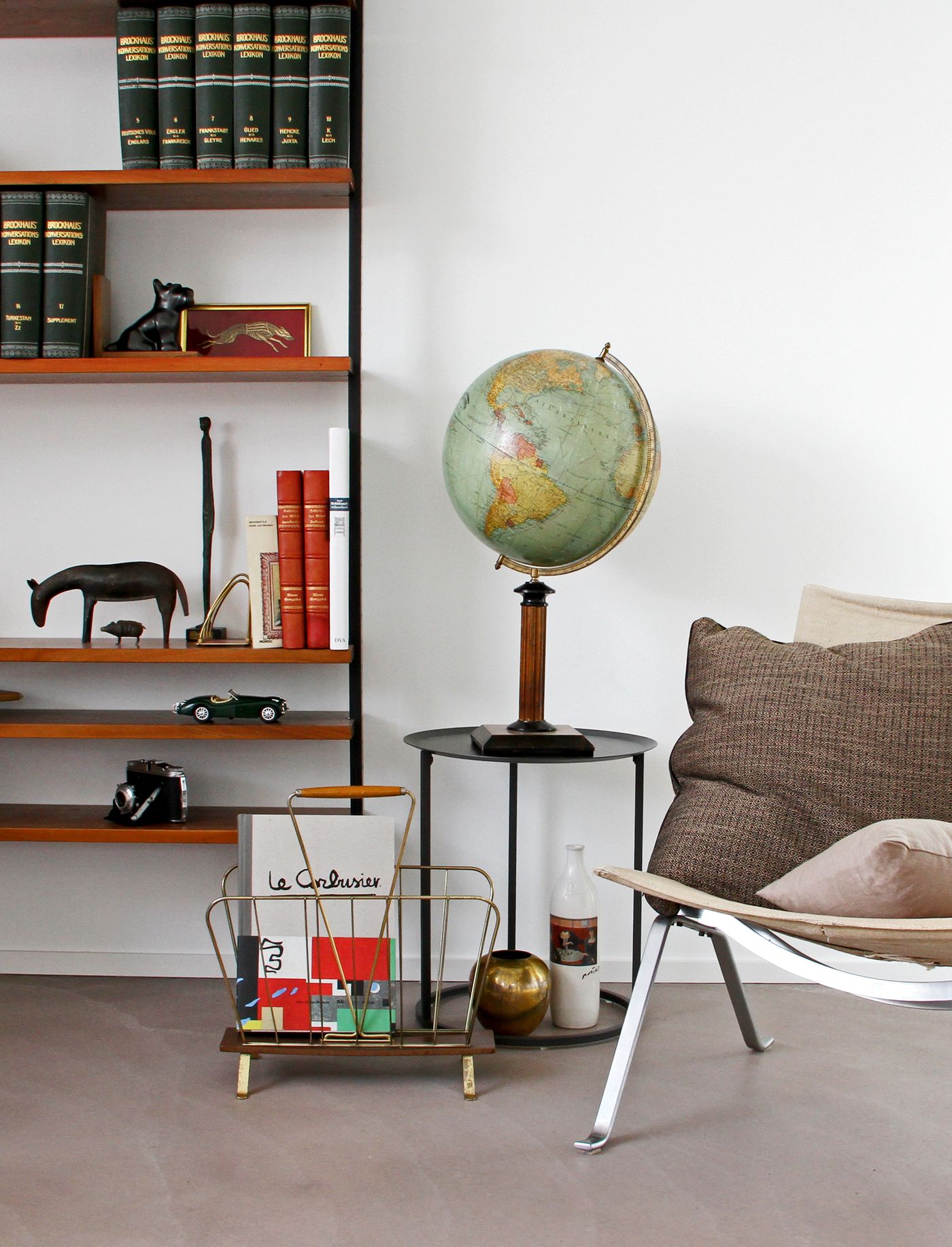
A tabletop globe takes more room than the circle made by its base. The sphere turns, a surrounding ring may project farther, and someone needs a useful position from which to read it. On a narrow shelf, a globe can look perfectly fitted while being difficult to touch without moving everything beside it.
Choose a location by checking the whole object in use. Consider its base, widest outline, intended movement, viewing height, and removal route. Try the globe you already own before replacing furniture or buying a larger decorative model for a small room.
Decide whether this globe is read, displayed, or both
A globe used to find places needs a different position from one kept mainly as a personal object. Ask what you actually do with it. Do you turn it while seated, point out places with another person, or simply enjoy its shape among books?
The Houzz fall 2026 design report describes collected interiors with personal character. Displaying a meaningful globe is one possible editorial application of that direction. The report does not establish a current ranking for globe purchases or make any particular globe a reliable geographic reference.
Check the information printed on your own model if you intend to use it for reference. A vintage decorative globe can be interesting because of its age while showing outdated information. Do not assume the map is current because the stand is in good condition, or discard a meaningful older object merely because it is not a present-day reference tool.
For a shared room, choose a purpose other people understand. A read-and-turn object should be accessible to the people invited to use it. A fragile display-only piece may need a more protected position, with that limitation made clear rather than discovered when someone tries to spin it.
Measure the widest fixed outline
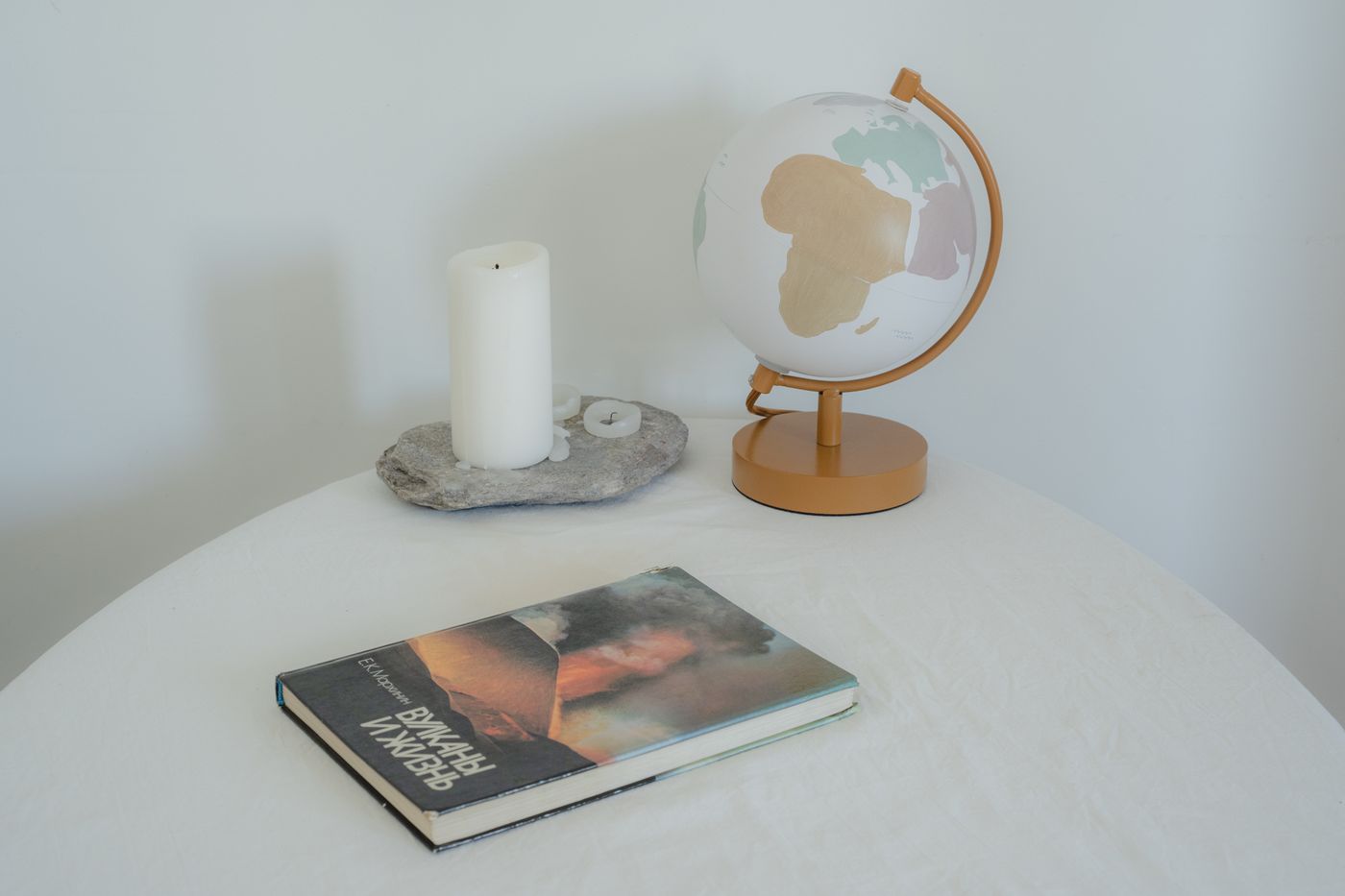
Look at the globe from the front, side, and above. The base, sphere, support arm, and any meridian ring can each determine a different dimension. A seller’s diameter figure may describe only the sphere, so verify what each published measurement includes.
Measure the actual widest outline and total height where you can do so without straining the object. Include protruding fittings or finials if present. Do not reduce the required space to the base footprint simply because the base is the part that touches the shelf.
Leave room for the globe’s intended movement as described by its maker. Some designs turn only around one axis; others have additional adjustment. Do not force a ring or support that appears movable, and do not loosen a fitting just to make the object work in a confined location.
On an existing shelf, compare the available opening with the whole object before lifting it into place. Watch overhead shelves and nearby walls as well as objects at the sides. A model that fits the opening only when tilted may be awkward to remove later.
Check the surface and the object together
Use a stable surface suitable for the object’s actual weight and base. A small base does not make a loaded shelf, lightweight tray, or wobbly side table appropriate. Follow any furniture load limits and the globe maker’s assembly directions.
Look for rocking, a damaged stand, or missing fittings before deciding on a permanent display. Do not solve an unstable globe with an improvised hidden wedge unless that method is appropriate and permitted for the object. Repair and safe support come before styling.
Think about the edge of the surface. A globe placed where its widest part projects into a walkway can be bumped even when its base is set back. Check the path of people passing, cabinet doors opening, and anyone reaching for the books behind it.
The same distinction between a footprint and usable access appears in our freestanding plant-stand planning guide. A globe has different needs, but it also needs room for the actions that make it usable. Do not fill all the surrounding space just because the object has stopped rocking.

Try the reading position in ordinary light
Place the globe provisionally on a suitable clear surface and stand or sit where you expect to use it. Can you read the places you want without leaning across a sharp table corner or lifting the globe every time? Consider the actual size of the printed labels rather than the dramatic appearance of the sphere from across the room.
Check reflections from lamps and windows. A glossy finish may make one side harder to read in a particular position. Try a modest change in placement before assuming the room needs a new lamp or the globe needs to be replaced.
If your model is illuminated, verify its power requirements, cable route, and manufacturer instructions. Treat that as a feature of the actual product. A pale or translucent globe in an image is not enough to establish that it lights up, and a decorative stand should not conceal a strained cable.
Keep the globe’s light separate from the room’s general lighting plan. A lit map may be pleasant to look at but does not automatically provide useful reading light for a nearby chair. Judge each activity from the position where it occurs.
Give the chair a role without crowding the route
If the globe is used from a chair, place it where a seated person can approach and leave comfortably. Do not move an otherwise useful seat into a corner simply to produce a matched globe-and-chair arrangement. Try reaching and viewing with the globe stationary and supported.
A side table that serves a chair may still need room for glasses, a book, or a drink. Decide which functions matter before the globe occupies the entire top. It may belong on a nearby shelf instead of the surface most frequently used during reading.
Our guide to arranging two conversation seats focuses on preserving actual seating. Apply that priority here as well: a decorative object should not take away the room’s useful sitting positions. If the placement makes conversation or movement awkward, it needs revision.
A new rug or supporting accent will not solve an inconvenient reach. If a rug is also being considered, use the reading-chair rug fit guide as a separate decision. Check one change at a time so the globe’s placement can be assessed without several moving variables.
Leave a practical way to remove it
A globe needs occasional attention to the surface beneath it and to its own permitted care. Plan how you will lift or move the actual object, following its handling instructions. Do not assume the sphere or meridian ring is a carrying handle.
If the intended support is part of a tall bookcase, consider whether removal would require an unsafe reach. A position that can be photographed from the floor is not necessarily one from which the object can be handled comfortably. Choose a reachable shelf or a more appropriate surface.
Keep the route clear of loose decorative pieces that must be caught or balanced during removal. You should not have to dismantle a fragile arrangement every time the shelf needs attention. Fewer neighboring objects can make the display both easier to use and more intentional.
For an unusually large or heavy model, check how it reaches the room before committing to it. Our furniture delivery-route guide provides a useful framework for measuring real openings, although a small globe will often need only a straightforward carrying check.

Stop at a placement that survives normal use
Leave the provisional arrangement in place through ordinary room activity. Notice whether someone can turn the globe as intended, whether books remain reachable, and whether the widest part is repeatedly brushed by passing people. Evaluate those observations before adding more objects around it.
If the globe works only when the chair is unused or the adjoining cupboard stays closed, the placement is competing with a more important function. Try another existing surface or keep the globe as a less accessible display with an honest purpose. Buying a larger stand is not the automatic next step.
The right spot lets the object be understood and enjoyed without reorganizing the whole room around it. A small globe can add character, but its value comes from the relationship you have with it and the room you can still use comfortably.
Explore related decisions in our Small-Space Living hub.
Sources and editorial scope
Editorial research checked October 24, 2026. Published trend reports are context for these editorial applications, not verified live keyword rankings. Practical household guidance; photographs do not document a tested household or authenticate pictured materials.