Cookware storage often looks efficient right up until you need the pan on the bottom.
Seven pieces nest beautifully inside one another. Then dinner starts, someone needs the medium skillet, the stockpot is on top of it, three lids fall sideways, and the whole arrangement has to be rebuilt after washing.
In a small kitchen, the goal should not be maximum compression. It should be minimum handling: how many other objects do you have to move before the pan you need is in your hand?
Begin with the cookware you reach for in a normal week
Before changing the cabinet, list the pieces that actually make dinner happen. For many families that is surprisingly small: one everyday skillet, one saucepan, one larger pot, perhaps a Dutch oven or stockpot, and one or two specialty pieces.
Cookware that is theoretically useful but rarely chosen should not occupy the easiest shelf.
Separate daily cookware from occasional cookware
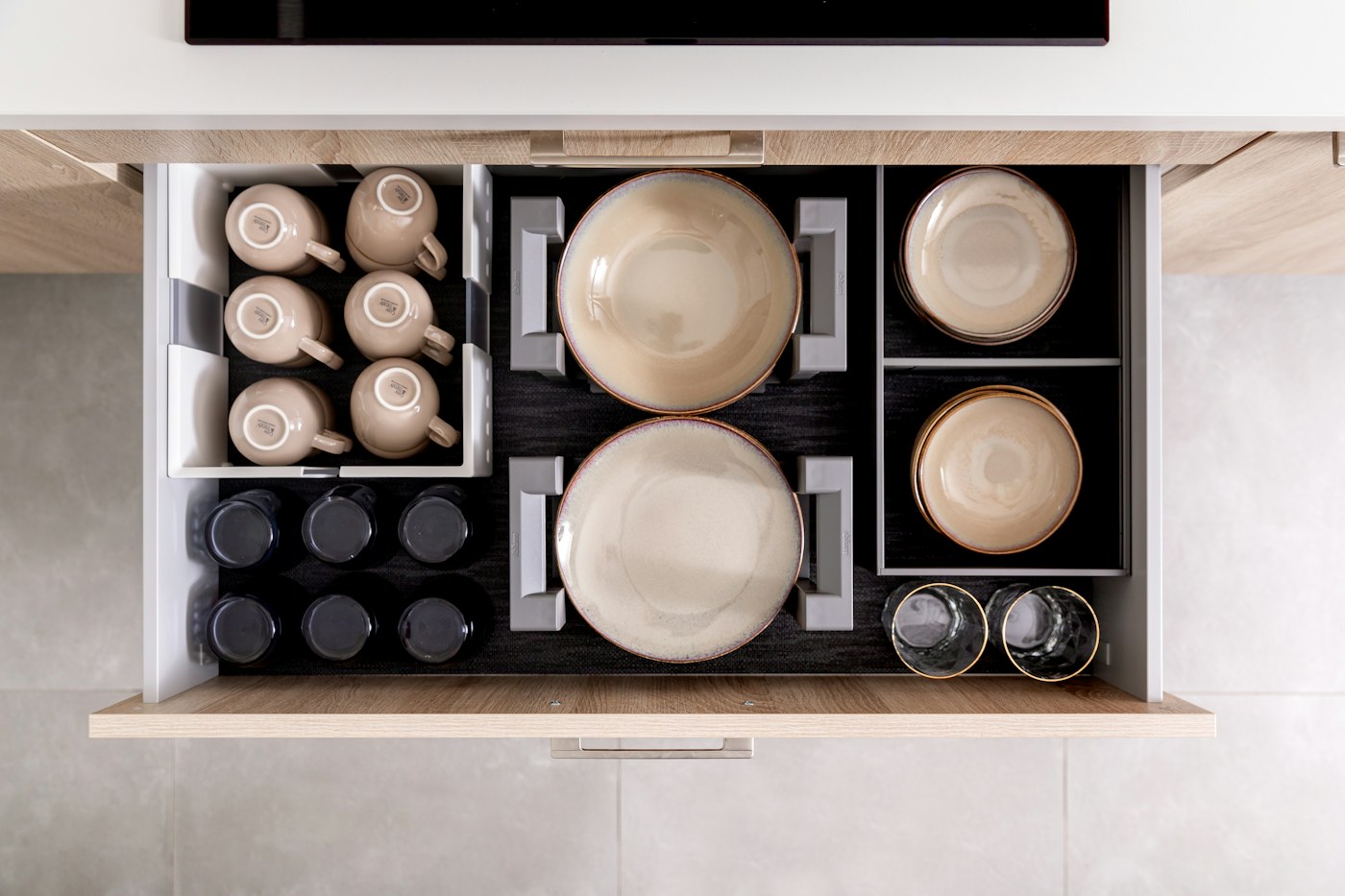
This distinction is more useful than arranging by size alone.
Keep daily cookware where it can be removed with one or two motions. Move the roasting pan, giant stockpot, specialty steamer, or holiday-only cookware to a higher, lower, or less convenient zone if the home has one.
A small kitchen improves dramatically when the cabinet stops pretending every pan is equally important.
Reduce the “stack depth” before buying an organizer
If four pans are stacked, the bottom one requires moving three. If two are stacked, the bottom one requires moving one. That is a meaningful difference in daily friction.
Try dividing cookware into two shorter stacks before adding any new product.
Use vertical storage when it matches the cabinet
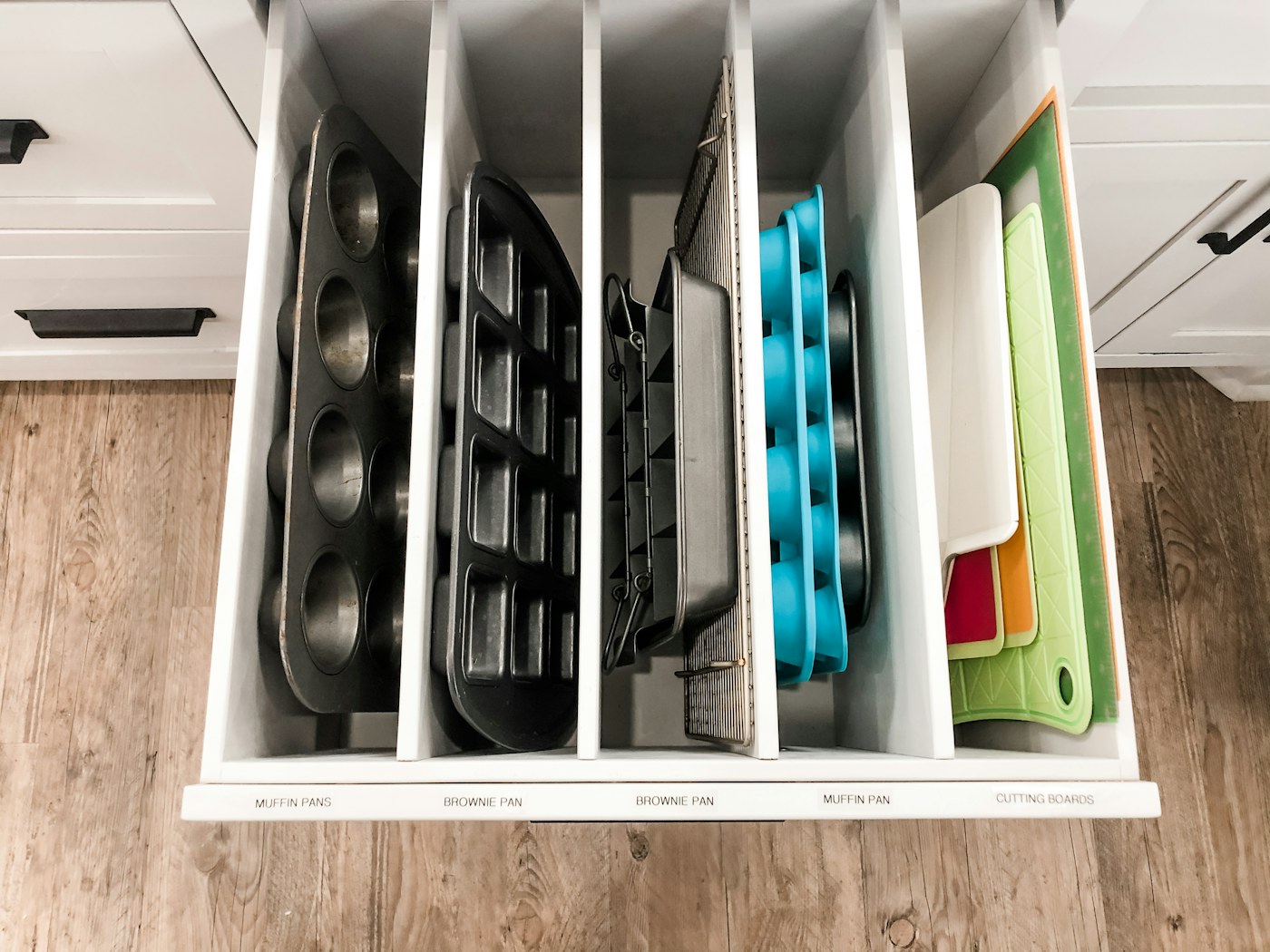
Skillets, cutting boards, baking sheets, and some lids can be stored vertically with stable dividers when the cabinet dimensions allow.
Vertical storage is especially useful when it turns “unstack and restack” into “slide one item out.”
But do not force a heavy pot into a narrow vertical slot just because the organizer exists. Weight, balance, and cabinet strength matter.
Give lids a different strategy from pots
Lids are not really cookware-shaped. They are flat, awkward, and often have handles that prevent clean stacking.
Three approaches usually work:
- Vertical lid rack: useful inside a cabinet or deep drawer.
- Shallow lid drawer: excellent when available.
- Pot-adjacent pairing: useful for one or two daily pots when cabinet space is simple.
What I would avoid is a loose lid pile behind the pots. That is where visibility disappears.
Match lids to pots before deciding how much to keep
It is easy to store a lid for years because it looks like it probably belongs to something. Match every lid deliberately.
If a lid no longer has a corresponding piece—or a pot has three interchangeable lids—decide what is genuinely useful before returning everything to the cabinet.
Keep handles from stealing the whole shelf
Long skillet handles can make a compact cabinet behave like a much smaller one. Try alternating handle directions or using a vertical divider if that improves retrieval.
Do not create a puzzle so precise that one pan placed slightly wrong prevents the door from closing.
Use deep drawers differently from lower cabinets
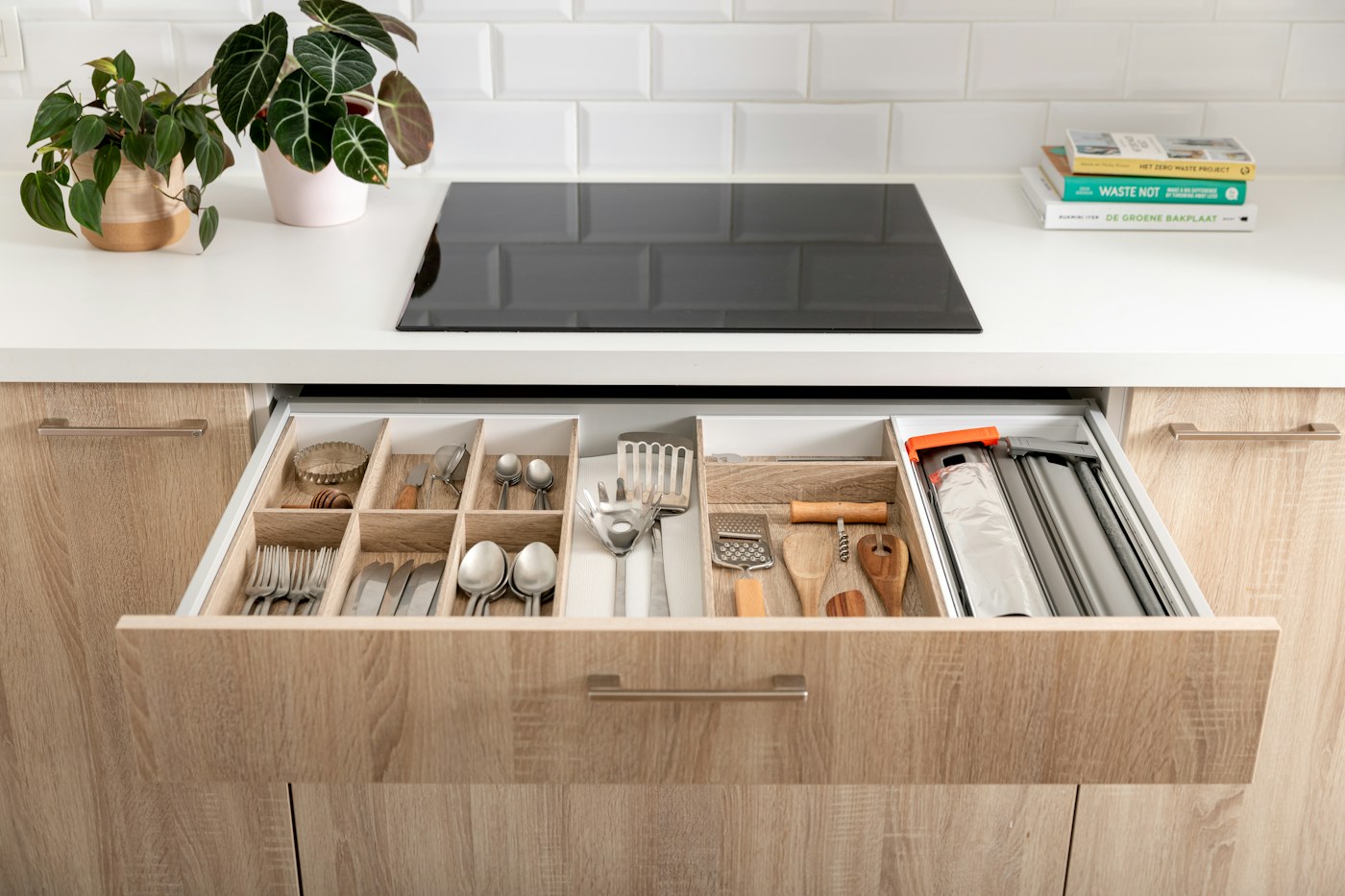
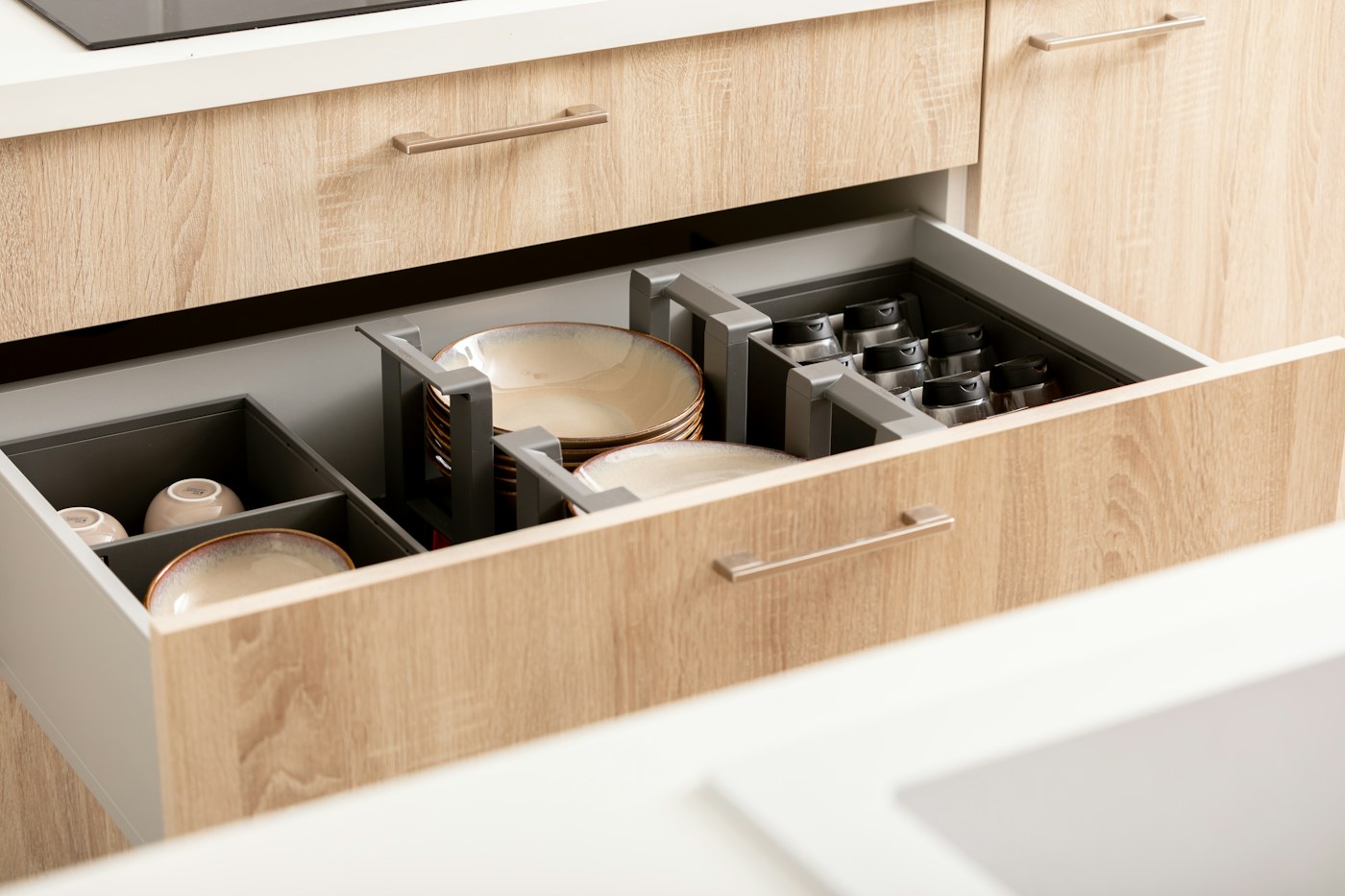
A deep drawer is one of the best cookware locations because you can see from above. Keep heavy pots low, use a small section for lids, and avoid stacking so high that the drawer becomes difficult to open.
A lower cabinet has a different problem: visibility. In that case, short stacks, pull-out shelves where appropriate, or vertical dividers can reduce crawling and digging.
Do not store cookware based on set membership
Cookware sets encourage us to keep all eight or twelve pieces together because they arrived in one box. Your kitchen does not care how they were sold.
Keep the pieces that earn their space. A family that uses two pots from a ten-piece set is not obligated to store the other eight in prime kitchen real estate. For a related step-by-step approach, see How to Create a Family Snack Station in a Small Kitchen Without Encouraging More Clutter.
Think about weight before height
Heavy cookware deserves stable storage that is safe and comfortable to retrieve. A cast-iron pan or large Dutch oven on a very high shelf may save cabinet space but create a poor daily routine.
Put lighter occasional pieces higher and heavier frequent pieces lower or around waist level when the kitchen layout allows.
Use the oven for cooking—not permanent storage if it creates friction or risk
Some households temporarily store baking sheets or pans in the oven because there is nowhere else. The system becomes fragile when the oven must be emptied onto the floor every time it is used.
If you do use appliance cavities for temporary storage, make sure your household has a safe, consistent routine and follows appliance guidance. Ideally, active cookware should have a storage home outside the appliance.
Keep baking equipment separate if it behaves differently
Baking sheets, cooling racks, muffin tins, and cutting boards are often easier to store vertically than round pots. Grouping them with cookware simply because both are metal can make both categories harder to retrieve.
Give flat equipment its own narrow zone when possible.
The “one-motion dinner test”
Stand in front of the cabinet and retrieve the three pieces you use most often.
Count what you moved.
- If you moved nothing else: excellent.
- If you moved one thing: probably fine.
- If you rebuilt a tower: that is the part of the system to redesign.
I prefer this test to judging the cabinet by how tidy it looks when closed. The cabinet exists to help dinner happen.
A realistic reset after dishes are dry
- Daily pans return to their easiest positions.
- Occasional pieces go to the deeper zone.
- Lids return vertically or to their dedicated section.
- Handles point in the normal direction.
- Nothing gets placed “temporarily” in front of the cookware.
If putting pans away takes more than a minute, the storage arrangement may still be too dense.
When an organizer is actually worth buying
I would buy an organizer when you can name the exact failure it fixes: “These four lids collapse every time the cabinet opens,” or “I need to slide each skillet out without lifting the others.”
I would not buy one simply because a product photo shows twelve pans in a cabinet similar to yours. Measure first, check weight limits where relevant, and choose the smallest intervention that removes the recurring friction.
What if your kitchen has almost no cookware storage?
Then the most powerful move is often reducing active cookware. A smaller, versatile set can outperform a large collection stored badly.
You can also review countertop appliances at How to Organize Countertop Appliances in a Small Kitchen and food-container volume at How to Organize Food Storage Containers and Lids in a Small Kitchen. Sometimes cookware feels crowded because several neighboring categories are also over capacity.
Protect cookware without turning protection into another storage problem
Some cookware benefits from pan protectors, soft separators, or careful stacking. The problem begins when every pan has a loose felt pad that falls onto the floor during cooking and has no home during washing.
If your cookware manufacturer recommends protection between surfaces, keep the separators with the cookware system and make their return obvious. If a protector is constantly missing, reconsider whether a different stack or vertical layout would protect the pan with fewer loose pieces.
The best storage method respects both the cabinet and the cookware material.
What if the kitchen is a rental with one terrible lower cabinet?
Do not assume you need to renovate the cabinet to make it usable. First test three low-cost changes: reduce active cookware, split one tall stack into two short stacks, and move lids into a separate vertical section.
If that solves 80 percent of the frustration, a permanent pull-out system may not be necessary. Renter-friendly organizers are most valuable after you understand the exact motion that is difficult.
For example, if the problem is “I cannot see the back,” a pull-forward bin or removable shelf may help. If the problem is “the skillet I use daily is under three saucepans,” visibility is not the main problem—priority is.
Make put-away easy for the person who did not design the cabinet
Many kitchen systems depend on one person remembering a precise nesting order. That person can fit everything perfectly; everyone else creates chaos.
A family-proof cookware cabinet should have obvious homes. The everyday skillet goes here. Saucepans go there. Lids slide into that section. If a pan has to be rotated exactly 17 degrees to close the door, the system is too fragile. For a related step-by-step approach, see How to Organize a Small Freezer for a Busy Family.
I would rather “waste” a little cabinet volume and gain easy family participation than maximize every cubic inch and make one person the official pan-stack technician.
How to decide whether a pan deserves space
When cookware is crowded, use four questions:
- Frequency: How often did we use this in the last two months?
- Uniqueness: Does another pan do the same job almost as well?
- Burden: Is this piece unusually heavy, awkward, or difficult to store?
- Replacement reality: If we let it go, would we immediately buy another?
A large specialty pan used for one beloved family meal may deserve space. A second skillet that is always skipped because the first one cooks better probably does not.
When a hanging pot rack makes sense—and when it does not
Hanging storage can free cabinets, but it also turns cookware into a permanent visual feature. It works best when the pans are used frequently, the installation is structurally appropriate, and the rack does not interfere with headroom, lighting, or circulation.
In a tiny kitchen, hanging every pan can make the room feel busier even if the cabinet is technically emptier. I would use visible hanging storage only for a small set of hardworking pieces, not as a way to avoid editing the collection. If you are working on the same space, How to Organize Foil, Food Wrap, and Reusable Bags in a Small Kitchen covers the next decision in more detail.
A two-week test before you buy anything
After reorganizing, live with the new layout for two weeks. Notice which pieces migrate to the counter, which lids are still annoying, and which cabinet section nobody uses correctly.
Those failures are useful. They tell you where an organizer might earn its cost. Buying before the test often means solving the layout you imagined rather than the one your family actually uses.
\nFrequently asked questions
Is it better to stack pans or store them vertically?
Use the method that reduces handling in your specific cabinet. Vertical storage is excellent when dimensions and stability support it; short stacks can be just as practical.
Where should pot lids go?
A dedicated vertical rack, shallow drawer, or clear cabinet section usually works better than a loose pile behind the pots.
Should I keep every pan from a cookware set?
No. Keep the pieces your household actually uses and has space to store safely.
What should go in the easiest cookware position?
The pots and pans used several times per week. Prime storage should follow actual cooking frequency.
A good cookware cabinet does not need to look impressive
It needs to let you pull out the right pan while onions are already in the skillet and return everything after dinner without reconstructing a metal tower. In a small kitchen, that ease is a better measure of organization than how tightly the set can nest. For the broader setup, How to Organize Spices in a Small Kitchen Without Buying Matching Jars is a useful next read.