
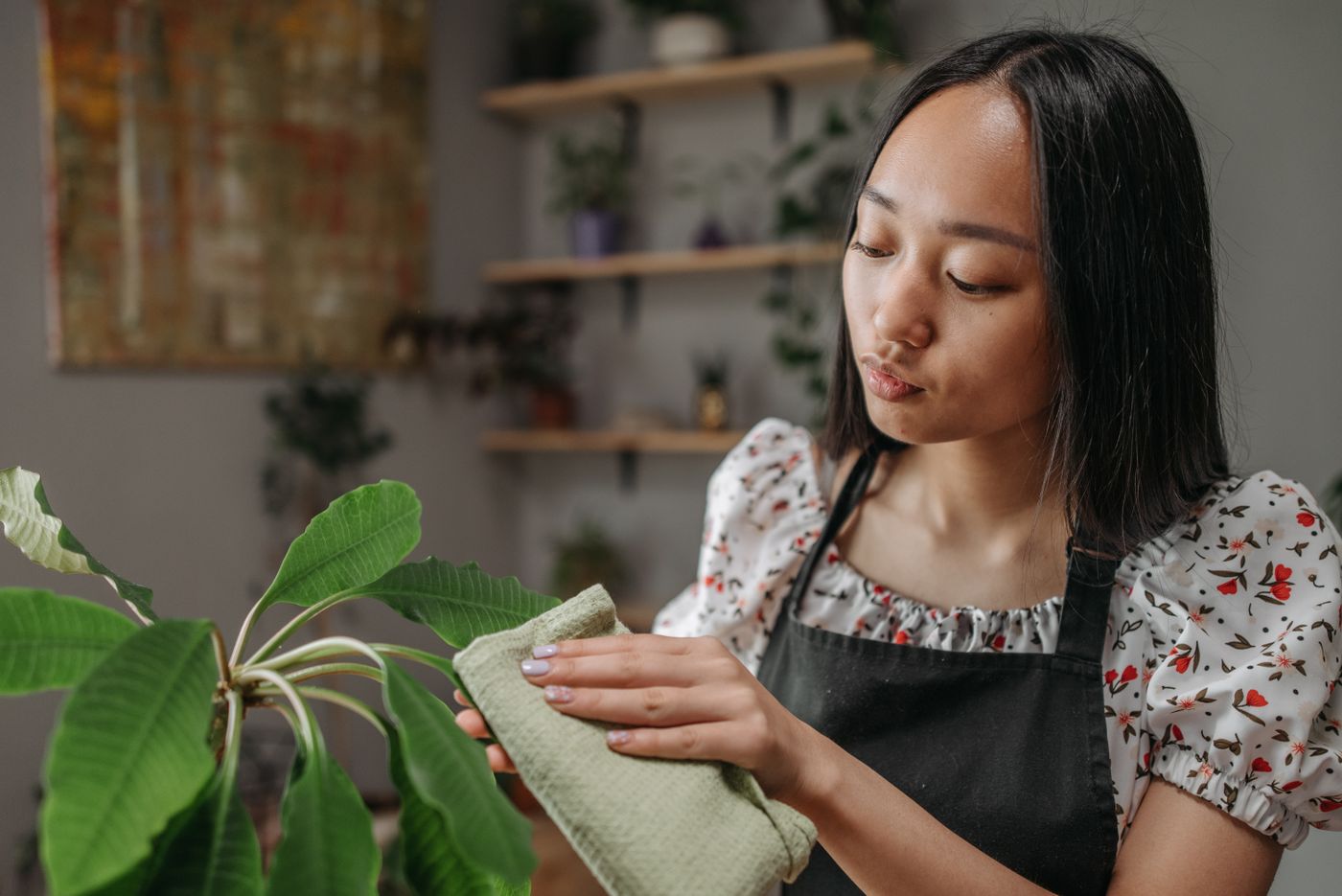
A dusty houseplant does not need the same cleaning routine as a coffee table. Leaves vary in texture, size, strength, and sensitivity, and an unexplained mark may not be ordinary dust at all. Start by identifying the plant and the surface you are seeing. Then choose the smallest suitable cleaning task, rather than working through every pot with one cloth and one bottle.
Pinterest’s autumn 2026 creator trends include renewed interest in plants and hands-on activities. That is context for caring for the plants already in a living room, not evidence that leaf polishing is a necessary decorative routine. This guide covers ordinary surface dust on identified houseplants. It does not diagnose pests, disease, nutrient problems, or the cause of leaf discoloration.
Establish what you are trying to remove
Look at the plant before wetting anything. Is there a loose dusty film, a persistent ring, a sticky area, or a change within the leaf? Notice whether the issue is widespread or limited to one leaf near a spray product or window. The question is not whether the plant looks glossy in a photograph; it is whether a suitable routine cleaning task is actually present.
The Royal Horticultural Society’s houseplant guidance notes that dust can reduce the light reaching leaf surfaces. It also describes marks associated with household sprays and hard water. Those different possibilities are a reason to observe carefully, not permission to scrub until every mark disappears. A leaf can remain naturally patterned or imperfect after ordinary dust has been removed.
If you cannot identify the plant or the mark, pause the cleaning experiment and seek plant-specific guidance. Keep a simple factual note or photograph if that helps explain the question. Avoid treating the mark with a succession of cleaners, oils, or homemade polishes while trying to discover what it is. Each extra treatment makes it harder to know what changed.
Match the method to the actual leaf
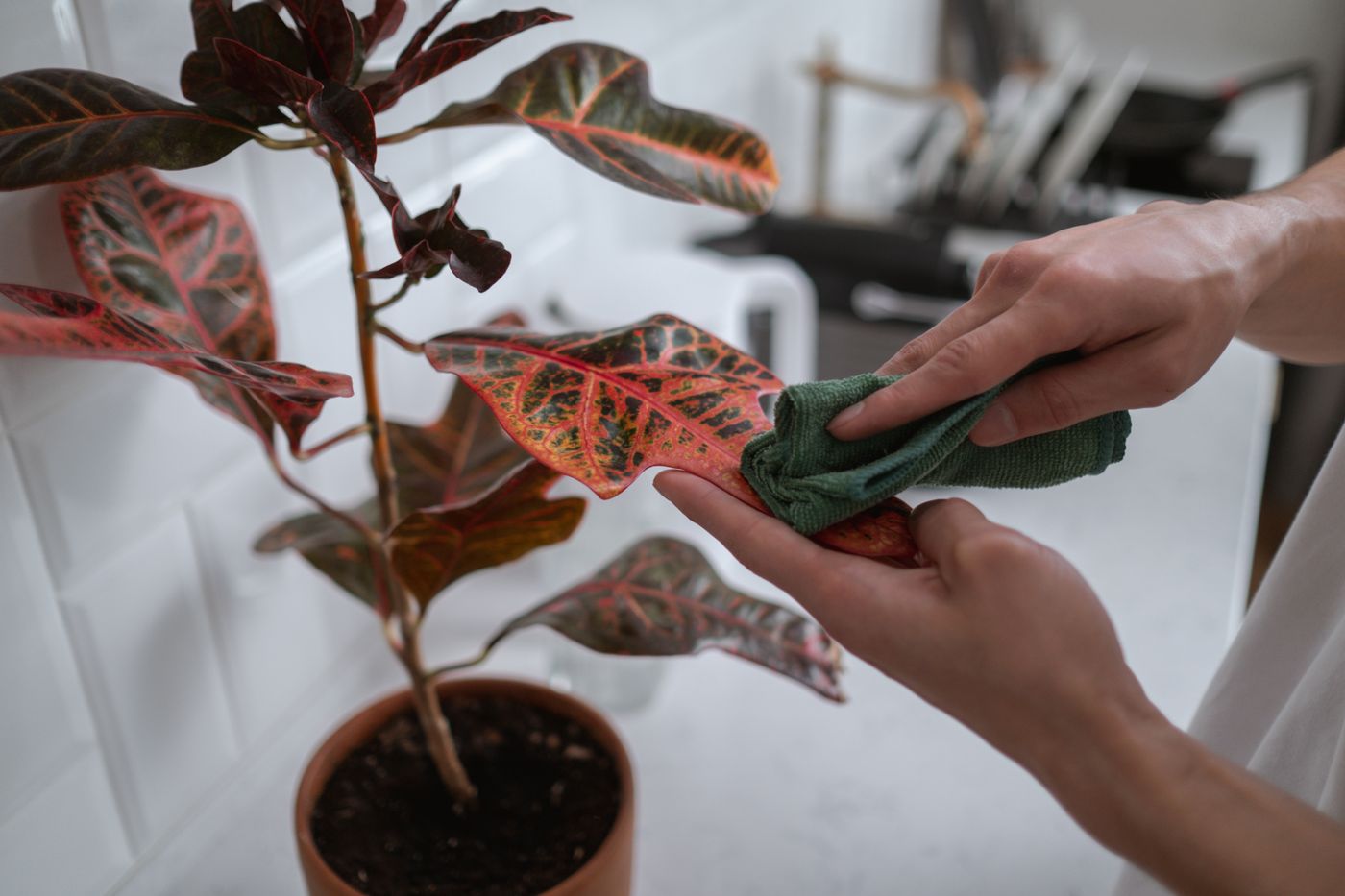
A broad, firm, smooth leaf offers a different working surface from a small delicate leaf or one covered in fine hairs. Do not assume that a photograph of someone wiping one plant establishes a method for yours. Find care guidance for the identified species and follow its limitations, including whether wiping or wetting the foliage is appropriate.
Where gentle wiping is suitable, support the leaf rather than pulling it against a resistant cloth. Work with a light touch and stop if the leaf bends awkwardly or shows damage. Cleaning should not become a test of how firmly a stem is attached. A high shelf or cramped corner may be the wrong place to do even a small permitted task.
For plants whose texture makes wiping inappropriate, use the method recommended for that plant rather than trying to reproduce a smooth, polished finish. The goal is ordinary care, not making every species resemble a glossy-leaved decorative plant. Several different care approaches can coexist in one room without making the collection feel disorganized.
Prepare one manageable plant at a time
Choose a stable working position that allows you to see the leaves and support the container. Check the pot, saucer, and any outer decorative container before moving them. A plant that has become heavy or awkward should not be lifted merely to reach a better photography background. Keep the task within what you can comfortably handle.
Use a clean, suitable cloth or tool for the permitted method. Keep it separate from a cloth carrying furniture polish or household cleaning residue. Have an appropriate place for used materials so they do not end up resting on the sofa between plants. Set up for one plant, finish that task, and then decide whether another needs attention.
Our guide to caring for removable cushion covers is useful if the nearby soft furnishings need a separate cleaning decision. Do not combine the jobs by carrying a plant-cleaning cloth straight onto upholstery. The living room can contain several materials with different care instructions, even when they share one small working area.
Keep sprays and decorative shine out of the decision
A product described as a household cleaner is not automatically a plant-care product. Equally, a plant-care product should be used only as directed for the appropriate plant and purpose. Do not add a spray because the leaf is near a window and you already have the glass cleaner in your hand.
The desired finish is the plant’s own clean surface. Avoid using the amount of reflected light in an online image as the standard for success. Photography, lighting, and natural leaf texture all affect appearance. A matte leaf does not need to be made glossy, and a persistent blemish is not proof that the cleaning effort was inadequate.
Where the plant’s guidance permits a damp method, control the task rather than soaking surrounding furnishings. If water or residue reaches a surface, deal with that surface according to its own instructions. Do not conceal a damp ring under the pot and return the plant to a shelf as though the job is finished.
Inspect access while the plant is in its normal place
After the permitted care is complete, look at how the plant sits in the room. Can you reach the leaves that normally collect dust? Is the pot squeezed against a curtain or positioned where routine household sprays are used? A small placement adjustment may make future care easier, provided it remains suitable for the plant’s light and other requirements.
Do not improve cleaning access by moving a plant into conditions that do not suit it. Species-specific care comes before a symmetrical arrangement on a shelf. If the current display makes every care task difficult, consider reducing the number of pots at that position rather than adding an elaborate stand around the same access problem.
Our lampshade-cleaning guide illustrates a related living-room decision: identify the material before choosing the cleaning method. Apply that order of thought, not the lampshade method, to the plant. An attractive collection becomes easier to maintain when each object remains reachable and its care requirements remain distinct.
Return tools to a compact care kit
Keep the small number of tools you actually use together and allow any permitted cleaning and drying of those tools to finish before storage. A damp cloth should not be shut into the same container as paper plant records. Retain useful plant-specific care notes where you can consult them before the next task.
Our guide to organizing indoor plant-care supplies helps keep those materials from becoming a permanent potting station in the living room. A routine leaf check should not require unloading a cupboard of unused treatments. Remove unidentified or unsuitable supplies through the appropriate route rather than keeping them merely because they once arrived with a plant.
If the collection includes cuttings, use a clear cutting and parent-plant record to retain the actual plant identity. That makes future research more useful than a label such as “green plant.” It also prevents applying the care routine of one similar-looking species to another simply because the pots share a shelf.

Let observation set the next cleaning date
There is no useful universal polishing schedule for every plant in every living room. Check the actual leaves and the conditions around them. A plant beside an often-open window may present a different ordinary dust task from one in another part of the home. Respond to what is there rather than adding a weekly treatment whose purpose has disappeared.
Finish when the suitable task is complete, even if the plant retains an older blemish. Put the pot back in an appropriate position, return the tools, and keep any unresolved plant-health question separate. Caring for a small collection should make it easier to enjoy the living room, with the plants remaining recognizable living things rather than another set of surfaces to polish into uniformity.
Explore related decisions in our Cleaning hub.
Sources and editorial scope
Editorial research checked October 21, 2026. Published trend reports are context for these editorial applications, not verified live keyword rankings. Practical household guidance; photographs do not document a tested household or authenticate pictured materials.

