TV storage is one of those categories that often survives long after the technology that created it. Large media centers once needed space for discs, game systems, receivers, speakers, remotes, cables, and physical collections. Many households now use fewer devices—but still buy furniture sized for an older version of the media setup.
In a small living room, I would not start by choosing between open and closed furniture. I would start by auditing what truly needs to live at the TV wall. If you are working on the same space, How to Make a Small Living Room Feel Bigger Without Buying New Furniture covers the next decision in more detail.
Audit the equipment first
List every device connected to the television and every object currently stored nearby. Separate active equipment from legacy cables, empty boxes, old remotes, game cases, batteries, manuals, and miscellaneous electronics.
If the category includes a large amount of unrelated tech clutter, the guide to organizing chargers and cables without creating a tech drawer may solve part of the problem before new furniture is needed.
Open media console: the strengths
Open consoles are easy to access. Devices slide in and out, cables can be reached without dismantling the furniture, and remote signals are rarely obstructed by doors.
They also tend to look lighter because shelves are visible through the piece. In a small room, visual lightness can matter.
Best for
- households with a few active devices,
- gaming systems that are used frequently,
- people who change connections often,
- rooms where the console needs to feel visually light.
Open media console: the weaknesses
Every device becomes part of the room visually. Black boxes, cables, controllers, routers, and charging docks can create a permanent technical layer even when the room is clean. For the broader setup, How to Create a Guest Sleep Zone in a Small Living Room Without a Permanent Bed is a useful next read.
Open shelves also collect visible dust and invite unrelated objects to join the media zone.
If the living room already contains visible toys, books, and family supplies, another open storage system may push the room past its visual threshold. You may also find How to Arrange Furniture in a Small Living Room With Kids useful for a closely related small-home problem.
Closed TV storage: the strengths
Closed doors can make the entire room feel calmer. Devices, controllers, board-game accessories, spare cables, and other small media categories disappear between uses.
This is especially useful in a living room that also serves guests, work, play, or dining.
Closed TV storage: the weaknesses
Closed storage needs more planning. Devices may require ventilation, remotes may need a clear signal path, and cables still need to exit the furniture safely and cleanly.
Doors also require opening clearance. In a very tight room, a console that fits the wall can still be annoying if the doors collide with a coffee table or walking path.
Cable access matters more than cable hiding
A console can hide cables beautifully and still be frustrating if changing one connection requires pulling the furniture away from the wall.
I prefer a setup where the most likely connections remain reachable without moving the entire unit. Cable management should reduce visual noise while preserving serviceability.
Gaming households need a different answer
Game consoles, controllers, charging docks, headphones, and physical games create a higher-turnover media zone. Open or partially open storage often works better because the equipment is active.
Closed storage can still work when frequently used devices have ventilated, accessible sections rather than being buried behind decorative doors.
Families with young children
Closed storage can reduce temptation and visual clutter, but child safety and furniture stability must be considered according to the furniture and household. Do not assume a door automatically makes a setup child-safe.
Controllers and remotes may benefit from a higher or clearly assigned drawer while family-accessible items remain lower.

Compare footprint, not just storage volume
A large closed console can hold more, but it may consume wall length that the room needs for seating or circulation. An open console may be shallower. A wall-mounted solution may free floor area but add installation requirements.
If the room already feels crowded, compare the media console against other central furniture. The coffee table vs. storage ottoman vs. no-table comparison is useful because furniture decisions interact; the room does not experience each piece separately.
Visual weight is a real cost
Closed furniture creates a solid visual block. Open furniture exposes more wall and floor but also exposes the equipment.
The better choice depends on what kind of visual noise bothers you more: furniture mass or device clutter.
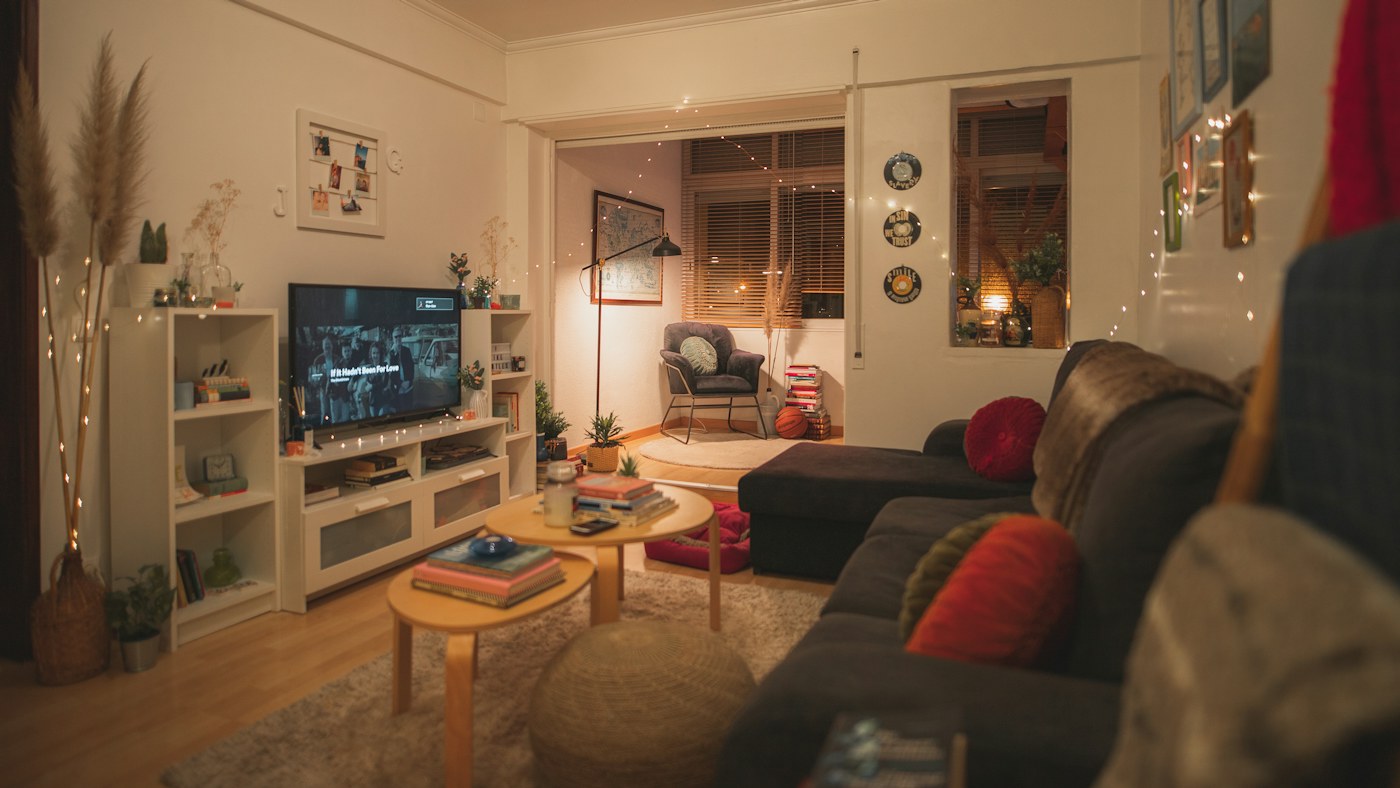
What should actually live at the TV?
I would keep:
- active devices,
- controllers and remotes used with those devices,
- a small number of charging accessories,
- current games or media if physically used,
- one maintenance cloth if useful.
I would question:
- empty device boxes,
- obsolete cables,
- manuals available elsewhere,
- unrelated board games, paperwork, toys, or decor stored there only because space exists.
Open shelving is not the same as open clutter
An open media console can look calm when each shelf has one clear job. The problem begins when every empty shelf becomes permission for another category.
This is similar to cube storage in a small living room: modular capacity is useful only when the categories stay bounded.
The hybrid console is often strongest
I frequently prefer one open device shelf plus one or two closed compartments. The active electronics remain ventilated and reachable while controllers, spare cables, and less attractive accessories disappear.
This hybrid reduces the weaknesses of both extremes.
What changes if the room is family-centered?
If children use the same room for play, the TV wall should not become another toy-storage wall unless that is deliberate. Keep media categories distinct from play categories so the room can reset visually. If you are working on the same space, Dining Room Storage Review: Sideboard vs. Storage Bench vs. Wall Shelves covers the next decision in more detail.
The article on creating a calm living room when kids use it all day is useful because it treats visual reset as a whole-room problem.
What changes if the room is very small?
In a tiny living room, I prioritize shallow depth and circulation over maximum storage. A small console that holds only active equipment is usually better than a large cabinet designed to solve unrelated household storage.
If there is not enough storage elsewhere, solve that storage problem in its proper zone rather than turning the TV wall into a general cabinet.
Streaming households often need much less furniture than they think
If most entertainment is streamed and the television has only one or two connected devices, a large media console may be solving an old storage pattern. Before buying furniture, remove obsolete disc cases, unused remotes, packaging, legacy cables, and electronics that no longer participate in the setup.
A smaller console can make the room feel larger while still providing enough room for current devices.
What changes if the TV is wall-mounted?
Wall mounting can reduce the need for a large piece directly below the screen, but it does not remove the need for device access, cable routing, and storage for controllers or remotes. A shallow low cabinet may still be useful; a full entertainment center may not be.
Do not use the empty wall below a mounted TV as automatic permission for another large storage piece.
What changes if the living room doubles as a playroom?
In a family living room, the media console often competes with toy storage. I would keep these categories separate whenever possible. A closed media cabinet should not slowly become the overflow home for blocks, craft kits, and stuffed animals simply because the doors hide them.
If toys are the dominant visual pressure, organizing toys without making the living room look like a playroom should be solved in parallel.
Cleaning and maintenance matter
Open shelves are faster to inspect but expose devices and cables to visible dust. Closed units reduce visual dust but can make rear cable areas harder to reach. Whichever style you choose, leave enough access to clean and service the setup without moving half the room.
A simple media-capacity rule
Give the TV wall capacity for active electronics plus a small amount of accessory storage. Everything else should justify why it needs to live there. This one rule prevents the console from becoming a general household cabinet.
Test the console with every door and cable in use
Before buying, simulate the furniture depth and door swing with tape. Then imagine the most awkward realistic moment: a controller is charging, one cabinet door is open, someone walks past, and a child is playing nearby. Furniture should still feel easy to live around.
This kind of real-use test catches problems that product dimensions alone do not show.
My expert conclusion
Choose an open media console when active-device access, ventilation, and visual lightness matter most. Choose closed TV storage when visual calm matters and the equipment can function comfortably behind doors.
For many small living rooms, the best answer is a hybrid: one accessible device zone plus limited closed storage.
Most importantly, size the furniture to the active media inventory—not to every cable, box, and electronic object the household has accumulated over the years.